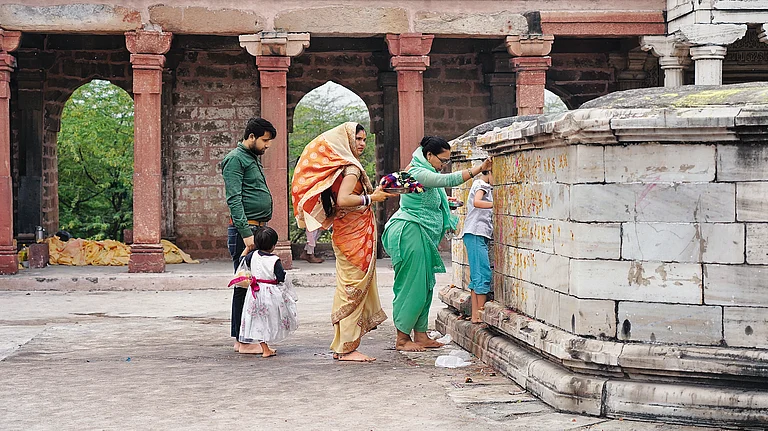
If you search for the oldest Christian structure in Agra, there is a possibility that people will take you to Akbar’s church. Unfortunately, that is not true. Akbar’s church was destroyed and rebuilt later in the eighteenth century. The oldest surviving structure is actually behind locked gates and overgrown paths. Marty’s Chapel in Agra is one of the oldest known Christian structures in North India. Built in 1611 during the time of Jahangir, it stands inside the Roman Catholic Cemetery, a site that records nearly four centuries of North Indian history. Yet for most visitors to Agra, this space barely exists. When it is noticed at all, it is usually eclipsed by the dramatic presence of the so-called Red Taj, the tomb of John William Hessing. Marty’s Chapel, older and far more consequential, remains quietly overlooked.
To understand the chapel is to understand how Christianity functioned in Mughal India, not as a colonial force, but as a deeply embedded, negotiated presence.
Before Missionaries, The Armenians
Christianity in Agra did not begin with Europeans. Armenian merchants had settled in North India long before the arrival of Jesuit missions, moving along land routes that connected Persia, Central Asia, and the Mughal heartland.
The Armenian influx into Northern India was catalysed by regional displacements in Western and Central Asia. In the early seventeenth century, the deportation of Armenians from Julfa to the Isfahan suburb of New Julfa by Shah Abbas I created a merchant diaspora that looked eastward toward the wealth of the Mughal Empire. These merchants brought with them not only goods but a unique fluency in Persian and a deep familiarity with Islamic culture, which allowed them to serve as vital interpreters, emissaries, and informants for the Mughal court and later for European trading companies.
Christianity is inseparable from Emperor Akbar’s idea of sulh-i kul, or universal peace, which shaped how Christianity was allowed to exist in Mughal India. This was not tolerance in a modern moral sense but a political principle that permitted different faiths to function openly under imperial authority.
Prompted by Akbar’s curiosity about religion, the first Jesuit mission to the Mughal court included Father Rudolf Acquaviva, Father Antonio de Monserrate, and Father Francis Henriquez. They were received with exceptional honour at Fatehpur Sikri, then the imperial capital. The missionaries hoped to convert the “Great Mughal”, believing his conversion would open the entire subcontinent to Christianity.
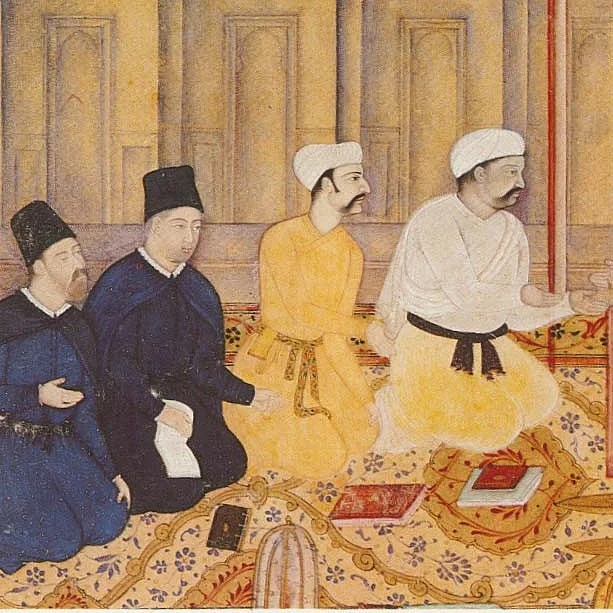

They were soon drawn into the Ibadat Khana, the House of Worship where Akbar hosted debates among scholars of different faiths. The Jesuits presented paintings of the Virgin and Child, which Akbar asked his sons and courtiers to venerate. It quickly became clear, however, that Akbar’s interest was intellectual rather than devotional. While he admired their learning and asceticism, core Christian doctrines such as the Trinity and the Incarnation remained insurmountable for him.
The most influential of the Jesuit missions was the third, led by Father Jerome Xavier, grand-nephew of St Francis Xavier, who arrived in 1595 and remained at court for nearly two decades. Unlike his predecessors, Xavier immersed himself in Persian language and culture, recognising the Mughal elite as a literary and philosophical class, and produced Christian texts in Persian to engage them on their own terms.
During the reign of Jahangir, a remarkable public ceremony happened in Agra when his nephews Hushang Mirza, Tahmuras, and Baysunghar, along with a fourth prince from Akbar’s extended family, were baptised as Christians. Led by the city’s Christian community, the princes went in a formal cortege from the fort to Akbar’s Church in a carefully choreographed display of imperial theatre. They rode richly caparisoned elephants, dressed in Portuguese fashion, gold crosses hanging from their necks. Church bells rang as they entered, candles in hand, walking through clouds of frankincense. The baptismal vows were recited in Persian, holy water was sprinkled over their heads, and each prince was formally received into the Church. They were then given Portuguese names: Hushang became Don Henrico, while Tahmuras, Baysunghar, and the fourth prince were renamed Don Philippe, Don Carlo, and Don Duarte. The conversions, however, were short-lived. Within four years, once political anxieties around succession had subsided, the princes returned to Islam, a reversal the Jesuits recorded with open bitterness, describing it as a “return to the vomit.”
The arrival of the English East India Company in the early seventeenth century, symbolised by the embassy of Sir Thomas Roe, disrupted this balance. The Jesuits at the court of Jahangir acted as informal diplomats, working feverishly to block English concessions. This rivalry was deeply ideological, as the Catholic Jesuits viewed the Protestant English as heretics.
Marty’s Chapel And Mughal Architecture

Marty’s Chapel was commissioned in 1611 as the tomb of Khoja Mortinepus, a wealthy Armenian merchant. What began as a private mausoleum soon became a shared chapel and burial site for the Christian community. Architecturally, the building is striking for what it chooses not to be. There is no European church plan, no spire, no Gothic gesture. Instead, the chapel follows Mughal funerary design. Octagonal in plan, built in sandstone, crowned with a single dome, it mirrors the tombs of Mughal nobles. The only clear marker of difference is the cross at the top. The structure was almost certainly built by Indian craftsmen trained in Mughal architecture.
The chapel also preserves a Persian inscription, recorded in nineteenth-century ecclesiastical accounts reproduced by the Archaeological Survey of India. The inscription identifies Khoja Mortinepus, an Armenian merchant, described as a professed disciple of Christ, noted for his righteousness and charity. It is recorded that the chapel was erected in 1611 as a funerary monument in his memory. The inscription further suggests that the chapel originally functioned as a private tomb before gradually becoming a shared sacred space for the Christian community of Agra.

Inside the chapel is a remarkable memorial plaque listing priests and missionaries buried here, many of them Jesuits. Among those buried in the chapel is Tiffentoller, an early cartographer involved in mapping parts of the subcontinent. Another was the chief astronomer, Father Andrew Strobl (d. 1758), who served as astronomers at the court of Raja Jai Singh of Jaipur, builder of the Jantar Mantar. Jai Singh was obsessed with precision in astronomy. To achieve it, he invited Jesuit astronomers to assist him. The Jesuits were highly valued for their expertise in mathematics and astronomy.

Another document reproduced in the same source records a list of Roman Catholic priests buried in the Chapel of Padre Santoos, as far as their names and dates of death could be read at the time. Among them are Fr. Manuel Garcia (d. 1634) and Fr. Manuel Danhaya (d. 1635), along with several other Jesuit priests who died in Agra across the seventeenth and eighteenth centuries. This list confirms the chapel’s continuous use as a burial site and situates it within a longer history of Christian presence, mortality, and memory in Mughal Agra.
Martyrdom And Political Rupture
The chapel derives the moniker “Martyrs’ Chapel” from this episode, named so after Fr. Manuel Garcia and Fr. Manuel Danhaya, who died in prison for their faith under Shah Jahan’s reign of persecution and were buried in unmarked graves within the grounds of the cemetery. This rupture must be read in the context of Shah Jahan’s violent confrontation with the Portuguese at Hooghly in 1632. The Mughal assault on the Portuguese settlement was triggered by a combination of factors: allegations of forced conversions, the harbouring of runaway slaves, and Portuguese fortification along the Hooghly River, which Shah Jahan viewed as a direct challenge to imperial authority. The capture of Hooghly was brutal. Hooghly Church were destroyed, the settlement was razed, and thousands of Portuguese and Indian Christians were taken prisoner and marched to Agra.
Among those brought to the Mughal capital were Jesuit priests, catechists, and lay Christians. Many were imprisoned for years under harsh conditions. Several priests died in captivity due to illness, deprivation, and exhaustion. It was these deaths, unmarked and largely undocumented in Mughal chronicles, that transformed the Roman Catholic Cemetery into a site of martyrdom. The priests who perished were buried quietly in and around Marty’s Chapel, giving the structure its name. Amazingly, Aurangzeb never bothered the Jesuits, unlike his own father. Fascinating, isn’t it, that the man of romance in Agra was responsible for religious persecution, while his son, who is renowned for his religious bigotry, somehow maintained certain sanctity
The Shadow Of The Red Taj
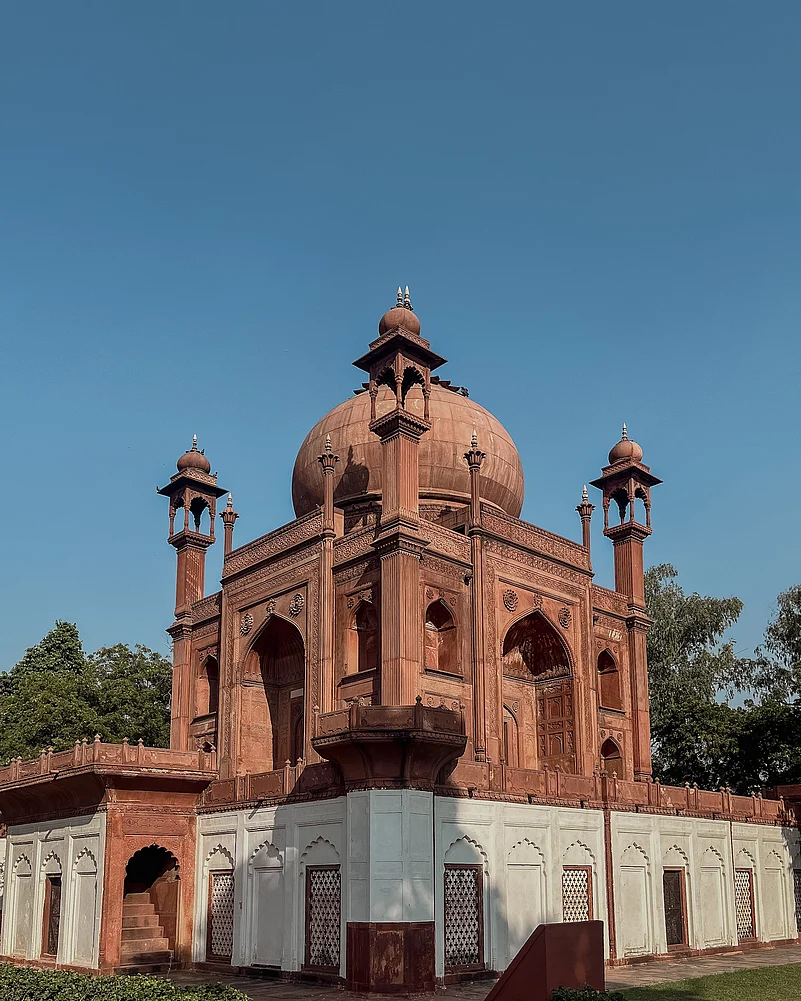
Today, the most photographed monument in the cemetery is the tomb of John William Hessing, the commander of Agra Fort during the Scindias. Built in the late eighteenth century, it is a miniature Taj Mahal in red sandstone, commissioned by his widow. Visually spectacular, it represents a later phase of Agra’s history, when European mercenaries filled the vacuum left by a weakening Mughal state.
But the dominance of the Red Taj has distorted how the cemetery is understood. Marty’s Chapel predates it by nearly two centuries. Where Hessing’s tomb speaks of Europeans in the princely powers of North India, which led to colonisation eventually, the chapel speaks of accommodation, hybridity, and everyday faith.
Marty’s Chapel matters because it complicates easy narratives of attaching Christians to colonial power. It shows that Christianity in North India existed long before colonial rule, that it was shaped by Armenians and Indians as much as Europeans, and that it expressed itself through Mughal forms rather than against them.
In a city reduced to a single monument, the Roman Catholic Cemetery and its quiet chapel offer a deeper story.
(The author is an Indian numismatist, amateur historian and social media influencer.)
The Information
Location:Located near Bhagwan Talkies.
Timing: 6 am – 6 pm (closed on Mondays)
Tickets: No tickets, free entry
FAQs
1. What is the oldest Christian chapel in Agra?
Marty’s Chapel, built in 1611 during the reign of Emperor Jahangir, is the oldest surviving Christian structure in Agra and one of the earliest in North India.
2. Where is Marty’s Chapel located in Agra?
Marty’s Chapel is located inside the Roman Catholic Cemetery near Bhagwan Talkies in Agra, away from the city’s main tourist circuits.
3. Why is Marty’s Chapel historically important?
The chapel reflects how Christianity existed in Mughal India through negotiation and accommodation, adopting Mughal architectural forms rather than European church designs.
4. Who built Marty’s Chapel?
Marty’s Chapel was commissioned as a tomb in 1611 by Khoja Mortinepus, a wealthy Armenian Christian merchant living in Mughal Agra.
5. Can visitors enter Marty’s Chapel today?
Yes. Marty’s Chapel can be visited free of charge during cemetery hours, though access may be limited and the site remains largely overlooked by tourists.