At the edge of Bandhavgarh National Park—where the forest still feels sovereign and the possibility of a tiger sighting hangs quietly in the air—a new safari retreat is reimagining how luxury sits within the wild. The Oberoi Vindhyavilas, designed by New Delhi–based Studio Lotus, unfolds across 21 acres of undulating terrain in Madhya Pradesh, positioning itself not merely as a base for wildlife excursions, but as an immersive landscape experience shaped by craft, climate and context.
Inside Oberoi Vindhyavilas, A Safari Stay Rooted In Craft, Climate & The Forest
Studio Lotus designed a safari retreat that preserves terrain, celebrates Gond art and brings understated luxury to tiger country

Advertisement
Unlike the conventional safari lodge that stages the wilderness as spectacle, Vindhyavilas attempts something more measured. Its design draws from the region’s tribal traditions and the memory of colonial-era hunting lodges, yet filters both through a contemporary, site-responsive lens. The result is a property that feels rooted rather than themed—where the forest is not backdrop but protagonist. As Ankur Choksi, Co-Founding Principal at Studio Lotus, explains, “The gestures draw on familiar archetypes, yet their contemporary articulation ensures the project feels evocative without becoming sentimental.”
Landscape First Approach
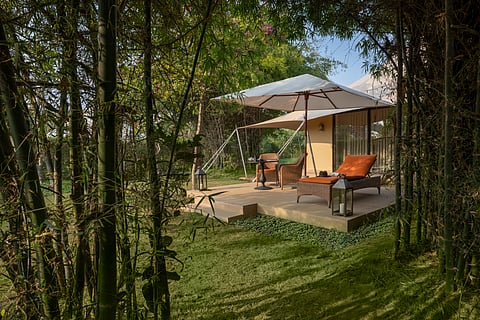
Deck View from Bamboo Grove in Oberoi Vindhyavilas Sanket Patel
The master plan begins with restraint. Instead of imposing geometry onto the land, Studio Lotus worked with the site’s ancient topography, retaining mature trees, respecting natural water movement and preserving existing boulders that echo the geology of the Vindhya range. “Over multiple site visits, careful observation of the terrain, water movement, mature trees, existing boulders, and the broader forest ecology shaped planning and architectural decisions,” says Choksi.
Advertisement
An on-site water catchment has been transformed into a perennial lake, now the visual and spatial anchor of the resort’s public areas. It functions as both orientation device and ecological gesture, sustaining the microclimate while drawing birds and wildlife to its edge. “The master plan prioritised retention of the natural habitat, embedding public spaces, villas, and tents within distinct landscape conditions rather than imposing a singular formal gesture on the site,” he adds. “For instance, the existing water catchment was developed into a perennial lake that now anchors the public realm.”
Movement across the property is deliberately gradual. Winding paths go through tall grasses, Mahua and Kachnar trees, and native plants. This makes it feel like a real forest instead of just a garden. Areas for guests, houses, and tents are set in special spots. This lets the forest feel like it's all over the resort. It feels like you're in nature, but not lost in it. You know the wild is there without feeling scared.
Advertisement
When you get there, you drive down a turning road that ends at the main building. This building is a modern take on a forest lodge. It's made with sandstone from Katni, stone and brick walls. This design copies how people in the area build things. Tiled roofs and porches help with the heavy rains, and pools at the entrance let guests relax before going in.
Lodge And Living
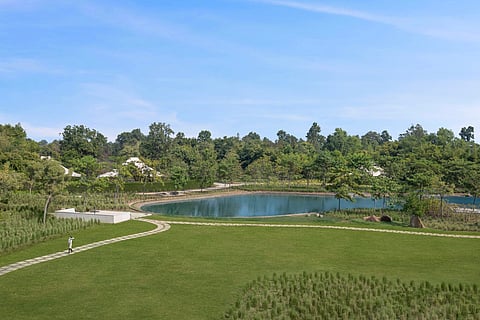
Front lawn and lake in the property Sanket Patel
The main lodge is where people meet and spend time together. A carved door with tribal designs opens to a space that feels private but also open. A bar works as both a reception and a place to hang out. Past that is a big room for eating and relaxing. Tall shelves split up the room without closing it off.
Big windows show views of the lake and Bandhavgarh forests. The colors are soft earth tones, forest greens, and stone. This copies the nature outside. The furniture is simple and classic, making the place feel peaceful and luxurious.
Advertisement
A smaller room in the lodge feels like a nature expert's office. Maps and old photos of the area are on the walls, and there are books too. The seats can be changed around so the room can be used for safari talks, lessons, or movie nights. It is a nod to the intellectual curiosity that often accompanies wildlife travel.
Accommodation is spread across 19 luxury tents set on low plinths, each within its own private garden. Constructed with durable outdoor fabric and lined internally with block-printed cotton, they strike a balance between lightness and enclosure. Sliding doors connect bedrooms to walk-in wardrobes and vanity areas, while extended decks hover above the ground, encouraging guests to remain in dialogue with the outdoors.
Craft And Culture
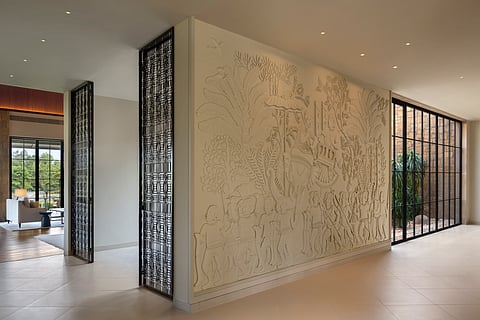
A 3D Art Baiga Tribe Procession Sanket Patel
At the northwestern edge of the property, a two-suite Royal Villa adopts the form of a colonial residence, complete with private pools and enclosed courtyards featuring open-to-sky showers. Elsewhere, a pool and fitness centre sit within a created Kadam tree grove by the lake. Experiential spaces—fire pits, bush dining decks illuminated by lamplight, and open-air breakfast areas—are woven discreetly into the landscape. A Tree Court hosts cultural performances by local artists, while the spa, positioned at the quietest end of the site, opens onto shaded gardens designed for introspection.
Advertisement
Materiality across the project is guided by durability and tactile authenticity. Timber, natural stone, natural fibre textiles and forged metal details have been chosen to weather gracefully in a forest environment. Equally integral is the collaboration with Gond and Baiga artisans. “Collaborations with Gond artisans began early in the design process, allowing their techniques and motifs to inform surface articulation and detailing, shaping the spaces in a meaningful way,” Choksi notes. “Craft, therefore, becomes an integral layer of the architecture, grounding the experience and reminding guests of where they are.”
Tribal narratives inform embroidery, plaster reliefs, hand-carved timber elements and curated artworks embedded throughout the property. Rather than applied decoration, these references are woven into the architectural language itself.
In doing so, The Oberoi Vindhyavilas subtly shifts the grammar of brand luxury. Instead of grandeur, it prioritises clarity of planning, material honesty and a deep engagement with site and community. As Choksi reflects, “In this way, the site fundamentally shaped the project’s planning, spatial experience, and expression.”
Advertisement
Here, the promise of a tiger sighting may draw travellers in—but it is the layered encounter with landscape, craft and culture that lingers long after the safari jeep returns.
FAQs
1. Where is The Oberoi Vindhyavilas located?
The resort is set on 21 acres at the fringes of Bandhavgarh National Park in Madhya Pradesh, known for its Royal Bengal Tiger sightings.
2. Who designed The Oberoi Vindhyavilas?
The property has been designed by New Delhi–based architecture and design practice Studio Lotus.
3. What makes the design of the resort unique?
It blends regional materials, Gond and Baiga tribal art traditions, and a contemporary safari-lodge aesthetic rooted in the landscape.
4. What types of accommodation are available?
Guests can choose from 19 luxury tents with private decks, as well as a two-suite Royal Villa with private pools and courtyards.
5. What experiences does the resort offer beyond safaris?
The property features a spa, lake-facing pool, bush dining experiences, cultural performances, and curated spaces for nature-led activities.
Advertisement
Published At: