At first its a gentle rustle on the forest floor. Then, a travelling sound of dry leaves crunching underfoot (a large foot a giant foot) the darkness of the night and the roar of the Ramganga river rushing in to fill the gap after the faintest stir. The small fire of driftwood and gathered Rohini branches around which were huddled appears feeble now. And I think I hear naturalist Manoj Negi p.a.u.s.e between countless stories of fear and valour and fear and common sense in tiger country, his ears pricked for moving shadows.
Uttarakhand In Corbett Country
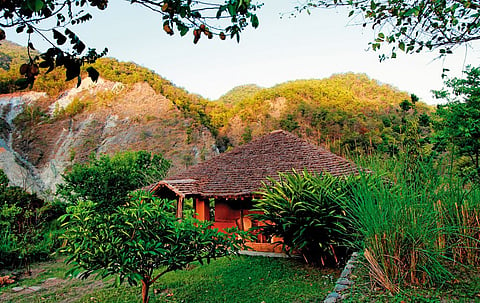
Vanghat, a charming lodge in Corbett, is a wilderness paradise

Advertisement
Should we retreat to the dining area (with a sturdy roof but no walls), I suggest weakly, wondering all along, if indeed ducking into bed in my cottage, under two blankets, and in my best camouflage gear, might not be a better idea. Balled up like an Indian pangolin. (Notice the absence of exclamation marks here, since this is a perfectly acceptable thing to do in the circumstances. Ask the pangolin.)

But why quizzes Manoj, flashing his torch nowhere in particular. Its probably just a wild elephant. Proceeding to narrate a presumably reassuring tale of his encounter with a tiger and her cubs that ultimately disappear in the gloaming. The details escape me now, but I think somewhere in that account is the insight that fear is trebled three times when we cant or dont see the object of our dread.Right.
Now, at night, forests can take some getting used to. Whisper, dont talk. Unless, youre near a river. In which case, yell. (But why are you near a river after dark, again) Dont forget the torch in the room. Pay no attention to the sambars alarm callsin plural. Certainly no more than you would to the cicadas song, or the brown fish owls hup-hup-hu from the semal tree. And neverand this is importantreplay any of the Animal Planet documentaries in your head. Now, repeat.
Advertisement
Once your eyes and ears have adjusted to its inky quietness though, the forest can be a wonderful place to be in, especially if youre in a property like Vanghat, which manages somehow to be both welcoming and wild, without apology. An hour away from Ramnagar, it can only be reached on footabout 2km from the car park near the Baluli suspension bridgebefore a quick and delightful crossing on a makeshift raft brings you to a cluster of huts with thatched roofs, like those of nomadic Gujjars, crouching in the green. Most people with a decent level of fitness leg this distance without breaking into too much of a sweat. But in the hills, on the best days, my walk is more a waddlelike a sloth bear in need of a tow truck, with paramedics on standby. It comes as no surprise then that I divest myself of shame and most of my luggage (to the accompanying staff) as we walk past Baluli village and the riverbed to finally arrive at a waiting table of pakoras and tea (can there be a better welcome drink). Nightfall follows my clumsy footsteps, and soon, I find myself by the feeble fire, with that which I cannot see
Advertisement

Unlike many hotels and resorts on the fringes of the Jim Corbett National Park, Vanghatalthough also in the buffer zoneis planted right in the thick of things. The jungle is a beautiful, if somewhat petulant, companion here. And the lodge, almost entirely off the gridphone calls by the river onlydoes as little as it can to disturb or provoke it (yes, even when provoked). It occurs to me that Vanghat is responsible and sustainable naturally, in a way that predates those words and what they have come to mean. It conserves nature, but also lets it be.
Sure, going for a safari in the Park from here might involve a 15-minute trek and a long-ish drive first (depending on the entry gate you choose). But who needs to tail a row of tourist jeeps on the prowl, when you can walk out of your cottage and give the forest and its wildlife a bear hug (not that Im suggesting you do, but its good to know you have the option).
Advertisement

Daybreak is known to change perspectives, and so it does for me, quickly replacing anxiety with wonder, and with the heady, foresty smell of wilderness. Lifting me out of a raft and hauling me over the rocks onto a fantastic walking trail that loses itself in thickets of Sal and Bel trees, naturalist Anil Kumar promises spotted forktails and a waterfall at the end of it all to keep me from collapsing in a heapnext to fresh, fibrous elephant poo, if you must know. I also follow him because the lodge is now some distance away and the packed breakfast is in Anils backpack. Did I also mention that we spot leopard scat and territorial scratches of a tiger on a bark and pugmarks (Oh, not to worry, they are at least a day old)
Before we trundle on though, I must stop awhile to catch my breath and talk a little about young Anil. Because, really, of all the wonderful things we discover in this neck of the woods, he is by far the best. Growing up in the village of Bagrotiperched high on a hill right across from VanghatAnil, unlike his peers, doesnt quite aspire to the life of the venerable Corbett tourist, particularly, the Dilliwalla. His wild calling is in fact a combination of intent, aptitude and geographical felicity. Taking him under his wing, Sumantha Ghosh, a seasoned naturalist who owns and runs Vanghat with an all-local staff, taught him the English names and behaviour of the birds and beasts that Anil already knew well from his 7km walk to school or cattle herding downhill to the river. Years later, this MA final-year student, travels to bird fairs in the state, and identifies species just by their call, and at least in one case, by poop.
Advertisement

Thanks to Anil, I see a lone Himalayan goral teetering on a scree slope, two beautiful yellow-throated martens darting across in the winter sun, golden mahseers in the water and over a 100 birds in two days. Had I made enough of an effortwhich in my case, usually means rising early from my bottomless pit of anabolic ineptitudeelephants and barking deer, otters and porcupines couldnt have been too far from my nose or the telephoto lens.
But since Im travelling with a birder (which Im told is a caaooler way of saying birdwatcher, like runner not jogger), let it be known that if indeed there were otters or deer or gharials to be spotted, we would have most likely missed them. Or worse, startled them by accident. For, birders invented the idea of beating about the bush
Bringing up the rear in our party of threewith my fellow traveller-birder and AnilI declare it to be a charming and active day, in which I pressed into service muscles that I had last put to use as a toddler. I also declare it to be a fruitful day, since the brown dipper, lesser fish eagle, spotted and little forktails, Siberian rubythroat, crested kingfisher, wallcreeper, rusty-cheeked scimitar babbler, red-headed vulture and even a handsome flock of great hornbills (a dead giveaway of an old forest, Im told) reveal themselves to us, among many, many others. But no, I am wrong.
Advertisement

After periodically poring over what look like large splats of lime plasterowl droppings, apparentlyour inability to see even one of the many owls in the area, including the tawny and brown fish owls, is cited as a good reason to go on yet another excursion in the evening. Post lunch at the lodge thoughwith a lovely light curry of radish ground on a sil batta (grinding stone), among other delicious local dishes and picklesI refuse to budge from my seat. And for all my efforts, Im duly rewarded by the rufous-bellied niltava, not a few feet from my plate, and by the red-billed leiothrix, frolicking in the birdbath nearby.
As for the owls, well, who gives a hoot
On our final morning at Vanghat, with the lactic acid hijacking my calves, I veto all other birding plans, and coax Anil to take us instead to his village Bagrotiby car, not on foot (also easily done, if you dont have plump pins for legs). He is only too glad to do it, he says. In fact, as soon as theres network on his phone near the river, I notice with great relief and joy, that he calls his sister-in-law to prepare breakfast for us.
Advertisement
Although one can see it from the lodge, it takes an hour by road to cover the 20km and then a short, steep climb down to Bagroti, where the roofs are still lined with slate, no ugly concrete or tin here. Once bashful, Anils neighbours and friends are now happy to greet ussome even enquiring if were Indians or NRIs from England (what Indians from India carry binoculars and not a single packet of chips). Walking past huddles of women drinking tea, an ironsmiths workshop, children playing around the small vegetable patches and boys sunning themselves on roofs next to pumpkins and bottle gourds, we arrive at Anils blue plastered house, hungry and curious. Revived by chai in a steel tumbler and a simple, gorgeous meal of stir-fried spinach and Pahari kadhi called jholi, I wonder how difficult it must have been before the road was built to go back and forth to town. The closest market is 7km away. As is the school. And even today, children bring food supplies after class and local Phoebes ferry LPG cylinders on their back. The villagers though seem only too glad that the new road brings the 108 ambulance apace. Its a different matter, of course, that the closest clinic to get an antidote for snakebite, for instance, is over 40km away. In Bagroti, where mobile networks arrived before electricity (although each family had a state-issue solar panel before that), life is a luxury.
Advertisement

My birder companion and Anil though appear to care little for their own. I find them nearly tumbling into the gorge to get a clear view of that brown blotch on a tree, also known as the mountain hawk eagle.
The dialogue that follows is short
Did you see its crest
Did you see the gorge

Back at Vanghat, packing our bags for the return trip and thinking wistfully about breathing the feral, fragrant air of Delhi again, I wonder what the lodges own 12-year-long journey has been like. Sumantha and his staff tell me that they have tried to do good by the land, succeeding at times and failing miserably at others. From setting up a community shop with a two-room shack owned and run by women at Ringora village, 5km from Ramnagar (where Kamla and Bimla make the best lemongrass-methi-tulsi-adrak tea ever) and supporting a school for children with challenges, to encouraging locals to run homestays and introducing conservation programmes for vultures and golden mahseer (currently on hold), their work extends beyond turndown service and hot water bags in bed.
Advertisement
Since angling was banned a few years ago due to discrepancies in the way permits were issued to some of the larger players in the area, the mahseer conservancy programme has been suspended. One night, I hear fireworks at a wedding in Baluli village. Or were they lit by farmers to fend off large animals from their fields I also fear the worst. But Im told that although, with the suspension of the conservancy programme and private beat patrolling, the blasting of bombs in the river to harvest fish is on the rise again, its usually done during the day. The steady stream of money that once flowed to the villagers and the local gilis who accompanied the anglers has also dried up.
Sumantha appears to take such things on the chin. Talking to me over a crackling phone line (hes away at a workshop in Delhi), he says, you win some, you lose some and start again. He should know.
Advertisement
I certainly won at Vanghat, and with Anil at Bagroti village. Lost my tourist heart to the Ramganga river and my knees to the walking trails. But I will be back. To crib again about aching limbs and lymph nodes. And to Rumi-nate on elephants in the dark.
The Information
Getting There
From Delhi, you can take a train to Ramnagarapart from the Corbett Park Link Express, check for seats on the Uttarakhand Sampark Krantiand hire a taxi to drive down to Vanghat (40km). The lodge can help organise pick and drop.
The other option is to drive down from Delhiit takes about 7-8 hours, if you take a break at Gajraula. Make sure to take the Moradabad Bypass to Kashipur and onward to Ramnagar. From Ramnagar, drive down NH121 till Mohan, where the road forks take the road on the left towards Garhwal (the other road winds its way up to Ranikhet). From here, drive straight until you spot the boards for The Solluna Resort and WelcomHeritage Corbett Ramganga Resort, just before Marchula. Turn in towards the BaluliSuspension Bridge from where the Vanghat staff will fetch you and some of your baggage. But travellight, since its a 2km hike to the lodge from this point.
The Stay
Vanghat is a cluster of five eco-conscious cottages with attached baths, including a Trapper Hut for long stays for researchers. Hot water arrives on demand in buckets and there are no ACs or TVs. Unless you have a BSNL connection, mobile network can only be found at spots by the river. The food is simple but delicious and includes local specialties. The lodge is clearly aimed at wildlife tourists (doubles for 7,117 for 3N, 7,375 for 2N and 7,980 for 1N, inclusive of all meals, guided walks and taxes, for children over 10 years, theres an additional charge of 2,550 per night www.vanghat.com)
What To See & Do
There are many walking trailsaround Vanghat, including one to the waterfall and onward to the Bagrotivillageand one around the propertythe latter can be very exciting for birders, since it offers a mixed landscape, from grasslands and the riverbed to low bushes and tall trees.
Apart from these, the lodge also offers walking safaris in the nearby community forests surrounded the buffer forests of Kalagarhand the Corbett Tiger Reserve.
Birders can also combine it with a trip to the forests of Manila(55km), where the lodge can help arrange for stay and naturalists.
Sumantha Ghosh also hopes to offer angling tripsin the upper stretches of the western Ramganga river soon, and to promote homestays in the Ramganga valley.
Published At:
Tags