The Chola Empire, whose reign stretched for 460 years from the beginning of the 9th century to 1279 AD, was one of the most powerful and longest-lasting empires in Indian history. Their rule was characterized by political stability, efficient administration, and tax collection. Politics and religion also came closer than ever before, with the Emperor projecting himself as a manifestation of God on earth. This great enterprise necessitated temple-building on a scale never seen before, and the rich flow of funds into the royal coffers allowed the Cholas to take these efforts to another level. Over 300 temples were built throughout the kingdom, with the primary efforts concentrated in the heartland, which centered around the Kaveri River and its great delta. Of these, the three most splendid are the Brihadisvara Temple at Thanjavur, the Brihadisvara Temple at Gangaikondacholapuram, and the Airavatesvara Temple at Kumbakonam, all three of which are UNESCO World Heritage monuments and living temples used for daily worship.
On The Chola Temple Trail
Spanning the greater part of four centuries, the reign of the Chola dynasty was one of power, stability, and endurance

Sittanavasal Caves
The Cholas lent their name to the region of Tamil Nadu since the word Coromandel is an anglicization of Cholamandalam, which in Tamil means the realm of the Chola kings. The best way to explore these small temple towns is to drive south to north from Karaikudi to Chennai. You will be rewarded with some fascinating sites well off the beaten tourist track.
About an hour north of Karaikudi is a giant rock outcrop the size of a small mountain, one of a number you find in the region. Innocuous looking in appearance, it hides two great treasures known as the Sittannavasal (meaning &ldquothe abode of great saints&rdquo). These caves date from the 1st century BC to the 10th century AD when Jainism was prevalent in the region. At the top of the hill and facing eastwards is a massive natural fissure with 17 polished stone beds lined up in rows where the Jain monks practised the ultimate penance leading to death. This cave is reached by clambering up nearly 300 stone steps carved out of the rock by the ASI. It feels like Sinbad slowly ascending an immense beached whale.
Scrambling down, we made our way to the second cave, a single small Jain temple cut out of the rock. This one is situated at the bottom of the hill and faces westwards. This temple&rsquos exact origins are unclear, but it resembles the cave temples built by the Pallava king, Mahendravarman (600 &ndash 630 AD). It contains only five basic carvings of Jain Tirthankaras and acharyas. But the actual stunning beauty of the temple reveals itself when you look more closely at the frescoes painted on its walls and ceilings, sadly most of which have been defaced by vandals before the ASI took over. Considered second only to the Buddhist Ajanta frescoes, these followed from the same tradition of fresco-secco or painting on drywall. The most exquisite of these is the one covering the ceiling of the entrance hall, which depicts bhavya (believers) in a pool full of flowering lotuses while birds, geese, fish, bulls, elephants, and other animals frolic in the waters.
Narthamalai Temple
A few miles further north, another massive outcrop called Narthamalai (the hill of the Chettiyars) hides another magnificent secret. We find the hill after a few lost-in-translation-moments&mdashthe villagers speak only Tamil, and we only English and Hindi&mdashand begin our trek across its rocky surface until a temple capstone comes into view like a submarine periscope. And in a few minutes, the lost temple of Vijayalaya Choleeswaram, named after the founder of the imperial Chola dynasty, is revealed in all its sombre glory. It sits there like a compact star cruiser stranded in this strange place where it came to rest centuries ago. And the best part is that we have it all to ourselves, not another visitor in sight.
Though much smaller in scale than the Big Three at Thanjavur, Darasuram and Gangaikondacholapuram, this Shiva temple has its own charm and beauty. Built in the second half of the 9th century by a vassal Muttaraiyar chieftain, it rises to four tiers with the most intricate carvings of gods, angels and demons on its outer façade. Six sub-shrines of lesser deities surround it. It can be considered the earliest structural stone temple of the Chola empire and undoubtedly the grandest of its time. Opposite are two cave temples, the first containing 12 relief sculptures of Vishnu and the other a cylindrical shivalinga.
Thanjavur and the Brihadisvara Temple
The Chola empire reached its zenith under Emperor Rajaraja (985 -1014 AD), who made the town of Thanjavur his capital and built the stunning Brihadisvara temple at its heart.
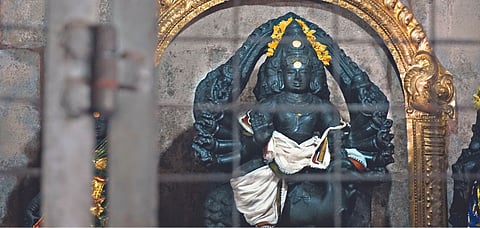
If ever there were a classic South Indian temple town, it would have to be Thanjavur, the original home of Carnatic music and dance, the finest hand-woven silk saris, exquisite bronze figurines, and unique paintings embellished with gold and semi-precious gems. All of these find a home at Svatma, the beautiful heritage hotel we had chosen for our stay, with a collection of carefully curated antiques displayed in the public spaces and restored furniture in the rooms.
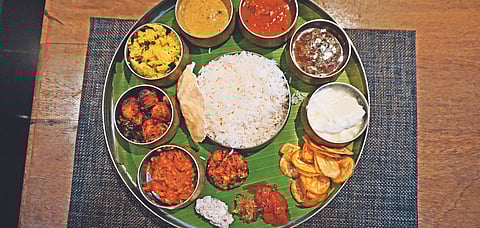
Svatma means inner reflection the hotel is a peaceful oasis amid the hustle and bustle of small-town India. I am a hard-core carnivore and was daunted by Svatma&rsquos all-vegetarian menu, but I shouldn&rsquot have worried. The restaurant Aaharam has a vast range of world cuisines.
The following day, we explored the Big Temple, which the locals call Brihadisvara. If Vijayalaya Choleeswaram is the small cruiser of the Chola galactic fleet, then this must be the aircraft carrier, its giant flagship, so imposing in its bulk and dominance.
We enter through two soaring pyramidal gopurams (entrance towers) intricately adorned with images of Shiva&rsquos manifestations and related deities into a massive rectangular courtyard measuring 241 X 121 m, nearly a perfectly proportioned double square.
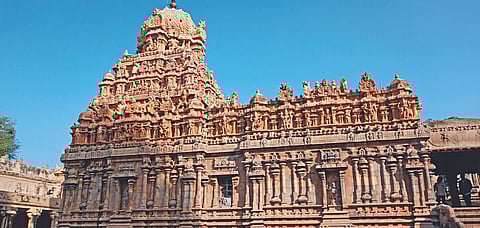
At the exact centre of the rear square of the enclosure is the monumental tower or vimana that rises to a height of 60m in a stepped 13-storey pyramid above the main shrine, which contains the huge cylindrical black lingam of Shiva.
This remains the tallest vimana ever built in ancient India, dwarfing all the other Chola temples that had come before. It is quite an architectural feat that the Big Temple is constructed almost entirely of hard granite laid in horizontal courses with no mortar. Even more remarkable is that all the 130,000 tonnes of stone required for its construction had to be quarried upstream, near Tiruchirappalli, and transported by water, a distance of almost 100 km.
The Brihadisvara Temple at Gangakondaicholapuram
Rajajraja was succeeded by his son Rajendra I (1014 -1044 AD), who was genuinely ambitious and adventurous in spirit and expanded the Chola empire far beyond the boundaries of India were expanded by sending forces on ships across 4,000 km of ocean to conquer the southern half of Southeast Asia. Additionally, the armies marched over 1,700 km to the north, right to the Ganges&rsquo banks and carried water from the holy river as a tribute to their Emperor. These extraordinary military adventures were celebrated by shifting the Chola capital 55 km to the north of Thanjavur and building a grand new Shiva temple named Gangaikondacholapuram, which means &ldquothe city to which the Chola emperor brought the Ganges.&rdquo
While very similar in design and structure to the big temple in Thanjavur, it is smaller in scale. Out of respect to his father, Rajendra I ensured that the vimana, which has only nine storeys, was kept to 55 m, slightly less than the Thanjavur temple. Such was the monumentality of these giant temples that it is estimated that of the 80 temples built under the reign of father and son, these two accounted for about 50 per cent of the total architectural effort and volume of stone used.
The outer walls of Gangaikondacholapuram are covered with sculptures depicting Shiva, Vishnu, and Durga in various forms, each set within its niche. At the same time, the interior has many superb bronze statues depicting the Chola art of the time. Look for the Northern and Southern Kailasa shrines on either side of the main temple, which were built to commemorate Rajendra I&rsquos conquest of the universe and the symbolic relocation of Mount Kailasa to the Chola lands. Alongside the temple is a 5 km long reservoir built to hold the &ldquocaptured&rdquo waters of the Ganges and fed by a branch of the river Kaveri. However, nothing remains of the fortified capital city at the heart of which the temple sat, razed to the ground by the armies of the Delhi Sultanate who plundered the Chola kingdom in the early 14th century.
Kumbakonam and the Airavatesvara Temple
The last of the Big Three on our temple trail was the Airavatesvara Temple, built towards the end of the Chola dynasty by Rajaraja II (1150-1173) and located just outside Kumbakonam, another temple town 45 km north of Thanjavur. Moving from the urban splendour of Svatma we opt for a more rustic experience at a spacious secluded retreat called Mantra Koodam, located a few minutes&rsquo drive beyond Kumbakonam. The name comes from the pillared reception hall where we are received with the traditional aarti ritual while the soothing chant of Vedic hymns can be continuously heard.
After the stressful car journey from Thanjavur along a crowded two-lane highway, I can feel myself physically begin to relax as the spiritual calm washes over me. There are 30 cottages spread over 15 acres, with the vast space designed like an &ldquoagraharam&rdquo literally translating into a garland of houses where the cottages are gracefully spaced out on either side of the street as they would in a Brahmin community. Our spacious cottage is designed like a traditional Tamil home&mdashwith a large veranda, Athangudi floor tiles, ornate Burmese teak doors, and a stone open-to-air bathroom. We had the Maharaja thali packed with 21 delightfully different items for dinner.
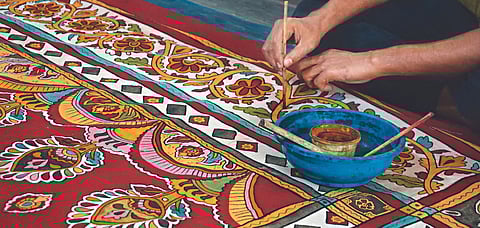
Built more than 100 years after the two great Brihadisvara temples, Airavatesvara is quite different in its layout, structure, and design. Legend has it that Lord Shiva was worshipped at this temple by Airavata, the cursed white elephant of Indra, King of Heaven, who then had its colours restored by bathing in the sacred waters of the temple.
This temple is much smaller in its conception, being enclosed in a courtyard measuring 104 by 64 m entered through a single gopuram and having a vimana 24 m in height and only five storeys high. But the true magnificence of Airavatesvara lies in the exceptional volume and quality of the stone sculptures.
Enter the temple through steps that lead up to a porch designed to represent a temple chariot (rath) with rearing stone horses and massive wheels. Spend some time examining the sculptures in detail in the mandapas, the open pillared halls that lead to the inner sanctum&mdasheach of the 48 pillars in the main hall carries a different deity and story.
Outside the courtyard, located a short distance away, is a separate goddess (Amman) shrine built to honour Parvati, Shiva&rsquos consort. This shrine was the earliest of its kind in Chola times and was created by a successor to Rajaraja II, signifying a belated acknowledgement of the importance of women in society.
As we ended our drive up the Coromandel Coast, we had nothing but admiration for the Cholas, their master builders, and their exquisite temples of stone.
ALSO READ The Sound of Music in Thanjavur