There was a time when “heritage hospitality” meant a predictable visual formula: carved wooden doors, antique trunks in the lobby, brass lamps polished to perfection, and a sepia-tinted story framed at reception. Beautiful, certainly. But often, little more than aesthetic theatre.
When Heritage Checks In: The New Language Of Hospitality Design
From local materials to cultural storytelling, heritage is reshaping the way travellers experience luxury stays around the world

Advertisement
Today, the conversation around heritage in hospitality design is becoming far more nuanced. Across India and beyond, architects and hoteliers are moving away from decorative nostalgia and asking a deeper question: can a hotel preserve the spirit of a place without turning it into a museum?
For architect Anil Badan of Studio B Architects, the answer lies in moving beyond imitation. “I don’t see heritage as copying old elements,” he says. “I see it as understanding how people lived, how spaces were used, and what made them comfortable within a specific climate and culture.”
That distinction is quietly reshaping the way some of the most compelling hotels are being imagined today.
Beauty Beyond The Surface

You can feel the craft in every texture and small detail here Supplied
In many modern luxury properties, heritage is no longer treated as a styling exercise. It is becoming part of the architecture itself, woven into the way a guest experiences a space.
A verandah that naturally cools a corridor before air conditioning becomes necessary. A central courtyard that encourages gathering the way traditional homes once did. Stone walls that respond to heat. Windows placed not for symmetry, but for wind.
Advertisement
These choices may seem subtle, but together they create something far more powerful than ornamentation: emotional authenticity.
“Every region in India has its own architectural language shaped by climate, craft, and community,” says Badan. “So the challenge is not replication—it’s reinterpretation.” That means a heritage-inspired hotel in Kashmir should not feel interchangeable with one in Chettinad or Coorg. The textures, materials, scale and even the silence of a place should feel rooted in where you are. And increasingly, travellers are noticing the difference.
A Hotel As Cultural Storytelling
Hospitality has evolved into something larger than accommodation. For many travellers today, a hotel has become the first chapter of a destination.
Long before a guest visits a monument or wanders through a market, the hotel can begin introducing them to a region’s identity—quietly, without explanation. “I believe hospitality spaces today are not just places to stay, they are cultural experiences,” says Badan. “When you enter a resort in Kashmir or Assam, you should feel where you are without anyone telling you. The design itself should speak.”
Advertisement
That storytelling often happens through details that are felt rather than announced. Handwoven local textiles. Indigenous woodwork. Locally commissioned art. Traditional joinery techniques revived in contemporary interiors. Regional craftsmanship integrated into a modern setting rather than displayed behind glass.
Across India, this design philosophy is showing up in striking ways. Century-old planter bungalows in Coorg are being reimagined as intimate retreats. Heritage havelis in Rajasthan are being adapted into immersive stays. In Kashmir, cedarwood interiors and handcrafted ceilings are preserving disappearing artisanal traditions while giving them renewed relevance. The result is a new kind of luxury—one that feels personal rather than performative.
Redefining Luxury Through Materials

Wood, fabric, and light come together in a really easy way Supplied
Luxury in hospitality once relied heavily on imported marble, gleaming finishes and a certain sameness that could make a suite in Delhi resemble one in Dubai, but that idea is changing.
“The idea of luxury has changed a lot,” Badan explains. “Earlier, luxury meant imported finishes and a kind of standardised opulence. Today, it’s more about authenticity, tactility, and context.”
Advertisement
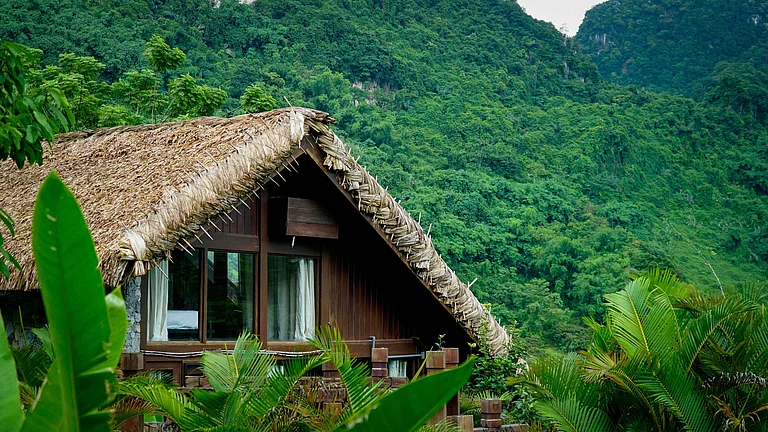
In practical terms, that means local materials are becoming central to the design narrative. Stone that ages beautifully. Timber that responds to regional weather. Lime plaster that softens with time. Textiles that carry a community’s craft tradition. When used thoughtfully, these materials do more than create visual character. They anchor a hotel in its landscape.
They also create a sensory experience that polished uniformity often cannot. Guests may not always identify why a space feels grounding, but they can sense when a building belongs to its surroundings. Of course, working with local materials can be challenging. In harsh climates, even simple construction decisions become more complicated. “In places like Gulmarg, even fixing a piece of marble becomes difficult,” Badan says. “Materials don’t behave the same way. You have to adapt your entire process.” Yet often, those constraints become the source of originality.
The Fight Against Global Sameness
One of the biggest tensions in modern hospitality design is the growing dominance of global templates. International hotel brands often require strict design consistency, from room layouts to finish palettes. While that creates familiarity, it can also flatten regional character.
Advertisement
For architects, preserving individuality within those systems has become one of the industry’s most interesting challenges. “Brand guidelines will always be there,” says Badan. “But within that, there is still room to create differences.”
Sometimes that difference appears in furniture crafted by local artisans. Sometimes in fabrics. Sometimes in the way public spaces open toward a landscape instead of closing themselves off from it. Resorts, in particular, are becoming fertile ground for this creativity because they allow for a stronger relationship between architecture and place. Unlike city hotels designed around efficiency, resorts can breathe. And in that breathing space, heritage often finds its strongest voice.
Designing Memory, Not Nostalgia

Soft fabrics and stone just make the space feel calm and re ADITYA ARYA
Perhaps the future of heritage hospitality lies in understanding that preservation is no longer about freezing the past. It is about translating it.
The most memorable hotels today are not simply restoring old buildings or borrowing traditional motifs. They are creating living environments where history can still be felt—not as nostalgia, but as continuity.
Advertisement
“The future of heritage in hospitality is not in replication,” Badan says. “It’s in interpretation.” And for travellers increasingly seeking connection over consumption, that may be exactly what makes a stay unforgettable. Not just where they slept, but how deeply the space allowed them to feel where they were.
FAQs
1. What is heritage hospitality design?
It is a design approach that blends regional architecture, local materials, and cultural storytelling into modern hotel spaces.
2. Why is heritage important in hotel design?
It helps create a stronger sense of place and gives travellers a more authentic connection to the destination.
3. How do hotels preserve regional culture through design?
By using local craftsmanship, traditional layouts, and materials that reflect the area’s history and identity.
4. Are heritage hotels only in historic buildings?
No, even new hotels can incorporate heritage by interpreting local design traditions in contemporary ways.
5. How is luxury changing in hospitality design?
Luxury is shifting from imported opulence toward authenticity, comfort, and experiences rooted in local culture.
Advertisement
Published At: