I'd downloaded a fancy-looking altimeter app recently, and had been itching to try it out. Driving from Indore to Mandu, with the high humps of the Vindhyas visible on the horizon, I decided to give it a shot. I was quite shocked with the reading - we were already 1,800ft up. Yet it all looked quite flat and low to me. Clearly, I didn't know enough about plateaus.
Exploring The Ancient And Medieval Charms Of The Malwa Plateau
The monsoon months are the ideal time to explore Budhi Mandu and the rock-cut caves of Bagh in Madhya Pradesh

Advertisement

I was looking to uncover the rock-cut Buddhist caves of Bagh, and the rumour-shrouded site of Budhi Mandu, or Old Mandu. Bibek Bhattacharya
But I was determined to find out. The Malwa plateau and its rolling southern edge, the Vindhyas, were terra incognita to me, a dedicated Himalaya junkie who disparaged all other elevations as anthills. I have reformed somewhat, of course, and the truth of the matter is that no matter how snobbish I try to be, my heart leaps up even when I behold an anthill rising up to the sky.
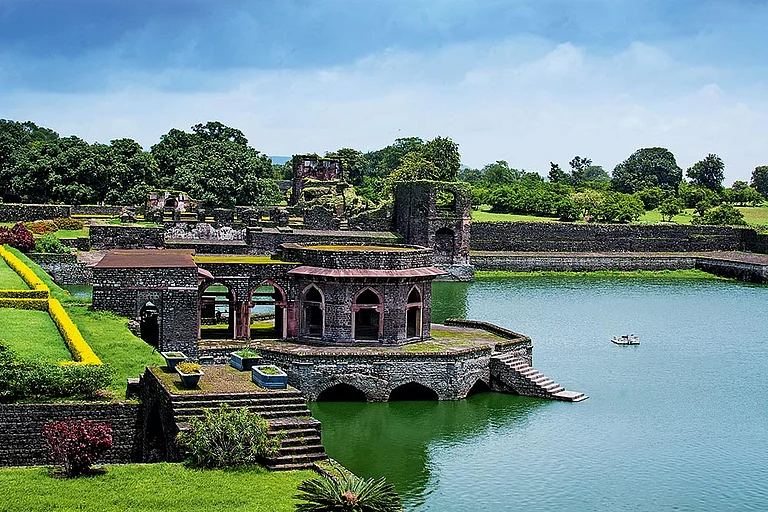
Exploring Mandu
Mandu is certainly the most famous place on the plateau, forming a sub-plateau all its own, largely abandoned except for stunning medieval ruins—the artistic heritage of the Malwa sultans (under whom Mandu was a thriving capital), and later, that of the Mughals, who treated Mandu pretty much as their monsoon pleasure capital. But that Mandu of Rupmati and Baz Bahadur's doomed love, of Hoshang Shah's marble tomb, the huge fortress of the Marathas and the grand edifices of the Mughals, is well-known and much-visited. I was looking to uncover, instead, a couple of hidden gems from the thick mists of Malwa's past—the rock-cut Buddhist caves of Bagh and the rumour-shrouded site of Budhi Mandu, or Old Mandu. There was also the small matter of enjoying the fabled Mandu monsoon.
Advertisement

Clouds skittered overhead, driven by the famous Malwa winds (the morning breeze is called the karaman, and the evening wind the shab-e-malwa) Bibek Bhattacharya
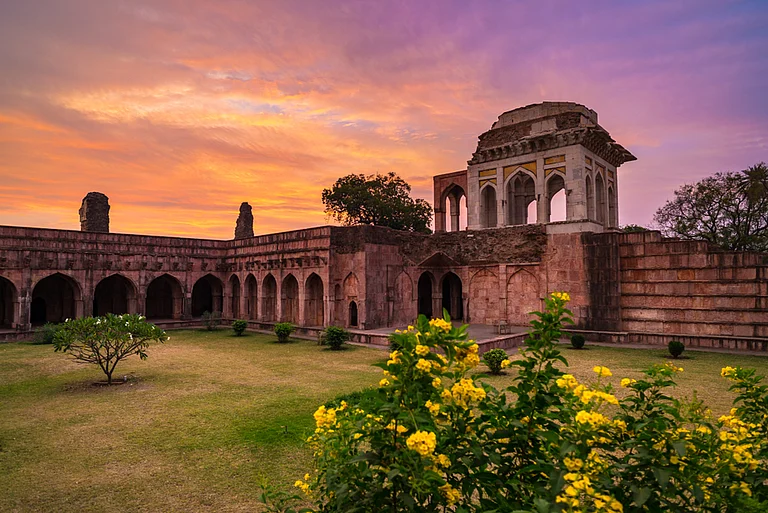
Alas, it never rained. The locals were as pained as we were. From our driver, a wizened old man called Johnny, to the people at the pretty Malwa Resort where we stayed, to random passersby we met on the roads of Mandu, everyone complained about the constantly overcast skies and the utter lack of any precipitation. The weather was fine though. The darkened sky lent depth to the wide vistas of forested Vindhyan slopes, and table mountains whose flat tops seemed to have been carved with a fine knife. Clouds skittered overhead, driven by the famous Malwa winds (the morning breeze is called the karaman, and the evening wind the shab-e-malwa) that whooped and howled through the ravines. Numerous old domes dotting the plateau reared up through the trees, and little children screamed "bye bye" by way of a "hello" whenever we stepped out for a walk.
Advertisement
From around the 2nd or 3rd century BCE till about the 6th century CE, this entire area, comprising of the Malwa plateau, the Vindhyas, the Nimar plain (as the Narmada valley is called) and the Satpuras to the south of the river formed the Valkha chiefdom, a part of the larger Avanti mahajanapada, ruled first from Valkha (modern Bagh) in the Vindhyas, and later from Mahishmati (modern Maheshwar) on the banks of the Narmada. It lay smack in the middle of two important trade routes one running north to south from the uttarapatha of the Indo-Gangetic plains via Ujjain and the Narmada valley to the dakshinapatha leading to the Deccan and the Konkan coast and the east-west route from Mahishmati to the western port of Bharukaccha (present-day Bharuch) in Gujarat. Due to this trade, and fertile agricultural lands, the region was prosperous, and big Buddhist vihara complexes like Bagh, just as at Ajanta, Karla, Bojjanakonda or Kanheri, were set up at nodal points, to serve both a religious function as well as a secular one of acting as stopovers on the trade routes.
Advertisement
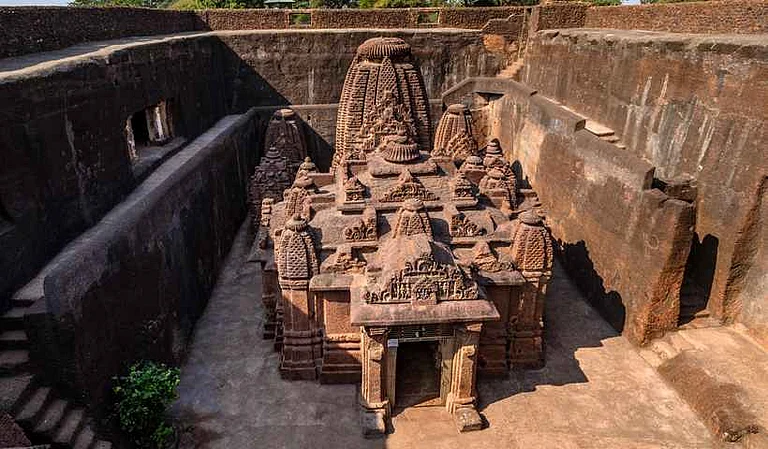
Caves And More
We set off for Bagh the next day, taking the winding road down from the plateau to the plains past the giant old Maratha fortifications of Songarh. Turning west from Dharmapuri on the banks of the Narmada, we drove over patchy roads to the town of Kukshi, traversing the ancient Mahishmati-Valkh trade route. The land was mostly made up of undulating, semi-arid grasslands, and I tried to picture horse caravans and traders on the march, past farmsteads and forests to some far trading post. Just before hitting Kukshi, we crossed a stream coming south to join the Narmada. This was the Baghini River, and we followed it north towards Bagh. The landscape changed to rolling conical hills, looking for all the world like the south England downs. Deep in the folds of these uplands, hidden until you stumble upon it, were the Bagh caves, with the Baghini flowing down below them.
Advertisement

Of the original nine caves, only about six have survived Bibek Bhattacharya
Dug into a long sandstone ridge, the caves looked like a combination of miniature versions of Ajanta and Petra. From 5th-century epigraphs found in the region, it is now known that the complex at Bagh went under the name Kalyana Vihara, and received patronage from the local chieftain himself, a nominal vassal of the imperial Guptas. Of the original nine caves, only about six have survived, while the roofs of the others have collapsed and are now bat-haunted holes in the ridge. Entering Cave 2, I was amazed by the scale of construction. A giant cavernous space of over 80sqft, it was both a monastery (vihara) as well as a school (shala). It also contained 20 separate cells for monks to reside in. In its darkest recess, shrouded in almost impenetrable darkness was a huge antechamber with a giant stupa almost 15 feet high. The chamber was flanked by two gigantic dvarapalas, and the side walls outside the stupa chamber contained two larger-than-life sculptures of the Buddha sculpted in the Gandhara style, flanked by attendants and Bodhisattvas. The pillar-supported roof of the cave would have once been covered with paintings, but now all that remains is lime-covered rock. Outside of the cave, on the long verandah, lay the stubs of a row of pillars. On one end was a spectacular image of desecration - a large rock-hewn image of the Buddha had been crudely modelled with plaster to turn it into an image of Ganesha. A century ago, a particular mendicant called Gonshai Jogi lived here, and he had attempted to turn some parts of the complex into a Shiva temple, and during his long residence here, he caused much harm to both the sculptures and paintings.
Advertisement
Cave 3 is a relatively modest vihara, but Cave 4 is a marvel. The largest cave in the complex, it is artistically the most refined, as well as the best preserved. Walking past a colossal statue of the Buddha, I entered the hall through a 15-foot-high doorway. The door lintel was adorned with carved vines and curlicue figures, and surrounded by tiny sculptures of female figures striking graceful poses. The hall itself was magnificent, with 28 pillars around the perimeter, enclosing a perfect octagon of eight round pillars, heavily decorated, which in turn enclosed four square piers that looked uncannily like the work of some classically-trained Greek or Roman sculptor. Locally known as the "rangmahal", this vihara was the most vibrantly painted of the lot. But centuries of water seepage through the fragile sandstone had destroyed extensive chunks of the paintings while threatening many of the remaining murals. In a bid to save them, the entire hall had been stripped of its paintings and relocated to the Bhopal state museum and the Gujari Mahal Museum in Gwalior.
Advertisement

Dug into a long sandstone ridge, the caves looked like a combination of miniature versions of Ajanta and Petra Bibek Bhattacharya
I went to the small ASI museum across the river to take a look at some of the original murals that are preserved here. The colours jump across the millennia with an immediacy that is breathtaking. There are various religious scenes, and some secular ones, including masterful geometric patterns, pictures of animals and tiled motifs. There's a beautiful scene from the Mahavastu Avadana detailing the story of Princess Malini of Benaras, a Buddhist re-telling of a story from the Mahab harata called the Vidur Pandita Jataka, as well as an enchanting portrait of the Bodhisattva Padmapani. But the best by far is a gorgeous mural of a musician clad in white surrounded by a swirling, sensuous group of dancing women. The image's sheer three-dimensional plasticity and the swaying abandon of the figures, make it a masterpiece.
Finding Fables
"Do you know the way to Budhi Mandu?" I asked the man at the reception of my resort.
Advertisement
"Where is that", he asked in return. A few hours later, I approached another man at the reception. "I would like to go to Budhi Mandu," I said.
"I don't know where it is, but it's in a forest. You'll never make it," he looked at me doubtfully.
"Where is Budhi Mandu" I asked Johnny. He spat out some gutkha, and grinned. "Don't know. But it must be here somewhere."
This was pretty much the standard response I'd been getting in Mandu, no matter whom I'd ask. On our first day here, while we were at the Lohani caves, I'd asked the many locals who'd come for the sunset about Budhi Mandu. Some had looked baffled, others had heard of it but had never seen it.
It was not until I met young Parvez Qureshi that my chances of actually making it to this fabled site started looking up. Parvez was a guide, from a family of guides. His father, Mohammad, was well known to Mandu visitors, and now Parvez, along with his elder brother Javed, have entered the business. I met him outside the resort and posed him the same question. "Are you comfortable with walking", he asked uncertainly.
Advertisement
Early the next day, we set off in Johnny's car for Nalcha, just outside Mandu, and then drove another few kilometers on a narrow rural road till we reached the village of Mograbao. A trail led off from here, past a crudely handwritten sign saying "Budhi Mandu 4km". We walked over rocky outcrops, and past small farms towards a line of forested hills. The Malwa plateau had been formed out of intense volcanism some 66 million years ago, a part of the same process that had helped wipe out the dinosaurs and laid out the bed of petrified lava that are the Deccan Traps. It gave me a bit of a thrill to think that we were walking on black basalt rocks that came into existence when the Indian subcontinent was floating north over the Reunion Hotspot on the Indian Ocean, having just parted ways with Seychelles.
We passed along the lip of a massive waterfall, and then entered a thick forest, blown and buffeted by the wind. This was welcome, as the sun had come out and the day had turned oppressively humid. The only people here were transhumant herders with large flocks of goats. We made friends with a man carrying a small axe. He seemed bemused to hear of our destination. "Wahan toh sirf khandahar hai," he said ("there are only ruins").
Advertisement

Bibek Bhattacharya
Soon we started getting glimpses of these ruins, eerily peeking out of the forest a portion of a carved pillar here, a set of fortifications there, all hewn out of the same basalt that made up these hills. After a couple of steep climbs, we passed through a rubble of colossal rocks that were the chief fortress walls of Budhi Mandu, and through the ruins of a gate onto a high, wind-swept escarpment looking out on the Nimar Plain. Just over a thousand years ago, the Gurjara Pratiharas of central India were locked in an intense struggle for control of the imperial capital of Kannauj with the rival empires of the Rashtrakutas of the Deccan and the Palas of Gauda. Either the Pratiharas, or their vassals, the Paramaras of Dhar, built a large, fortified city on this windswept ridge, called Mandapika in Pratihara inscriptions.
Presently, we came to the heart of the ruined city a high mound, crowned with the ruined plinth and walls of two temples or palaces, surrounded by some of the most artistic rubble I've ever seen. Exquisitely carved blocks, fine pillars, a statue of Bhairava, architectural jambs and friezes of standing deities lay around, overrun by high grass, creepers and tall trees. Just like present-day Mandu, ancient Mandapika too must have suffered from water shortages, and just like Mandu, it too depended on deep wells and lakes for its water, for just beside the mound was a huge well, and two boys were gambolling in its depths. One of them, Ranjit, would take some time out to play a haunting tune on a rough-hewn flute. Later I saw that many of the herders had similar flutes that they would play on while walking. The plaintive music added a whole other level of strange to the already eerie scene. A large, dried-up lake bed contained more ruins, with fallen old capitals and mounds that may have been temples. The only thing left standing from this forgotten city in the forest on a hill was an extensive embankment beside the lake, carved rocks set out in a perfect geometric pattern. I asked Parvez if any excavation work had ever been done here. He shook his head and said that most people didn't even know that this place existed, and that he came only about once every year, bringing mostly foreign tourists who didn't mind a bit of a hike.

Walking out of the forest onto the heather-covered cliff overlooking the Narmada plains, we were hit by a violent gust of karaman and the overwhelming scent of wild mint. I felt like Rip Van Winkle, walking out of a long sleep into a world that had changed. It was time to head back. We passed Ranjit on our way out, still playing his flute sitting on a bit of 1,200-year-old masonry. As he saw us, his face creased into a smile. "Bye bye," he said, "bye bye."
The Information
How To Reach Mandu
Daily flights connect Indore to all the metros. Mandu is 100km from Indore and taxis to Mandu cost approximately Rs 2,500.
Getting Around Mandu
You can rent a taxi from Indore. Try Shri Joshi Travels (0731-2493948 www.shrijoshitravels.com). They provided me with an Indica for a flat rate of Rs 2,000 per day plus Rs 250 per day for the driver. Petrol/diesel charges extra.
Where to Stay In Mandu
The best options are the two MP Tourism hotels The Malwa Retreat (from Rs 2000 plus taxes doubles www.mptourism.com) and The Malwa Resort (from Rs 3,590 plus taxes doubles).
Things To Do In Mandu
The stand-out monuments in Mandu are the Delhi Darwaza and fortifications, Jahaz Mahal and Hindola Mahal in the Royal Enclave, Hoshang Shah's Tomb and the Jami Masjid in the Central Group, the medieval caravanserai and Malik Mughith's Mosque in the Sagar Talao Group, and of course Baz Bahadur&'s Palace and Roopmati's Pavilion in the Rewa Kund Group. Check out the sunset from Kaliaghat, Sonagarh fort or the Lohani Caves. Bagh Caves are a 2-hour drive and can be covered in a day. On the way back you can catch the sunset on Maheshwar's lovely ghats by the Narmada. If you have the time, visit the fort as well. To reach Budhi Mandu, you will have to drive to the village of Mograbao and then hike for about 5km. Mohammad Qureshi and his sons Javed and Parvez (07869996237 javedjavedqureshi@gmail.com) are knowledgable guides. The standard guide rates are Rs 300 for 3 hours or Rs 1,500 for a full day.
Published At: