The guide was clearly enjoying himself. Pointing to a beautifully sculpted panel on the wall of the Lakshmana Temple, which depicted a group of sensuous maidens in languorous poses, he asked a gaggle of college students from Bhopal, “Who can tell me which girl here resembles Pamela Anderson?” The response was met with silence and a few embarrassed snickers. Finally, one girl timidly raised her hand and pointed to a sura-sundari admiring herself in a mirror. “She is correct,” announced the guide triumphantly. “These stunning women were the Kareena and Katrina of their time—supermodels,” he added with a flourish.
Chasing The Chandellas: A Journey Through Khajuraho's Architectural Marvels
Pursuing the architectural heritage of the Chandellas in the historic realm of Jejahuti, Khajuraho

Advertisement

Sculptures of Khajuraho Pinterest
Another guide asserted that ancient India had it all, including designer purses. The evidence was a charming little niche sculpture depicting a woman handing a piece of jewellery to her attendant, who was carrying the aforementioned purse. Recently, when I showed this to some Italian tourists, they jokingly claimed it was a Givenchy. I had anticipated finding such comments annoying, but in the presence of the unearthly brilliance of the Khajuraho temples, I found it easier to be amused instead.
Paroma and I had arrived that very day on an early morning train from Delhi and driven away from Khajuraho towards the Ken River, located about 15 km away. We were guests of wildlife conservationists Dr. Raghu Chundawat and Joanna Van Gruisen at their luxurious forest resort, The Sarai at Toria. Over the past few days, Joanna and I had been exchanging emails to finalize our itinerary. My visit wasn’t primarily for the Panna Tiger Reserve, the usual draw for guests at the Sarai, nor strictly for Khajuraho, but rather to explore the countryside in search of other rumored Chandella-era ruins.
Advertisement
The Chandella kings of Khajuraho were a powerful local clan of Gond tribal origin who rose to prominence in the 9th century CE. Like many royal families of that era, they crafted a convenient myth of descent from the moon god, which elevated them to the caste status of chandravamsiya kshatriyas. Over the following century, they harnessed military prowess to become a significant power in north-central India, now part of Madhya Pradesh. They then embarked on an ambitious building campaign throughout their kingdom, resulting in the sandstone wonders of Khajuraho. The dynasty envisioned Khajuraho as their sacred center, filling it with temples, monasteries, and lakes. However, what is less well known is that these indefatigable builders left behind numerous signposts of their refined aesthetics throughout Bundelkhand, formerly known as Jejakabhukti or Jejahuti. The core territory of the Chandellas was bisected by the Ken River, encompassing Khajuraho and their capital, Mahoba, to the west, along with the imposing Vindhyan fortresses of Ajaigarh and Kalinjar to the east. All these sites still boast excellent remains of Chandella architecture, and I was eager to explore them.
Advertisement

Rock cut temple structures in Bundelkhand Wikimedia Commons
The Usual Suspects of Khajuraho
Perhaps it was my fatigue or the somnolent heat of the midday sun, but after navigating the chief temples of Khajuraho's western group of monuments, my head was spinning. I believe it was the sheer richness of the sculptures and the concentration required to absorb it all. The sun gleamed off the delicate sandstone forms of the innumerable deities. The ascending pyramid of subsidiary shikharas of the Kandariya Mahadev Temple seemed to rise into infinity, leaving me giddy. The leaping vyalas, mythical beasts that were half-dragon and half-horse, appeared to escape from the niches of the kapili walls, while amorous couples gloried in their bodies, exuding supple lines and loving expressions. The walls of the Lakshmana and Jagadamba temples also featured biting sectarian satire, depicting pious-looking monks in flagrante delicto. Similarly, the Kandariya displayed sculptural references to the literary tradition of sandhyabhasa, or the twilight language, replete with puns and metaphors, creating a multilevel narrative through its intricate carvings.
Advertisement
A carousel of sandstone elephants, horses, soldiers, musicians, dancers, and siddhas endlessly circled the temples, creating a perpetual procession around divinity. The grand old man of Indian archaeology, Alexander Cunningham, during his tours of Bundelkhand as the director of the newly formed Archaeological Survey of India in the latter half of the 19th century, meticulously counted the number of individual sculptures on Khajuraho's 21 temples—Shaiva, Vaishnava, and Jaina. The Kandariya Mahadev Temple alone boasted 872 pieces, each standing between 2.5 to 3 feet high.
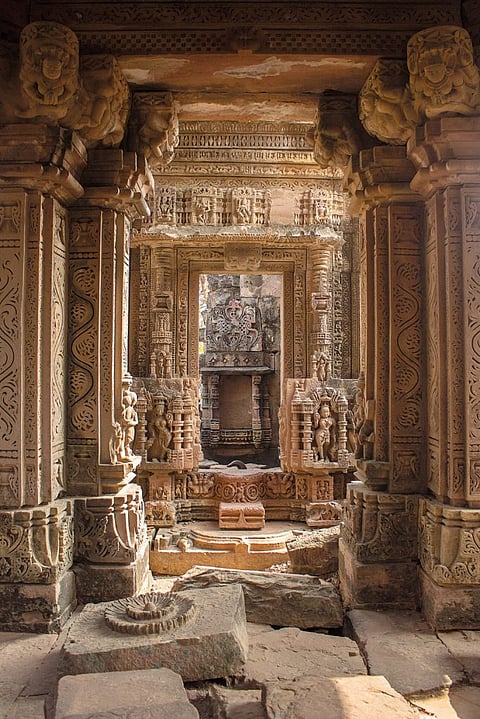
Inside the temples of Khajuraho Twitter
Paroma and I retreated to the Sarai to plan our outings over some excellently brewed coffee. Joanna kindly guided me to the library and handed me a selection of books on Khajuraho, including Cunningham’s survey report and a volume on the forts of Bundelkhand. The latter proved particularly useful, as I knew next to nothing about Ajaigarh and Kalinjar, our next destinations. Part of me longed to stay put and bask in the sunshine pouring into the charming wood-and-mud living area of the Sarai, enjoying breakfast and lunch in the garden, with the only sounds being the gentle twittering of countless birds. The staff, all locals, were hospitable and pleasant without the obsequiousness often found in larger resorts.
Advertisement

Tea setup at Sarai at Toria Sarai At Toria
While the comfort of our pastel-hued cottage beckoned, the itch to travel stirred within me. The next day, with a lunch hamper packed by Raghu in hand, we set off for the forts, accompanied by our guide, a local lad named Jaipal. We hopped onto NH-75, crossing the Ken River and heading east through the Vindhyan forest of the Panna Tiger Reserve. After taking SH-49, we drove north for about an hour across the flat plains of Bundelkhand, occasionally interrupted by looming outcrops of the range. Just outside Panna, we passed a rudimentary diamond mine, a reminder of the area's mineral wealth. In ancient times, these flat-topped hills often served as ideal sites for fortresses.
Exploring Ajaigarh Fort
Ajaigarh's thickly forested ridge shelters a large village of the same name, remarkably clean and tidy, much like the rest of Bundelkhand. At the village's end, a set of steep stairways leads through a teak forest up to the fort's ramparts. According to tradition, the fort was founded by a mythical ruler named Ajaypala. However, it is believed that Jayapura Durga, as it was once known, was first settled by the Chandella king Kirtivarman in the early 11th century CE to commemorate his victory over the Kalachuris. Later, during the latter part of the Chandella reign, when King Paramardideva lost his capital, Mahoba, to Prithviraj Chauhan in 1182 CE, Ajaigarh became the administrative capital of the kingdom.
Advertisement

Ajaigarh Fort panna.nic.in
Ajaigarh is truly a gem. Upon entering the first gate, you are greeted by a finely sculpted statue of a dancing Ganesha, accompanied by a long inscription in medieval chitra-varna script that celebrates the installation of the image. As I ascended the stairs, passing through two smaller gates, the rock face came alive with intricate carvings. Here, a group of meditating Jain monks; there, a collection of tirthankaras; and scattered throughout, countless depictions of people worshipping shivlings, a carving of Mahishasuramardini, and numerous small yoginis.
Beyond the Mughal-era gate known as the Kalinjar Darwaza, the trail winds up the hill, flanked by two Chandella-era tanks named Ganga and Jamuna, before entering a thick teak forest. Giant granite blocks from once-grand palaces and residences lay strewn about, remnants of the fort’s past splendor. One path led me past ruined architectural fragments to a large lake called Ajaypala Talao.
Here, a small whitewashed shrine—reminiscent of both a dargah and a Bundela-style temple—houses a black stone idol of Vishnu, revered by local villagers as Ajaypala. Legend has it that a British officer once tossed the idol into the tank to express his disdain for idolatry. Subsequently, he fell gravely ill and did not recover until the idol was restored to its rightful place.
Advertisement
While I was wandering around the tank, a family from Ajaigarh approached the shrine barefoot to pay their respects. One of the men grinned at me and asked in broken English, “Which country are you from? Like Ajaigarh?” When I smiled and replied in Hindi that I was from the area, he chuckled and said, “Damn, there goes my chance of practicing English,” before walking on.
Jaipal had been trailing behind and had led Paroma down a different path to a group of ruined Chandella temples hidden in the forest. I inquired with some goatherds about the route, and they referred to it as Rangmahal, offering me a rough direction to follow. Soon, I found the trail, leading me to a gate marked by the ASI. Beyond it lay a scene straight out of Indiana Jones, as Paroma later remarked.
Advertisement
Here stood a group of three temples, two of which were constructed in the mature style of the Khajuraho temples. Partially destroyed, they were mere husks of what must have once been structures rivaling the Khajuraho group. Only their mandapas, garbhagriha, and kapili walls remained standing, their exquisitely sculpted interiors exposed to the elements. Surrounded by the forest, the temples presented a striking sight. Joanna had mentioned that this place reminded her of how Khajuraho must have appeared when it was first discovered in 1832 by British engineer T.S. Burt. She was right; these eerie temples possessed a presence that the manicured lawns of the Khajuraho complex simply couldn't replicate. Sculptures of Bhairavas and yoginis adorned every surface. The third temple, however, was of a different style and appeared older.
A short walk from the group of temples led us to another ruined structure beside a large tank known as Parmal Talao. Parmal was the nickname of the last major Chandella monarch, who retreated to Ajaigarh and Kalinjar following his defeat by the Chauhans. In 1203, he would lose Kalinjar to the forces of Qutb-ud-din Aibak and was ultimately assassinated by his minister for surrendering the fort. Before these misfortunes, he was known as something of a playboy and a successful king. The tank was originally excavated to quarry stones for the temple's construction but was later transformed into a waterbody featuring a rock-cut ghat reserved for the exclusive use of the royal women of the palace.
Advertisement
A trail led away from the temples towards the southern ramparts of the fort, passing a Mughal-era kiledar's (master of the fort) post to the southern gate, known as the Tarhaoni Darwaza, named after a village of the same name on the plains below. The rock face here was adorned with stunning carvings, including a panel depicting eight large yoginis, sternly seated on corpses, in meditation. One yogini was illustrated running, holding a flaying knife and a severed head. The tantric yogini kaula cult had flourished throughout the Chandella domains around the turn of the first millennium CE. The most evident representation of this was the rectangular Chausath Yogini Temple, the earliest temple in Khajuraho, which we had seen the previous day. This location appeared to be a veritable yogini pitha. Revered by the tantric Mantramarga and Kaulamarga Shaivas, as well as Vajrayana Buddhists (evidence of the latter can be found in Khajuraho), yogini and matrika shrines were typically situated at the edges of cities and towns, and this was literally the edge of the fort, with a ridge dropping down some 600 feet to the plains below. Additionally, a large panel seemed to depict the five Pandava brothers alongside Draupadi. The area also served as a fertility shrine, featuring images of a cow and calf, a sow with her young, and a representation of Shitala or Hariti with a child on her lap. Alongside the wall was a row of tiny, meditating monks. A long inscription, dating back to around 1300 CE, provided a list of Chandella kings, beginning with Kirtivarman.
Advertisement
Secrets Of Kalinjar
We still had another fort to explore, so we retraced our steps and drove towards Kalinjar, just across the border into Uttar Pradesh. Needing to eat our lunch, we pulled over beside the road for an impromptu picnic. Raghu’s killer lemon pickle was the star of the meal as we devoured parathas, sabzi, and omelettes, washed down with plenty of water. After tramping around Ajaigarh, we were left feeling quite dehydrated.
Fortunately for us, you can drive all the way up to Kalinjar. Looming over a village of the same name, it is one of India’s most renowned forts, once referred to as Kanagora by Ptolemy. This site has been a settlement for at least two millennia and is considered a sacred location. The title of Kalinjaradhipati, or Lord of Kalinjar, was a coveted honor held by the Kushanas, Kalachuris, Guptas, and Gurjara Pratiharas until the Chandellas acquired the fort, maintaining control for over 200 years. Strategically positioned on the Indo-Gangetic plains, the sheer walls of the fort seem to grow out of the hill itself, presenting an almost unassailable appearance. As we drove through the hinterland towards it, the hill first appeared as a blue silhouette on the horizon, looking impossibly massive. As we got closer, the ridge-top began to bristle with battlements.

Natraj statue at Kalinjar fort Shutterstock
The Chandella king Vidyadhara, who commissioned the Kandariya Mahadev Temple, successfully defended the fort against Mahmud of Ghazni on two occasions, in 1019 and 1023 CE. When Prithviraj Chauhan attacked the Chandellas, he pillaged Mahoba but was forced to retreat from Kalinjar. Qutub-ud-din Aibak’s army only succeeded in 1202 because the fort ran out of water. Aibak’s historian praised this victory, declaring Kalinjar the strongest fort in the world, second only to Alexander’s. Much later, Humayun failed twice to capture the fort from a Chandella chieftain, and Sher Shah ultimately died while attempting to seize it. The British had to bribe the chief who held the fort to commandeer it.
Today, Kalinjar is a ticketed ASI monument, scattered with the remnants of 1,500 years of history—Gupta, Chandella, Delhi Sultanate, Lodhi, Mughal, Bundella, and British. Yet, it is Kalinjar's spiritual history that remains a vital, living presence. As a site of Shiva worship dating back to the Puranas, the cave temple of Neelkanth on the fortress's western wall boasts spectacular art and draws numerous pilgrims.
As the sun sank in the west, we hurried past day-tripping locals to reach the temple. A steep flight of steps led down to the courtyard housing the cave, flanked by a continuous gallery of rock carvings. Sculptures of various sizes and eras jostled for space, most dating from the Chandella era. These included numerous ornate ekamukha shivalingas, intricate panels depicting fierce Bhairavas and Chamundas, and countless representations of Shaiva yogis, pilgrims, dancing yoginis, and votive lingams.
At the southern end of the courtyard rose magnificent mandapa pillars in the Chandella style, built by Paramardideva, enclosing a homa pit. This led to an intricately carved doorway of the cave shrine, adorned with exquisite images of musicians, dancers, and deities from the Gupta era. Inside, the main lingam—a large blue stone—sat with eerie eyes painted upon it.
As the priest commenced the evening prayers with the cacophonous ringing of bells, we moved past the mandapa to a recessed pool. Opposite it, carved into the rock face, stood a colossal statue of Bhairava, towering at 24 feet tall. With bared teeth, the deity assumed a dancing posture, his 18 arms bristling with weapons and severed heads. A garland of skulls adorned his neck as he straddled the world, his phallus erect. Beside him was a smaller yet equally fearsome carving of an emaciated Kali/Chamunda.
As the sun gradually sank into the haze on the western horizon and the bells fell silent, it was time to return to the evening fire at The Sarai for a drink. God knows, after the wonders of Bundelkhand, I certainly needed one.
The Information
Getting There
Khajuraho is well connected to Jhansi and Gwalior by both road and rail. There’s a daily overnight train to Khajuraho from Delhi's Nizamuddin station, specifically the UP Sampark Kranti Express. Air India and SpiceJet offer daily flights via Varanasi to the new chrome-and-glass international airport at Khajuraho. The Sarai at Toria is located approximately 15 km from Khajuraho.
Published At: