Fragrant flowers being plucked from the garden. Brass vases polished with wood ash until they gleamed in the sun. Candles and incense sticks, mostly sandalwood because my mother loved the scent, bought from the local dukaan. The aroma of khao tek or popped rice wafting from the kitchen at the far end of the house. These were packed into little handkerchiefs for us children to carry to the temple. After offering our prayers, we would carefully tuck the popped rice back into the cloth and eat it the moment we stepped outside the temple grounds. There was always a sense of excitement when preparing for a wan satang or auspicious day in any Tai-Khamti household. Wan satangs are holy days deeply revered by the Khamti kinsfolk who live in the Namsai district of Arunachal Pradesh, where Theravada Buddhism is practised. These occasions are marked by visits to the temple to offer food, pray, meditate and reflect.
From The Latest Issue: In Arunachal’s Namsai, Tradition Lives At Home
In Arunachal Pradesh’s Namsai district, childhood memories, family devotion and Tai-Khamti traditions unfold in a landscape of temples, pagodas and sacred festivals

The Tai-Khamtis are descendants of migrants from the Shan region of Myanmar who arrived in India in the mid-18th century. Today, they form a close-knit community with a rich cultural heritage in eastern Arunachal Pradesh. They are also one of the few tribes in the state to possess their own script, Lik-Tai, which is mostly taught by monks in monasteries.
Since we were mostly away in boarding school in Shillong throughout the year, the few religious events we attended during holidays were always special. We would sit huddled in the prayer room, which was where all the action took place. The usually neat puja room turned into a picture of organised chaos on such days.
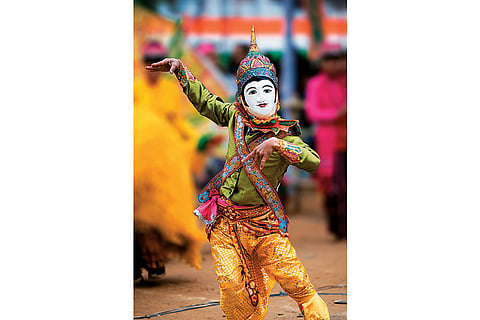
The gleaming brass vases filled with fresh blooms were always reserved for my parents, while the younger lot were given cone-shaped vases made of leaves. My sisters and I particularly enjoyed making these little cone vases from strips of tong leaves, filling them with flowers, candles and incense. These green tong or packing leaves (Phrynium pubinerve) are ubiquitous in Khamti life and used on many occasions, from packing cooked rice to wrapping food.
Whether it was a festive celebration, a wedding or even a funeral, the first thing that needed to be organised was always tong. I remember my mother, along with the other ladies of the village, piling into convoys of jeeps with baskets and sharp machetes, returning later with bundles of these leaves and vegetables they had foraged in the forest. Trust me when I say that these foraging trips in the lush tropical rainforest are not for the faint-hearted.
The Golden Chong
Temple visits on sacred days meant waking up at the crack of dawn, which in the Land of the Rising Sun meant as early as 4 am. It was considered blasphemy to reach the temple after six, and elders would always pass a comment or two if we were late. Besides, arriving early also meant securing a seat at the front; those who came late had to sit at the back, as the hall would fill up quickly.
We made sure our ivory handwoven phamais (shawls), sinhs (sarongs), and the colourful tasselled belts called si sinhs that held our sarongs in place were ironed and ready the previous night. My mother always insisted we wear traditional attire on such occasions, and we happily swapped our frocks for these elegant outfits.
Temple visits on sacred days meant waking up at the crack of dawn, which in the Land of the Rising Sun meant as early as 4 am
Luckily for us, the village vihara was just a five-minute walk from home. Just as the rays of the sun hit the tip of the thi (the spire atop the temple roof), the sound of chanting would rise in unison from the prayer hall. I was only seven years old then, but it is a memory I hold close to my heart.
Chongkham literally translates to golden (kham) temple (chong), and the village of my childhood grew around this modest Buddhist monastery dating back to the 18th century. It is said that the temple once had a gold-plated roof, which is how one of the oldest villages in Arunachal Pradesh got its name.
Every religious and cultural occasion took place in the temple grounds and continues to do so today.
But the golden chong of my childhood has since been replaced by a brand new temple. On one of my annual visits home, I was saddened to see that the old structure no longer stood where it once did. There was nothing grand about that temple, yet from the moment you entered its grounds, a sense of calm washed over you.
While I was working in Delhi, my elder sister called with astonishing news: His Holiness the Dalai Lama was visiting our temple
I remember tiptoeing along the corridors and circumambulating the complex to light candles in the many shrines and stupas that surrounded the main temple, eventually stopping beneath the towering Bodhi tree that stood watch over everything.
Today, the old temple has been replaced by the Chongkham Raj Vihara. The new structure is impressive, with tiered roofs built in traditional Tai-Khamti architectural style. Yet the stupas scattered across the grounds still remain, remnants of another era.
Faith And Family
For the Khamtis, religion is inseparable from daily life. Their routines revolve around the teachings of Lord Buddha and the pursuit of merit, with the hope of attaining nibbana (final liberation).
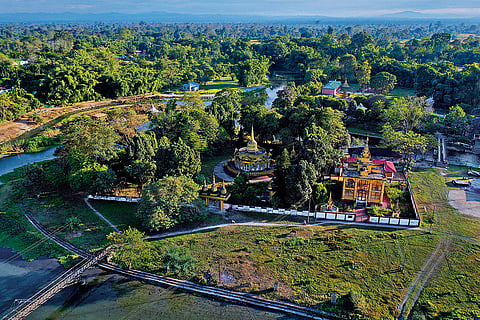
Many shrines and pagodas in the region have been erected by families as acts of devotion. Thanks to my late parents, our family had the rare privilege of donating one such temple.
Located on a small island between the Terang and Berang rivers in Chongkham, my parents donated a temple in 2001. My father named it the World Peace Pagoda because he believed deeply in harmony and wished for peace across the world.
Featuring marble Buddha statues carved in Rajasthan, the temple has an inner sanctum that feels sacred. The consecration ceremony was held with great pomp, and people from Khamti villages across the region were invited to participate.
My sisters and I spent days helping organise the event, attending to guests and assisting wherever we could. I remember days filled with prayers, offerings, community feasts and dances accompanied by cymbals and drums. It was exhausting, but deeply satisfying.
A few years later, while I was working in Delhi, my elder sister called with astonishing news: His Holiness the Dalai Lama was visiting our temple.
In 2003, he came to bless the World Peace Pagoda. To this day, the sal tree he planted still stands in the temple grounds.
The Festival Of Sangken
Today, when I return home with my seven-year-old daughter, we always drive to see the sprawling Kongmu Kham, or Golden Pagoda.
Overlooking the Tengapani River and perched atop a plateau, it is the grandest Buddhist monastery in eastern Arunachal Pradesh. Donated in 2010 by the state’s Deputy Chief Minister, Chowna Mein, and his family, the Burmese-style complex includes a meditation hall, a library, a multipurpose hall, and a monastery.
Spread across 20 hectares, the main pagoda houses a bronze Buddha statue in meditation. An eco-resort within the complex allows visitors to experience the religious customs and traditions of the Tai-Khamti community.
Among the many festivals celebrated by the Khamtis throughout the year, my favourite has always been Sangken.
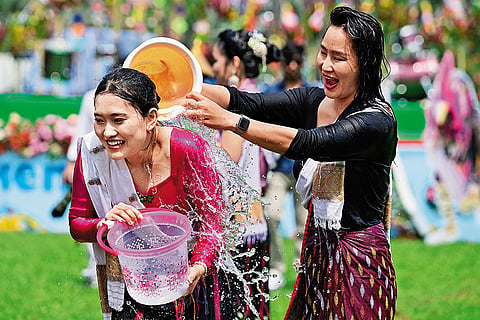
The three-day water festival that ushers in the New Year is celebrated on April 14. During the celebrations, Buddha idols are ceremonially bathed at a temporary shrine.
My sisters and I would follow my mother carrying small buckets filled with perfumed water and flowers to pour over the sacred statues. We also washed the shrines and stupas within the temple complex.
Our feet would ache from the many trips to the river to refill our buckets, but along the way we splashed water on friends and family we met, laughing as everyone ended up drenched.
I have not attended Sangken in Chongkham for several years now, but the tradition continues in my Delhi home. Each year I wash my collection of Buddha idols and offer prayers.
I have taught my daughter to make the same cone-shaped leaf vases my mother once taught me. When I close my eyes to pray, I imagine myself back in the golden chong, surrounded by voices chanting: Buddho Dhammo Sangho.
The Information
Best time: Plan your visit around Sangken (April 14–16), the Tai-Khamti New Year, marked by water rituals and community celebrations. Another good time is Poi Pee Mau (late November), the post-harvest New Year festival in Namsai, featuring traditional rituals and cultural performances.
Getting there: The nearest airport is Mohanbari Airport in Dibrugarh, Assam, about 123 km from Namsai, with taxis available on arrival. The closest railway station is New Tinsukia Junction, roughly 80 km away.
Pro Tip: Visitors to Arunachal Pradesh require an Inner Line Permit (ILP). Apply online at eilp.arunachal.gov.in
Looking for more such exciting and meaningful stories? Grab our latest issue on Amazon.
