The Mogao Grottoes complex in China consists of hundreds of caves carved into a cliff face along the Daquan River and lavishly decorated with wall paintings and sculptural works. Also known as the Thousand-Buddha Caves, the place contains approximately 45,000 square metres of murals and over 2,000 painted sculptures, making it the world's largest collection of Buddhist art. Inscribed as a UNESCO World Heritage Site in 1987, the grottoes are strategically located along the Silk Route, at a crossroads of trade, religious, cultural, and intellectual influences. According to UNESCO, the grottoes were first constructed in 366 AD.
All About China's Mogao Caves, A UNESCO World Heritage Site
The stunning Mogao Grottoes, also known as the Thousand Buddha Caves, contain thousands of murals and painted sculptures, making them one of the world's largest collections of Buddhist art

Advertisement
A Display Of Buddhist Art
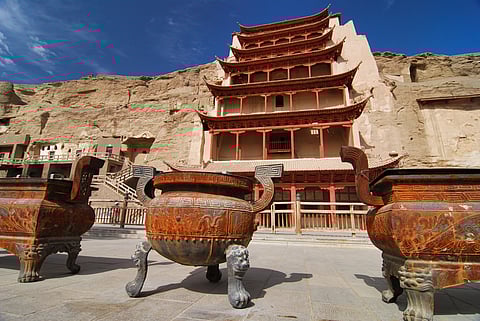
The Thousand Buddha Grottoes, Mogao Caves Marcin Szymczak/Shutterstock
The Mogao Caves are located south-east of the Dunhuang oasis in Gansu Province. Carved into the cliffs above the Dachuan River, the grottoes are considered to represent the great achievement of Buddhist art from the 4th to the 14th century. They are the world's largest, most richly endowed, and longest-used treasure house of Buddhist art.
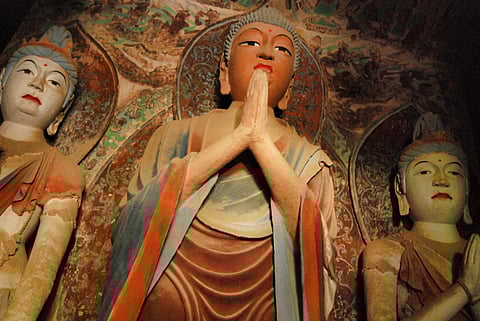
The distinct artistic style of Dunhuang art is a synthesis of Han Chinese artistic tradition and styles assimilated from ancient Indian and Gandharan customs, as well as the arts of Turks, ancient Tibetans, and other Chinese ethnic minorities. Many of these masterpieces are the work of artists with unrivalled aesthetic talent.
What To Watch Out For?
Marcin Szymczak/Shutterstock
The complex consists of 492 caves that house approximately 45,000 square metres of murals and over 2,000 painted sculptures. While the complex is interesting in its entirety, there are some caves that you should not miss visiting. One of the oldest and most vivid scenes of cultural exchanges along the Silk Road can be found in Sui dynasty Cave 302, which depicts a camel pulling a cart typical of trade missions at the time.
Advertisement
Caves 23 and 156 of the Tang dynasty depict workers in the fields and a line of warriors, respectively, and Cave 61 of the Song dynasty depicts the celebrated landscape of Mount Wutai, where nothing has been left out - mountains, rivers, cities, temples, roads, and caravans are all depicted.
The Thousand Buddhas
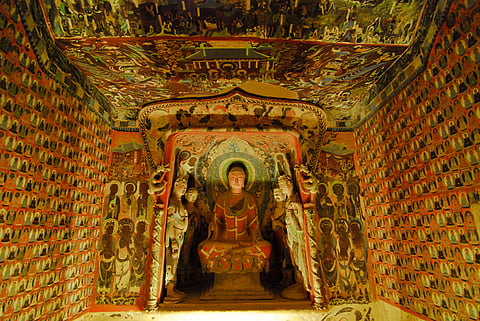
Thousand Buddha Grotto Marcin Szymczak/Shutterstock
The label of Thousand-Buddha Caves comes from a legend. In 366 CE, a monk named Yuezun saw a thousand radiant Buddhas on the cliff face, which inspired him to begin excavating the caves. There are over a thousand painted and sculpted Buddhas in the caves today.
The Information
Location: 25 km (15.5miles) from downtown Dunhuang on the eastern slope of Echoing-Sand Mountain
Timings (Monday - Sunday): 8am-6pm, April 1- November 30. 9am-5:30pm, December 1-March 31.
Tickets: CNY 258/INR 3029 PP (peak season). CNY 168/INR 1972 PP (off-season)
Best time to visit: Dunhuang has an arid climate with little rain. Summer and autumn (May to October) are the to visit. Dunhuang tends to get sand storms in spring, and it is too cold in the winter.
Advertisement
Pro Tip: Wear good walking shoes as it takes around 3-5 hours for a tour. And be prepared for intense sunlight in the area.
Getting There
The Mogao Caves are located on the southeast outskirts of Dunhuang city, about 24 kilometres from the city centre. To get there, you must first visit the Mogao Caves Digital Exhibition Centre and buy tickets for the shuttle bus to the Mogao Caves Area. The Mogao Caves Digital Exhibition Centre also serves as a ticket office and serves as the only entrance to the Mogao Caves Area. There is a large parking lot for tourists in the Mogao Caves area.
Trains from Beijing, X'an, Lanzhou, Urumqi and Zhangye connect directly to Dunhuang. Dunhuang Railway Station is only about 2km from the Mogao Caves Digital Exhibition Center.
You can fly from Beijing to Dunhuang. Dunhuang International Airport is about 13km to the east of Dunhuang downtown and 22km to the north of Mogao Caves. You can take the airport shuttle bus to Dunhuang Railway Station and walk to the digital centre.
Advertisement
Where To Stay
Dunhuang is a small prefecture-level city in Gansu province with reasonably priced accommodation. There are mid-range hotels to choose from, as well as comfortable guest houses and hostels. You can stay in the city centre of Dunhuang or hotels near Mingsha Mountain and Crescent Lake. A popular place is The Silk Road Dunhuang Hotel located about 1.5km away from Mingsha Hills and Crescent Lake. You can also book a room at the Dunhuang Grand Soluxe Hotel on Yangguan Middle Road, Dunhuan. It has free WiFi and parking, restaurants, bars, and gardens.
Published At: