Kenya’s wild heart is most clearly heard in the Maasai Mara, where survival plays out not in hushed corners but beneath an unblinking sky. It is a theatre of dust and golden grasses, of wings that carve thermals, of hooves that churn dry earth, and of predators that move through the day with studied restraint. To fly over it in a small bush plane, skimming escarpments and tracing the meandering Mara River, is to witness life as geometry, rhythm and migration—an aerial map of life and its seasonal negotiations. On the ground, those same shapes reveal stories that are older than borders, and more urgent than myth.
A Journey Through Kenya’s Skies & The Savanna, Scripted By Light, Dust And Survival
Soar over riverbeds, land among predators; Kenya blends flight, wilderness and raw beauty in one unforgettable journey

Advertisement
To witness those stories first-hand, Outlook Traveller turned to wildlife photographer and seasoned IT professional Koushik Chatterjee, whose visual narratives marry technical precision with deep wilderness empathy. On assignment in Kenya, he travelled with his sister, Sanghamitra Mukherjee, and the journey evolved into a collaborative exploration of landscapes, behaviour, and wild character.
While Chatterjee focused on the great wildlife dramas and the charismatic megafauna that define the savannah, Mukherjee turned her lens skyward, capturing the birds of the Mara, raptors riding thermals, lilac-breasted rollers catching the light, and a chorus of wings that animate the plains just as vividly as any lion or elephant.
Together, they traversed remote landscapes and fragile habitats, photographing Kenya at rare proximity and encountering some of the continent’s most symbolic figures. "Photographing Craig, Kenya’s largest tusker, felt like standing in the presence of living heritage. And then seeing Najin, the world’s last surviving northern white rhino, was something else entirely—it’s a reminder that extinction isn’t theoretical, it’s happening right in front of us,” says Chatterjee.
Advertisement
What follows is not merely a catalogue of Kenya’s wild inhabitants, but a shared journey through images, encounters and unfiltered scenes that reveal the daily calculus of life in the savannah, where nothing is guaranteed and everything has a purpose.
Wildlife Encounters Across The Kenyan Plains
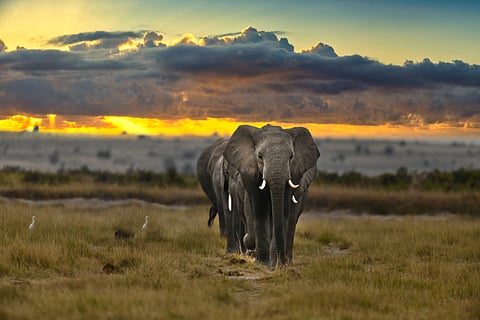
A matriarch leads her herd beneath a burning Mara sky Koushik Chatterjee
The African sun drops into a haze of amber and indigo as a herd of elephants crosses the plains in silhouette. At their head, the matriarch moves with the kind of authority that beats no drum and needs no fanfare. Their immense forms reshape woodlands, sculpt riverbanks, and carve quiet corridors through memory itself. In this suspended light, they feel both ancient and fragile, as though the landscape itself holds its breath until they pass.
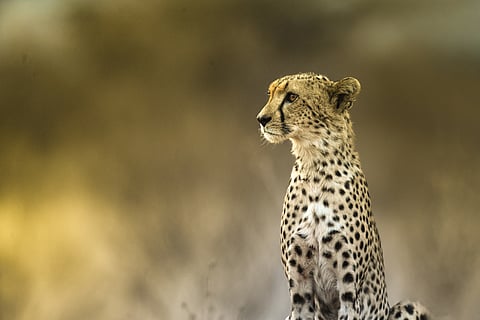
The fastest hunter, frozen in contemplation Koushik Chatterjee
Elsewhere, in grasslands baked gold, a lone cheetah sits poised between desire and hesitation. For the world’s fastest land animal, survival is not measured in reckless acceleration but in when not to move. Muscles coil beneath a spotted coat; air carries scent and possibility. What astonishes is not the sprint, but the stillness, the understanding that speed without timing is wasted.
Advertisement
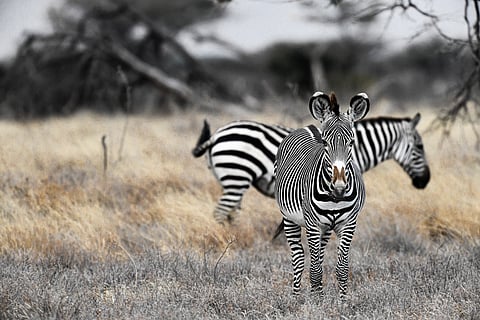
Two patterns, one survival Koushik Chatterjee
On a dusty rise, two zebras form a monochrome study in contrasts: the narrow stripes and robust stature of the endangered Grevy’s beside the familiar plains zebra, whose abundance belies its own delicate place in the ecosystem. Their quiet juxtaposition reveals a truth the savannah whispers often—that survival is not always shared evenly, even among kin.
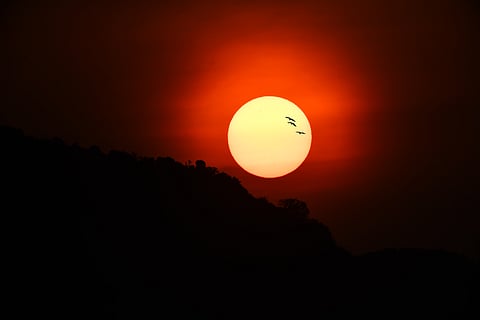
The African sun descends, sealing another chapter of survival Koushik Chatterjee
The light softens further and the diurnal world begins its retreat. The sun drops as though sealing a chapter, flattening horizons and heightening instinct. Dusk in Kenya is not conclusion but transfer of power. Predators stretch into their evening roles while antelope slip into shadowed vigilance. There is a pause—a momentary stillness before the night sharpens every sound and scent.
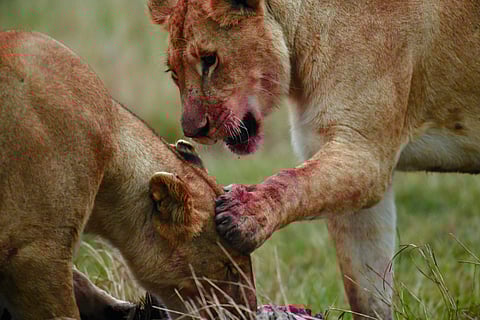
From play to purpose, the pride is forged Koushik Chatterjee
Within a lion pride, innocence rehearses necessity. Cubs tussle in mock combat, paws swatting and bodies tumbling in dusty play that mimics tomorrow’s battles. Later, at a carcass, those movements return with purpose, coordinated feeding, jostling hierarchy, and an urgency that is neither cruel nor dramatic, simply required. The pride endures through strategy, shared labour and instinct learned long before adulthood.
Advertisement
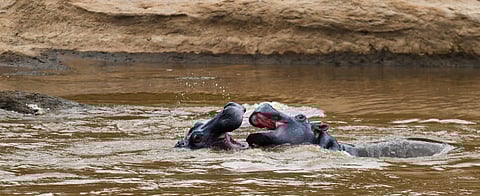
A submerged giant guards its domain Koushik Chatterjee
In muddy shallows, a hippopotamus observes the world through patient eyes just above the waterline. Misread by many as passive, hippos are territorial giants for whom water is both refuge and contested terrain. Their silence is misleading; survival here is negotiated in the unspoken.
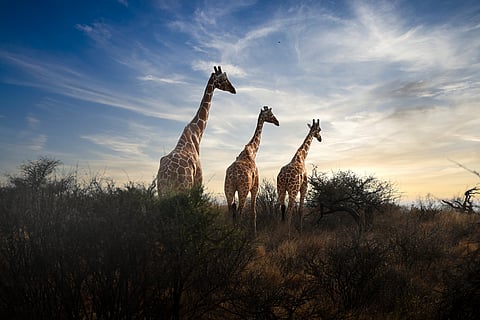
Sentinels of the savannah at first light Koushik Chatterjee
At dawn, giraffes drift across pastel skies like elongated hieroglyphs. Their measured stride and high vantage lend serenity to a landscape defined by sharp teeth and sharper hunger. Browsing acacia leaves, they prune canopies and open space for others to live, proof that not all power requires speed or violence.
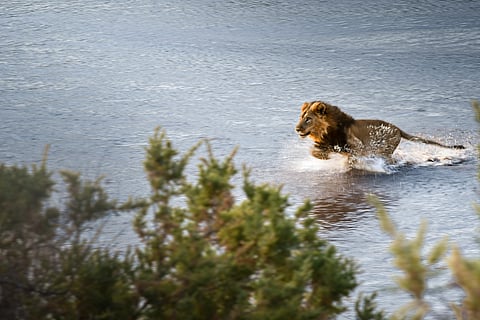
Momentum becomes destiny Koushik Chatterjee
Then, in a sudden eruption of muscle, a lion breaks into full sprint. It is the moment before outcome decides itself, which is a brief gamble between hunger and flight. The chase lasts seconds, yet within it sits hierarchy, nourishment, energy, and risk. Even the so-called king must earn his crown one sprint at a time.
Advertisement
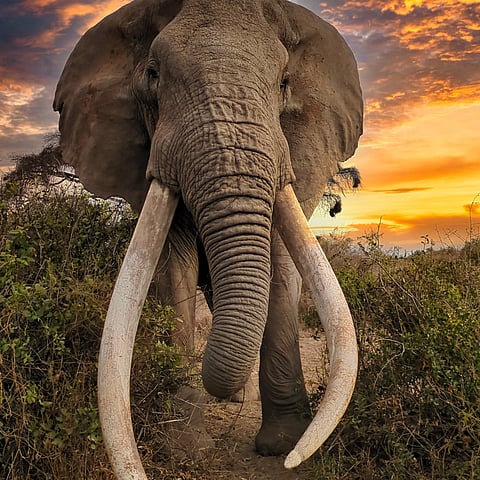
Craig, a living monument of Africa’s ancient giants Koushik Chatterjee
Among these stories of movement and muscle stands a figure out of another age: Craig, one of Kenya’s last great tuskers. His sweeping ivory and deliberate stride seem almost prehistoric, a living echo of a time when giants were not rare enough to name individually. To see him in the wild is to witness a genetic memory still walking, a heritage not yet erased.
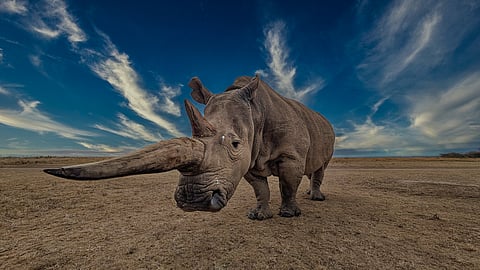
Najin, the fragile custodian of a vanishing bloodline. Koushik Chatterjee
And beyond Craig, at Ol Pejeta Conservancy, stands Najin and Fatu, the final Northern White Rhinos on Earth, graze within a ring of armed protection and scientific hope. Najin carries dignity etched by decades; Fatu, her daughter, represents the final viable thread of a lineage now measured in individuals rather than populations. Extinction here is not an abstraction, and it is visible, breathing, and escorted by human guardians.
Custodians Of Kenya’s Open Skies
Yet Kenya’s wilderness does not only unfold at eye level. It rises. It soars. While hooves and claws script narratives across the dust, the skies above tell their own stories. Bush planes trace invisible corridors between reserves, and from their windows travellers glimpse raptors riding thermals, waterbirds stitching delicate paths across flooded marshes. To look down upon migration routes and then look up to see the true aerial custodians is to understand the Mara not as a flat stage but as a layered theatre.
Advertisement
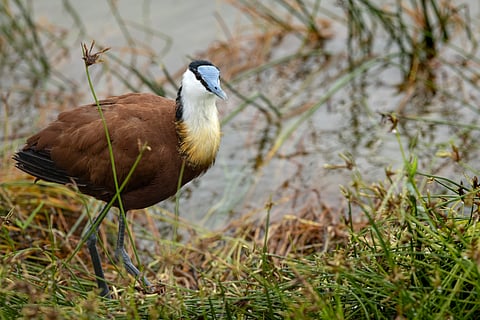
The lily-walker of African wetlands Sanghamitra Mukherjee
In seasonal wetlands, the African Jacana performs feats that make water seem inconsequential. Its elongated toes disperse its weight across floating lilies, allowing it to stride where heavier birds would sink. Adaptation here is expressed in balance, not dominance, a different kind of survival that treads softly.
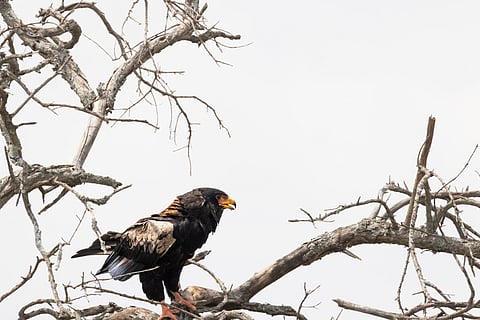
A vigilant sovereign of the savannah skies Sanghamitra Mukherjee
High above acacia skeletons, a Bateleur Eagle rules the thermals with unblinking composure. Its short tail and vivid plumage cut through the sky in arcs both aesthetic and efficient. Part hunter, part scavenger, it watches without hurry, a sovereign whose command lies in patience.
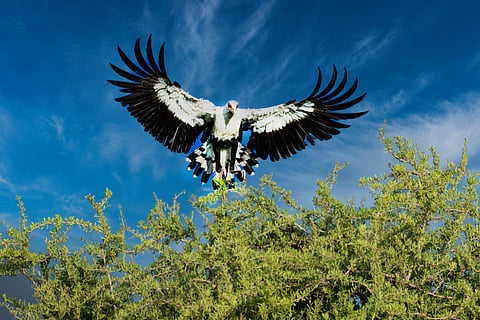
Elegance armed with intent Sanghamitra Mukherjee
And sometimes, as if to remind the world that not all hunting happens in the air, the Secretary Bird takes flight. Usually a terrestrial strategist, dispatching serpents with disciplined strikes, it becomes unexpectedly graceful once airborne, all wingspan and ceremony, a creature balanced between the elegance of flight and the lethality of ground.
From the earth to the sky, from dusk to dawn, the Maasai Mara reads like a manuscript authored by survival, written in hoofprints, wingbeats, scars and light. Some pages hold abundance, others scarcity. Some reveal endings, others beginnings. Yet all of them affirm that Kenya’s wild spaces endure not through coincidence but through an ancient choreography that, despite everything, refuses to fade.
Advertisement
FAQs
1. When is the best time to visit Kenya for wildlife viewing?
July–October for the Great Migration in the Mara; January–March for clear skies and excellent predator sightings.
2. Do domestic flights operate to major wildlife reserves?
Yes. Light aircraft service conservancies like the Maasai Mara, Amboseli and Samburu with short scenic hops from Nairobi.
3. Is it safe to fly on bush planes?
Bush flights are regulated, well-maintained and frequently used by researchers, safari operators and conservation teams.
4. What wildlife species can travellers expect to see?
The Big Five, cheetahs, endangered Grevy’s zebras, rare tuskers, and unique birdlife—including crowned cranes and lilac-breasted rollers.
5. Can aviation support conservation efforts in Kenya?
Very much so. Aerial patrols help monitor wildlife, deter poaching and track movements of endangered species across vast landscapes.
Published At: