An enormous African elephant bull, the largest land animal on earth, stands majestic in our path and trumpets his bugle call. We freeze. I remember all the stories I've read about African elephants - they can weigh up to eight thousand kilos, they can topple a Land Cruiser like a tin can. Our perfectly composed guide whispers, "Don't worry, he thinks you are part of the jeep." He explains later, "If he were really dangerous, his ears would be pinned back and he wouldn't have trumpeted as he just did." Then comes the afterthought, "But he was in a state of musth or raging testosterones, when he could have veered towards being aggressive."
A Trunk Call From Kruger Safari: How To Have A Classic African Safari Experience
The classic African safari - the kind that books and movies are made of, is not for the faint-hearted, a traveller finds out on a maiden trip to Kruger National Park in South Africa

Advertisement
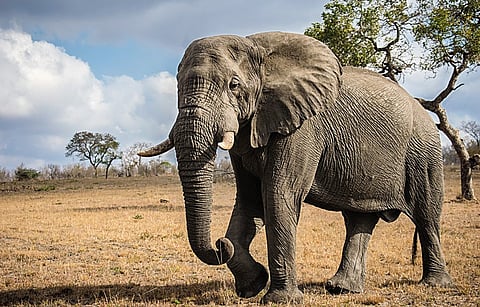
The majestic African elephant Depositphotos
An African safari is not for the faint-hearted. I am at the swish Clifftop Safari Hideaway set inside the private Welgevonden Game Reserve in Limpopo, South Africa, where eight suites overlook a deep ravine of the river Sterkstroom, and resemble more a luxury hotel than a safari camp. All the white buildings are linked by decks with private plunge pools and there are comfortable hanging basket chairs matched with trendy accessories in wood and metal, which give the place a rustic but chic ambience.
The Classic Safari Holiday
I am here to experience the classic African Safari, inspired by a thousand movies and books, spreading my stay over three wildlife lodges belonging to the UB Group-owned Kingfisher Resorts, with different environments and animal life. We are soon whisked away on a game drive, covered in fleece and rugs, with Sebastian Spann, our young, energetic ranger navigating over a vast and stark ochre and sepia terrain. Sebastian is passionate about his job and makes even a routine sighting a marvellous thing. He says that the secret to a safari is obvious if you want to see creatures in the wild, you have to be patient.
Advertisement
We bounce around in our Land Cruiser beyond the worn tracks, bones cold from the wind, delighting in the sightings of legions of impalas (they are the pigeons of the African bush), mountain reedbuck (a sub-Saharan antelope) and the tiny dwarf mongoose (Africa's smallest carnivore). I am overwhelmed by the abundance of wildlife there is no lurking or straining for a glimpse of animals, or designated roads to stick to, which is so Africa Our ranger is ready to plough over trees, drive through dry riverbeds and park on the sides of steep ditches just to get closer to a sighting.
The highlight of the evening safari are sundowners on a makeshift table with snacks like salty biltong (cured meat) and mixed nuts, as I dip my feet in a stream and chat about the delicate ecosystem and life in the bush. I ask Sebastian if he misses city lights, and he replies poetically, "There is a saying that rangers get paid in sunsets." And he points to the African skies turning a vivid orange and pink with syringa trees silhouetted against the grassy plains. We return to the lodge and its creature comforts and are met with hot towels and glasses of Amarula, a South African cream liqueur, followed by a gourmet three-course dinner. Whoever said you have to suffer on a safari.
Advertisement

A Grand marula tree Steven Tan/Flickr
A Crash Course in Tracking
Over the next few days, I learn to read pugmarks and identify dung, like a detective piecing together clues at a crime scene, wrapped up in my olive green poncho, taking refuge from the icy cold winds lashing my face. Most atmospheric is our night safari under a full moon, and skies free from the pollution of lights, perfect for wannabe astronomers. Our ranger drives with one hand, manipulating a special searchlight with the other, focussing on the enormous eyes of nocturnal bush babies (little primates seen only at night), genets (that look like domestic cats) and beady-eyed owls on a gnarled branch. It's easy to get hung up about spotting the Big 5 (buffalo, elephant, leopard, lion and rhino) but Sebastian teaches us to appreciate the smaller treasures of the bush - the familiar cry of a grey lourie (it's also called the go-away bird for the way it sounds) or the grey shadows that translate into an eland (another graceful antelope), the brilliant colouring of a lilac-breasted roller, and the majestic spiralling horns of a male kudu. I am like a kid all over again, excited by the melancholy call of the fish eagle, the sight of red-billed woodpeckers which feast on ticks from the backs of buffaloes and giraffes, and the gargantuan termite hills that dot the barren landscape.
Advertisement
My next stop is the sprawling Mabula Game Lodge in Limpopo province, set in one of South Africa's largest private reserves, sprawling across 12,000 acres with the backdrop of the Waterberg Mountains. The chalets are done up in rustic style and earthy tones, set amid sausage and fever trees, and a reptile centre with snake demonstrations. Mabula is a family-focussed safari camp, which means it offers swimming pools, a tennis court and even a spa, plus a range of activities from quad bikes to special "horseback safaris".
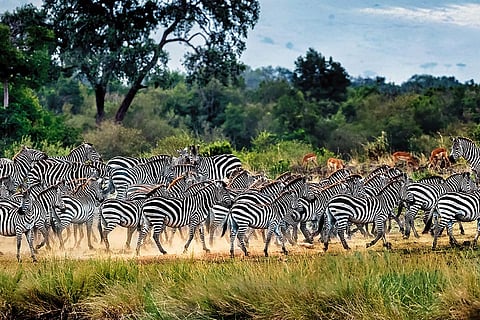
A zeal of zebras Shutterstock
As we set out on our game drives, we see hordes of zebras, wildebeest and warthogs. My favourites are the stocky waterbucks with white stripes on their rumps, which the genial manager of the resort, Henie Nell, calls "painted toilet seats". Henie brims with much bush humour the skittish impalas with the "M" on their backsides are the Big Macs of the Bush. And the zebras Oh, they are just donkeys in pyjamas
Advertisement
Unscripted Adventures
I get used to the rhythm of a day in the bush - wake-up calls at 5am and time for a quick coffee, safari drive at dawn (before it gets too hot) and a chance to see animals at their most active, and another safari drive in the late afternoon with excellent meals in between. Sometimes, there's time to relax in the plunge pools and read a book on my Kindle. We end the day with bush dinners in outdoor bomas or fortified enclosures, ablaze with candles and lanterns, watching a performance by local tribal dancers who persuade us to shake a leg with them around a bonfire.
Every game drive is an unscripted adventure as well as a lesson in flora and fauna - the ranger points out bright green fever trees with chlorophyll on their barks and sausage trees with gigantic fruits sometimes weighing over five kilos. I see the intoxicating marula - its fruits, used in making the Amarula liqueur we sampled earlier, are said to "drive the elephants mad". "Do you remember the old classic movie Beautiful People" our ranger asks with a smile. "The baboons and elephants in that movie got drunk eating overripe marula fruits."
Advertisement
I watch gangly giraffes nibble at thorny acacias and learn that the giraffe has a heart as big as a football because blood needs to be pumped a great distance to its head, and that it has special valves so that it can bend its neck and drink or eat without causing brain damage.
My last bush experience is at the ethnic Hoyo Hoyo Bush lodge, a private concession set within the Kruger National Park, South Africa's oldest and largest national park, and built on the tracks of an old elephant route of the Mluwati River. Established in 1898, Kruger sprawls over two million hectares with more than 150 mammal species and 119 reptiles, besides many forms of bird life. Modelled on a traditional Tsonga homestead, our lodge has circular rooms decorated with tribal motifs and a thatched reed roof as well as objets d'art sourced directly from the tribes. The property is unfenced, so our guide, who is appropriately named "Sweet Boy", escorts us with heavy torches to our rooms, which are equipped with walkie-talkies instead of phones. I go to sleep getting used to the grunts of unidentified beasts, the howl of hyenas, the humming of insects, the calls of owls, and a certain mysterious rustle outside my windows.
Advertisement

Luxurious chalets and outdoor tables at Imbali Imbali Lodge
The next day we have lunch at another sister property, the swish Imbali Lodge with its luxurious chalets and outdoor tables for dining. Suddenly, there is a commotion and we see a matriarch elephant and then two, and then three - there's a whole family just across the narrow stream that separates us from them. It's a true African moment as we watch the herd drink water at the watering hole, posing like movie stars.
The true stars of our time at Hoyo Hoyo, however, are the passionate rangers who are always in radio communication with other rangers quite often, we head off somewhere, when a lion has been sighted or a leopard spotted on a tree. I see stocky white rhinos with their young ones, almost hunted to the brink of extinction in the last century for their horns (which were sold in China as a kind of Viagra and made their way into Yemeni ceremonial daggers), portly warthogs (which I prefer to remember as pigs with horns), and jet-black ostriches. Most exciting are the near-conflicts and predatory turf wars that we witness - like a wily jackal stalking a guinea fowl.
Advertisement
My true African safari moment occurs on the last day when our ranger's radio crackles to life and he is informed that a lioness is feasting on a just-killed impala. Making our way to the spot, we watch from several feet away a pride of the resplendent Kalahari lioness and her cubs with blood-stained jaws, feasting on the carcass of an impala. Grunts and growls are the only sounds that we hear in the complete silence. "The males have to be nearby," says our ranger. And true enough, we find them a little later, helped by the excited cries of a troop of baboons - two magnificent lions with their tawny manes above the grass, bellowing in a larger-than-life version of their MGM counterparts. They are consummate performers and seem to be saying, "Go on and look to your heart's content...after all it's your last day here".
The Information
How to Reach
Advertisement
South African Airways, Qatar Airways, Emirates, Etihad, Air India and a host of other airlines fly from Delhi and other Indian metros to Johannesburg from Rs 54,000. The drive to Kruger National Park can take 3-4 hours from Jo'burg but the Mabula Game Lodge is only a 2.5hr drive (212km) from it.
Visa
Indian tourists are charged no visa fees but have to pay a service charge of Rs 1,350 per person in cash to VFS. Apply at VFS South Africa Visa Application Centre in Delhi or Mumbai outstation applicants may send the required documents through someone else processing takes about five working days. More details on their website
When To Go
South Africa is good at any time of the year, but June to November is perhaps the most ideal time to visit as temperatures are very tolerable, even pleasant, and light rains keep the country cool.

Hoyo Hoyo Safari Lodge in Kruger Hoyo Hoyo
Where To Stay
Advertisement
Stay at the UB Group's Hoyo Hoyo luxury game lodges or The Mabula Game Lodge in Limpopo Province is good for families (from R 4527 doubles Website) whereas the Clifftop Exclusive Safari Hideaway in the Welgevonden Private Game Reserve is perfect for couples (from R 7983 Website). Inside the Kruger National Park, Hoyo Hoyo Safari Lodge is simple and rustic (from R 8,367 Website). The more plush options here are the Imbali Safari Lodge (from R 10,532, Website) and the Hamilton's Tented Camp (from R14,448 Website), both of which are also inside Kruger. The Kwafubesi Tented Safari Camp (from R4868 Website) in the Mvubu plain is also a game lodge from Kingfisher Resorts, apart from the Cape Milner Hotel in Cape Town and the Mabula Time Share Units. All rates are per night on twin sharing, inclusive of food and game drives.
Do it on a budget
SanParks.org, the official website of the South Africa National Parks authority, is an exhaustive resource click on the "Tariffs" link and download complete tariff lists, park-wise. Kruger Park, is another good resource that shows off the state-run properties within Kruger as well as lesser-known camps outside. Descriptions, tariffs, amenities, pictures, reviews, availability and reservations are within easy reach across budgets. Check out Balule (from R210, includes room for two) to Talamati (from R1,440, includes four) to the tented Safari Camp (from R650 per person per night on full board) in the hugely famous and equally expensive Sabi Sands Game Reserve next door. For a really budget Kruger experience, pitch a tent. SA Venues is a similar resource for Limpopo.
What to See & Do
Game drives, tribal dances around a bonfire, star-gazing. Try some safaris with a twist like a horse safari at Mabula. Good binoculars are de rigueur carry a light jacket and scarf as it can get cold on game drives. You can't count on wi-fi in the bush, so pack a book. Don't smoke, the African bush ignites easily. Never walk alone, observe animals quietly, and dress in neutral shades.
What to Eat
Game lodges are a haven for meat lovers. South Africans love their braai or barbecue, full of grilled meats. Try game meat like impala, kudu and eland and desserts like the malva pudding, a hot Cape Dutch speciality served with cold custard or ice cream, and koeksisters (sugar-coated, braided doughnuts). Try the herbal rooibos tea. Sample local staples like potjie (pronounced "poiky"), which is a thick stew, as well as a fluffy maize porridge called pap.
Published At: