I first noticed her in Miami airport, while I was waiting to take yet another, thankfully final, flight on my long journey to Lima. She wore a beige long-coat, sturdy tan shoes, large expensive bags and a general air of distinction. She was also clearly very old, walking with the help of her cane. I stared in fascination as she wended her way with a slightly worrying confidence through the impatient crowd. I wondered what she was going to do in Lima, hoped that family would pick her up from the airport, that grown grandchildren would relieve her of those large bags.
OT Itinerary: Trailing Through Peru In 10 Days
Travelling with strangers along the Peruvian coast. Everyone's favourite Peruvian city is a civilised warren of quaint narrow streets lined with picturesquely shabby colonial houses

Advertisement
Six hours later, I had the answer while waiting as instructed for the Globus tour company representative at Lima airport. "Oh-h-h, hello-o-o. I am really so-o-o tired," Mary Raitt trilled in refined accents as we trailed behind the welcoming gentleman. In this first encounter between the oldest and youngest members of the ten-day Globus 'Legacy of Incas' tour of Peru, I was too ashamed to say the same of myself too. But I was (so-o-o) tired there had been the fifteen-hour non-stop flight from Delhi to Chicago, the two-hour wait in Chicago, the two-hour flight from Chicago to Miami, the five-hour wait in Miami, the six-hour flight from Miami to Lima.
The Joys Of Travel

Machu Picchu in Cusco, Peru was declared a UNESCO World Heritage Site in 1983 SLPhotography/Shutterstock
I really shouldn't have even dreamt of complaining. This was after all a dream trip, the Trip of a Lifetime. A hardly original desire - who doesn't want to go to Peru, to have seen Machu Picchu? And which Western tourist hasn't already done so? Peru is to Westerners what Southeast Asia is to us. A great one for drawing deep inferences from coincidences, I'd vaguely thought of this trip as a sequel to my last "big trip", when I discovered fortuitously that I had been tracing Pierre Loti's 19th-century journey exactly to Angkor Wat, and been rewarded with a sense of kinship with that remote Frenchman. Hiram Bingham was a very different character, both more well-known, more crucially responsible for the world's deification of Machu Picchu, as well as more controversial. He was American, of course, and my romantic affection for the US was a sign of things to come, I thought.
Advertisement
All places are refractions. Landscapes are dazzling, built monuments can be awe-inspiring, but few of these does one see "with one's own eyes". People get in the way - all too literally, swarming all over such magnificent sites as Angkor Wat and Machu Picchu. People one travels with are a pain - photographers one doesn't see eye to eye with, travel journalists who couldn't care less that Pablo Neruda spelt Machu Picchu - Macchu Picchu. People are best left to themselves, and if you truly dislike them, perhaps to each other.
That's what I thought. It's appropriate then, for a dream trip, that the fantastic should happen. That I should still be wondering why twinkly-eyed "Mad Dr Ken" didn't reply to my email, worrying if his can't-stop-those-puns-coming wife, Maryann, was all right after this demanding trip on "borrowed time". Whether Dorothy Delmistro's shoulder had healed adequately for her to plan her next trip to India with Ricardo. If the interior decorator in San Antonio, Texas, had renovated Linda and Yair's kitchen to their satisfaction. How Barbara was doing in Calgary. How much Mary Raitt had dissed this trip back home in Washington DC, with former colleagues at the Library of Congress. And if Mauricio the Marvellous had already consigned us all to the recycle bin of his laptop's memory as he directs yet another tour around Peru, politely solves problems and unflappably caters to the demands of yet another bunch of naïve escorted tourists.
Advertisement
Mauricio Yonfa, our tour director, has been on the job for fourteen years. He is Ecuadorian, not Peruvian but it matters not a whit to any of us - thirty Americans, five Canadians and one Indian. We are all ignorant of this country that we have travelled so far to visit. And anyway he has an answer for every question, a Plan B for every A that might potentially end in disaster.
Glimpses of a Modern Time

Miraflores skyline in Lima Flickr
Disaster is no longer an eventuality in Peru. The country saw a spectacularly turbulent few decades in the last century, marked by exhibitionistic extremism (Sendero Luminoso, or Shining Path, guerrillas famously introduced themselves to the nation by hanging dead dogs from lamp posts, setting off a cycle of violence that claimed a total of nearly 80,000 lives), theatrically corrupt politics (former President Alberto Fujimori allegedly even contrived to rewrite the Constitution to stay in power) and a frighteningly unsound economy (inflation hovered over 50 per cent through those bad years). Shining Path leader Abimael Guzman has been behind bars for nearly twenty years Fujimori is serving a twenty-five year term. Peru's nuevo sol is considered the soundest of all currencies in Latin America. This year's general elections (2011) have installed a seemingly stable leader in place. And it all feels a lot like India.
Advertisement
From the gleamingly modern airport, thronged by crowds of thrusting cab-drivers and hopeful tour guides, to the streets of genteel neighbourhoods such as Miraflores abutted by main roads choked with fancy cars, in turn bordered by pedestrian paths that are home to the homeless, to a down-at-heel downtown studded with historic colonial gems - Lima feels familiar, an intensely knowable city for someone from New Delhi.

Downtown Lima Wikimedia Commons
Notes from my diary
No sun, no cold. In coach to Plaza des Armas. At stunning library in Monastery of San Francisco. Sunlight on broken old, old books. Heart beats fast. Guard at gate says Namaste How did he know Lima like antipodal point, not end of world.
I am not to get to know Lima better a day and two nights later, our group is on the large comfortable motor-coach heading down the famous Pan-American Highway along the Peruvian coast through the desert to the town of Paracas. It's just past six in the morning, but I am wide awake trying to comprehend a new geography, one they never really tell you about in our high schools (or maybe they did but I wasn't wide awake). Lima is an old city, sprawled lengthwise beside the Pacific Ocean, in the middle of a desert. This is a desert characterised by very little sun and a lot of fog, a meteorological curiosity caused when the Humboldt Current travelling up the Pacific from Antarctica tangles with the warm equatorial winds. "Lima gets sixteen days of sunshine a year," one cabbie had told me. I thought he was being cute for the entertainment of tourists, but his statement was simply lending precision to the well-worn literary theme of Lima being a gloomy city. "The strangest, saddest city" (Melville), "Lima, the Horrible" (César Moro), "Plundered and bankrupt"(Paul Theroux) ,"Atrocious Lima" (Mathew Parris). But I, like Michael Jacobs writes in his recent Andes, had "loved Lima from the beginning".
Advertisement

Highway Pan American (1S) in Sechura Desert A Duarte/Flickr
Strange geography dogs us in Paracas too. A few hours outside Lima, Paracas has exactly two tourist attractions, both famous but neither actually in town - the Ballestas Islands ("Peru's Galapagos Islands"), to which boats depart for a roundtrip couple of hours, and the Nazca Lines, giant patterns etched in the desert, to view which small planes depart for another roundtrip hour or so. The latter is the more famous, some members of my group declaring that this was really what they had come to Peru to see. I barely saw the Lines at all, even though - or more likely because - the little eight-seater plane banked and circled this way and that, and up and down and close, so that everyone got a view. When I could bear to look out of the window with one eye open, I decided Google Images would have done just as well. The highlight of the flight for me was the topography seemingly endless flat stretches of sand, broken by swirls of russet peaks, bordered on one horizon by high hills and a deep blue coast on another.
Advertisement
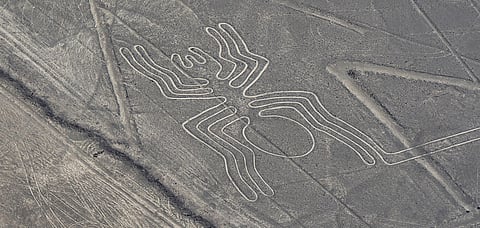
A spider figure etched in the sands of Peru, an example of the Nazca Lines Depositphotos
The cruise to the Ballestas Islands was unmixed delight. In blinding sunshine, the wind whipping through our hair, we bobbed speedily to the tiny group of islands off the coast near Paracas to take a close look at such unique creatures as the Humboldt penguin, the Inca tern and a vast joint family of sea lions that flopped about fatly on the rocks. The day ended at the wonderful DoubleTree Paracas resort, set unostentatiously by the bay in the middle of nowhere.

Ballestas Island in Peru Wikimedia Commons
Never A Dull Moment
And so it went. From coastal city to desert to animal islands to the great mountains and their great monuments to the highest navigable lake in the world, these will prove to be a richly active ten days. By the end, our group will have taken three internal flights, been on two boat rides, done two rail journeys and spent several hours on assorted buses. It's all very tiring - I am asleep by 9.30 most nights - and I wonder about my fellow travellers. It's impolite to ask of course but I estimate the average age of this group to be about sixty-five when I'm scrounging for souvenirs for my children, aged seven and two, they are doing the same for grandchildren of the same age group.
Advertisement

Cusco at dawn Matito/Flickr
On our fourth day in Peru, we suddenly find ourselves transported to yet another New World. Landing in Cusco feels like an event. Visitors whip out their cameras as soon as they step off the plane to capture photographic souvenirs of this picturesque little airport surrounded by mountains. We are now in the Andes, also the heartland of tourism in Peru. But we must first leave Cusco before we can enter it, and clamber into two minibuses to head for the heart of the Sacred Valley.
Meticulous Logistics
Everything is perfectly orchestrated waiting bus and driver, guides armed with water and information, sightseeing stops as scheduled, lunch stops just when you need them. The logistics are formidable. Which brings me back to Mauricio. Every morning after breakfast, he would greet us cheerily and hand each of us a printed sheet with the programme for the day. If that doesn't sound particularly impressive, just something he should be doing anyway, perhaps I should share a typical sheet!
Advertisement
Saturday, October 29
6.00am Wake up call
6:30 am Breakfast
Bags out (suitcases and other bags, you don't need in Machu Picchu, make sure they have a GLOBUS tag with your name, you will see them again on Sunday night in Cusco)
7:30am Check out and depart to OLLANTAITAMBO (please bring the overnight bags to the bus). Visit of an Indian house, and the ruins of OLLANTAITAMBO. Then to Train Station. Please take all your overnight bags and other belongings to the train. "Don't leave them on the bus."
10:30 am Arrival at AGUAS CALIENTES. On the platform I will be collecting the overnight bags to send them directly to the Hotel Sumaq. Lunch (Included) at TOTO'S HOUSE Restaurant. Then take a bus for 20 min ride to MACHU PICCHU ruins. Visit of the Citadel, and return by bus to Aguas Calientes
7:00 pm Dinner (Included) and overnight at HOTEL SUMAQ
Advertisement
It is possible to think of everything.

Peru Rail Depositphotos
A day later and we have taken a gorgeous train ride up to Aguas Calientes, a town whose main reason for existence is to act as gateway to Machu Picchu. The Inca stronghold is as fiercely protected in some ways as it must have been five centuries ago. Thus, there are only two ways to get to Machu Picchu on a difficult, four-day hike up to the site, known as the 'Inca Trail' or by getting to Aguas Calientes and then catching one of the buses that depart at regular intervals to wind their way up on a brief journey through stunning mountain forest and deposit you at the gates to Machu Picchu. We, naturally, are taking the bus.

The ancient site of Machu Picchu Shutterstock
It is proper to be rendered speechless at moments like this - entering the gates to this "larger world, a landscape built by titans in a fit of sheer megalomania", as Isherwood wrote in The Condor and the Cows. I am quiet because the sight of Machu Picchu ("old mountain") and its Other, Huayna Picchu ('young mountain'), the clouds hanging over both, the stone terraces that we have all seen in countless representations, the grazing llamas have rendered everyone else ecstatic.
Advertisement
But this is the image that moves me - elderly, dignified Marlene Szary unemotionally remarking on finally arriving at the place her ailing husband has longed to see all his life but can't. I insist on carrying her bag so she can better support herself up and down the sometimes steep stones. Great places can feel like pilgrimages but the ostentatious piety of genuflectors can be sickening. In the presence of such over-described beauty, I am moved perversely by an absence - old, energetic Ricardo, who had been waiting so impatiently to get to Machu Picchu, had stayed on with old, frail Dorothy in Cusco after she had fallen and fractured her shoulder earlier that day.
Notes from my diary
"Extreme homesickness. Machu Picchu again. I should be staggered. Back on train, can see tops of mountains through ceiling windows. Endless (2hr) bus journey to Cusco. Rolling green fields, grasslands, stunning low mountains like nothing I've seen, great road along 'altiplano', potato farming, yet another landscape."
After the heights of Machu Picchu, Cusco seems like a doll's town. Everyone's favourite Peruvian city is a civilised warren of quaint narrow streets lined with picturesquely shabby colonial houses, the main square a hub for locals and visitors alike, the town centre framed by mountains in the background making for an adequately pleasing picture postcard. I long for Lima.
Our one evening in Cusco is "free", and dinner is not "included". Dining recommendations are discussed - those determined to extract every last flavour of Peru want to eat the Cusco speciality, roasted cuy (guinea pig). My idea of eating local is a Bembo's burger. This Peruvian fast food chain now has a global presence but, between you and me, Burger King still rules (and of course I made sure I ate a Whopper in Lima). On the other hand, I could probably have lasted all ten days eating just ceviche. This famous Peruvian coastal staple is simplicity itself - chunks of fish or seafood, or both, marinated in lemon juice and served with fine rings of onion and prettified with chopped red chilli. I managed to eat ceviche only twice in my ten days.
The final highlights of this trip are in the Lake Titicaca region. The storied lake is shared by Peru and Bolivia ("depending on whether you're Peruvian or Bolivian, two-thirds of the lake is in Peru or Bolivia," joked our guide (a personable and popular young man whom we all agreed is likely to win the Peruvian presidency when he grows up). The main attractions of the Peruvian side of the lake - apart from the lake itself, of course - are the residents of Uros and Taquile islands. The former continue to live as they have for centuries, on little islands they have created entirely out of reed, when they were forced onto the lake by the marauding Incas (yes, the conquered were once conquerors too).

Lake Titicaca Flickr
Journeying Back To Reality
We take a boat from the unexceptional town of Puno to Uros. Stepping on to the island feels like walking on a wet old mattress, spongy and weird. A few of us take a toss and there's much hilarity. Mary Raitt has stayed behind at the hotel despite her protests ("He more or less ordered me to" she said of Mauricio later. But then Mauricio always knows best.) I experience a creeping dismay when we are all led into little huts and "dressed up"in Uros attire. I should have been horrified at this brazen tourist entertainment, but yet again I am charmed into silence by the genuine pleasure everyone, not least the islanders, derive from this "treat".
Suddenly, it's over. "Bye-bye [We'll probably never meet again but] it's been lovely knowing you".
Five weeks later and this story nearly written, Ken writes back "What a pleasure to hear from you...Our world will be a little different here since Maryann will need to resume her treatment for...."
The Information
Getting There
Whichever way you choose to fly from India, Peru is on the other side of the world - brace yourself for long flights. There are of course no direct flights from Indian cities to Lima. The most painless (one-stop) route is to fly via Europe. KLM connects to Lima via Amsterdam and Air France via Paris. You can also fly via the USA or London, but this will be a two-stop journey.
Visas
Visas can be obtained from the Embassy of Peru in New Delhi through VFS. Remember that you'll also need either a Schengen or a US visa for air- transit reasons.
Itinerary
I travelled on Globus's 'Legacy of the Incas' 10-day tour of Peru, which began and ended in Lima. But I travelled some time back and since then, Globus has modified this tour to make it a 9-day tour of Peru Escape with Nazca Lines, excluding Titicaca from this particular itinerary. They have tours starting from 4 days to 17 days now and that is amazing, because its offering more days to explore more in both Lima and Cusco, cities that I felt I could have seen more of. It will also relax the pace of the tour.
Day 1 Lima: We went on a walking tour with a local guide. Highlights included the colonial centre, the Plaza de Armas with the Government Palace, Cathedral and the San Francisco Monastery. The evening ended with a "welcome dinner" at a restaurant that serves Peruvian classics (we ate lomo saltado, a stir-fry dish that usually features beef and onions, but was modified to chicken).
Day 2 Lima - Paracas: A superb early morning drive along the Pan-American Highway. Paracas is where you get on to a little plane to fly over the Nazca Lines.
Day 3 Paracas-Lima. According to the itinerary, the morning is given over to a visit to the Ballestas Islands, followed by a return to Lima. Since Peru is like India in some ways, the tour director might have to take a spot decision to modify the itinerary our tour combined both the Nazca Lines flight and the Ballestas Islands visit in one day, which gave us more time in Lima on this third day. Another change of plan was that our lunch at the popular highway restaurant, El Piloto, had to be postponed to the third day because of roadblocks by agitating farmers.
Day 4 Lima-Cusco. This morning, we flew to Cusco. We didn't actually enter Cusco but drove off into the "Sacred Valley of the Incas", to reach the Temple of Sacsayhuaman, notable for having been built with gigantic stones, some weighing more than 350 tonnes. We continued to Pisac, the first of several picturesque Andean villages we visited, with Indian markets that sell handicrafts, both fake and genuine. Again, we should have visited another Inca fortress at Ollantaitambo and then a village home, where it's fascinating to see how frozen-in-time Inca-style living has adapted to the opportunities that mass tourism affords.
Day 5 We did so on this day. We then boarded the legendary Inca Rail for a lovely journey through the Urubamba Valley. We stopped for lunch at Aguas Calientes and transferred to a minibus for the short (20min), stunningly beautiful ascent to Machu Picchu.
Day 6 We visited Machu Picchu for the second time this morning (some people opted out to rest). After lunch, we made the return journey by train and bus to reach Cusco in the evening.
Day 7 Cusco-Juliaca-Puno: We had just the morning in Cusco, which included a guided visit to the Cathedral and the Santo Domingo Monastery. Then came the option to visit an alpaca factory or to wander the town on our own. That afternoon, we flew to Juliaca, and then took a bus to Puno on the shores of Lake Titicaca.
Day 8 Lake Titicaca: The day was spent visiting the Uros reed islands and Taquile island, further out on the lake, where we had a fabulous meal of grilled trout and salad made by the islanders.
Day 9 Puno-Lima: The final attraction of the tour was a stop at the pre-Incan burial ground of Sillustani, en route to Juliaca to take our flight back to Lima. Depending on the timing of our international flights, members of the tour group either stayed on in Lima airport or entered Lima once again for one last night.
Where To Stay
We stayed at excellent hotels. Many of these were part of the Casa Andina group, which has a varied bouquet of hotels ranging from smart city hotel in Lima (in Miraflores), to a lovingly restored colonial mansion (Cusco), to a fabulously located one in the Sacred Valley. In Aguas Calientes, the Hotel Sumaq is another new, delectable hotel with balconies that face an Andean cliff-face and a gushing stream. The DoubleTree Paracas is a splendid resort set by the tranquil Bay of Paracas, and offers accommodation in suites you'd be happy to live in forever. The Puno Libertador has dated décor, but its location beside Lake Titicaca is unmatchable and the food outstanding.
What To Eat
A characteristic of most Globus escorted tours is that while they take care of all logistics, there is usually enough free time and meals that are not "included", by way of encouraging travellers to taste local foods. On a packed trip like this, though, most meals were in fact "included". The good part is that it's all laid out, literally - generous, excellent, buffet spreads or pre-plated meals awaited us wherever we arrived exhausted. Travellers with a genuine interest in food might be disappointed, though, since opportunities to sample street foods or truly high-end meals are few. Peruvian food is now among the hippest foods internationally (Frommer's anointed Lima the gastronomic capital of the world for 2012).
How To Book
For more information and to make bookings, see globusjourneys.in. Or call Globus toll-free at 1800-425-3575.
Published At: