Across India, several historic sites—many recognised by UNESCO—change noticeably once the sun goes down. Lighting schemes, natural dusk tones and occasional sound-and-light programmes alter how these places are seen and felt, though the results are not always consistent. In some cases, the lighting brings out texture, scale and detail in a way that feels considered and respectful of the architecture; in others, it can feel excessive or poorly judged, overpowering the very structures it is meant to enhance.
World Heritage Day: How Light And Atmosphere Redefine India’s Heritage After Sunset
Across India, heritage sites take on a different mood after sunset, as lighting and night views change how their architecture is seen, sometimes revealing detail and depth, and at other times overwhelming the original character of the monument

Advertisement
Monuments that are busy and familiar in the daytime tend to feel steadier and less hurried in the evening, with carved surfaces and long walls becoming more defined under focused light. The Taj Mahal, the ruins of Hampi and the sandstone structures of Jaisalmer Fort all show a different side at night, when the heat eases, the crowds thin and the details of their architecture stand out more clearly against the dark.
Chhatrapati Shivaji Maharaj Terminus, Mumbai
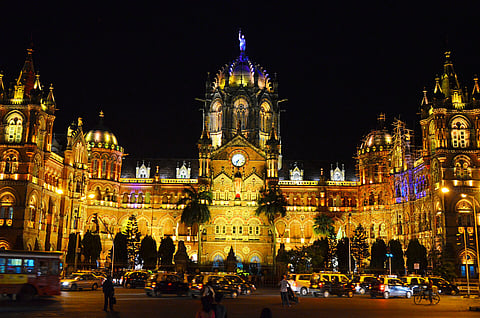
Chatrapati Shivaji Terminus lit up at night Mintu500px/Wiki Commons
Chhatrapati Shivaji Maharaj Terminus (CSMT) in Mumbai remains one of the city’s most striking heritage landmarks after sunset. This UNESCO World Heritage Site, still commonly called CST or Victoria Terminus, is best known for its Victorian Gothic Revival architecture, which gains depth and definition under night lighting. Earlier illumination was relatively subtle, allowing the carved stonework, arches and domes to read clearly without distraction, and the building carried a certain dignity in that form. More recent changes, with shifting multi-coloured lights, feel less restrained and tend to overpower the structure rather than complement it. The use of tricolour lighting on national occasions such as Republic Day and Independence Day is also visually heavy, and on this façade it often appears garish rather than fitting, weakening the architectural elegance the building naturally holds.
Advertisement
Jaisalmer Fort, Rajasthan
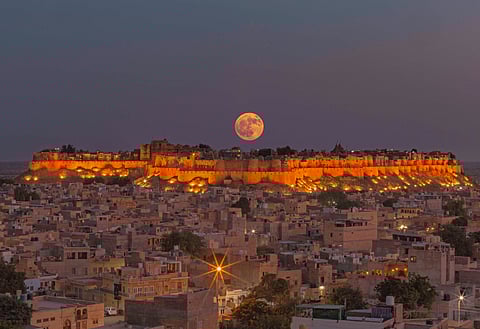
Jaisalmer Fort against the night sky Shutterstock
Jaisalmer Fort in Rajasthan looks very different once the sun goes down. Made from yellow sandstone, the walls pick up the evening lights and give the whole structure a warm, golden tone against the dark desert sky. From parts of the city, it can look almost like a lit-up hill, with the fort rising clearly above the old town. The effect is strongest from a distance, where the outline of the fort is easy to see and the colour of the stone feels deeper under the lights. Even though it is a major tourist spot, it is not just a monument; people still live inside the fort, so it has a constant sense of activity. At night, visitors often gather at viewpoints outside the fort to take in the glowing structure and the wide desert backdrop around.
Qutub Minar, Delhi
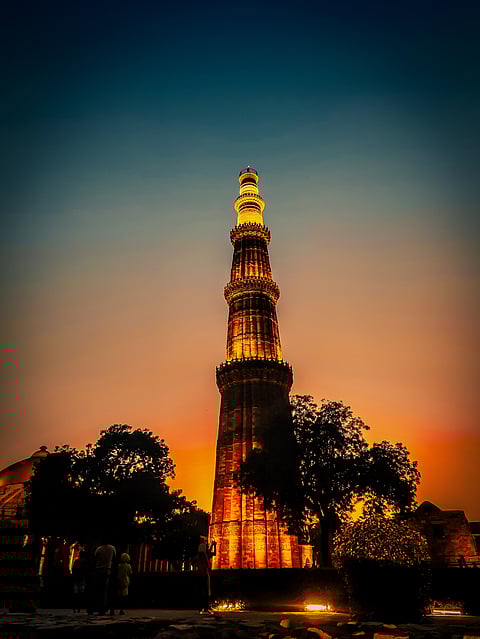
Qutub Minar lit up at night Shutterstock
Qutub Minar in Delhi takes on a quieter, more atmospheric presence after sunset. This 12th-century UNESCO World Heritage Site in Mehrauli is often experienced through an evening light and sound programme that brings the 73-metre minaret and its surrounding complex into focus once daylight fades. When the lights come on, the minaret’s stone bands and carved patterns stand out more clearly, especially in the upper sections that are harder to notice in daylight. The illumination is handled with a wide spread of fixtures placed around the complex, enough to keep the structure visible without flooding it in brightness. The evening programme generally runs for about half an hour to forty minutes between 7 PM and 9 PM, and tends to attract visitors who prefer a quieter time inside the site. As the day crowd thins out, the complex feels more open, and the tower against the night sky has a still, almost unhurried quality when viewed from different corners of the garden.
Advertisement
Metropolitan Building, Esplanade, Kolkata

Calcutta Illumination Project plans to illuminate approximately 500 structures in Kolkata Mudar Patherya
The Metropolitan Building at Esplanade dates back to 1905 and still carries the look of its early commercial past, when it formed part of the Whiteway Laidlaw department store. In recent years, it has been included in the Calcutta Illumination Project, where LED lights have been added to bring out the building’s exterior details after dark. The lighting is kept fairly restrained so the façade remains readable rather than washed out. The effort is led by Mudar Patherya and The Kolkata Restorers, and it sits within a wider push that has brought illumination to over 94 heritage structures across the city since 2023, including the GPO and Writers’ Building. The lights usually stay on from dusk until around 11 PM, changing how the building sits within the evening streetscape of Esplanade.
Mysore Palace, Karnataka
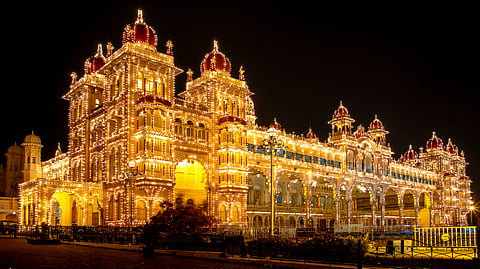
The Mysore Palace during Mysuru Dasara Shutterstock
Mysore Palace in Karnataka is one of the most recognisable night-time sights in India, especially when it is fully lit up. This Indo-Saracenic structure, completed in 1912 and designed by Henry Irwin, becomes the centrepiece of the city once evening falls. On Sundays, public holidays and during the ten-day Dasara festival, around 97,000 bulbs are switched on, tracing the outlines of the palace, its arches, domes and the tall golden tower that rises above the complex. The lighting usually stays on between 7 PM and 8 PM, drawing large crowds who gather outside the gates to watch the building glow against the night sky.
Advertisement
During selected evenings, a sound and light show is also held, narrating the history of the Wadiyar dynasty over the course of about 45 minutes. The palace, still the official residence of the royal family, feels very different at night—less like a monument and more like a stage where the entire structure itself becomes the focus.
FAQs
Do night illuminations change the way heritage sites are experienced?
Yes, lighting often shifts focus to details and creates a different mood compared to daytime visits.
Which Indian heritage sites are best known for night views?
Mysore Palace, Qutub Minar, Jaisalmer Fort and CSMT are among the most well-known.
Are evening visits usually crowded?
It depends on the site—some become quieter after sunset, while popular spots still draw steady crowds.
Do all monuments use permanent lighting?
No, some are permanently lit, while others are illuminated only on specific days or events.
Is there an entry fee for night viewing?
Many sites have standard entry tickets, and some light and sound shows require separate tickets.
Advertisement
Why do some lighting setups look better than others?
It usually comes down to design choices—some highlight structure and texture, while others prioritise colour effects.
Published At: