Holi, at its heart, is a festival of colour—but in Mathura and Vrindavan, it becomes something far deeper, older, and wildly immersive. This is Braj Bhoomi, the land of Krishna’s childhood, where Holi isn’t a day on the calendar but a slow-burning celebration that unfolds over nearly ten days. Here, colours are layered with mythology, devotion, music, flowers, mischief, and centuries-old ritual.
Where Holi Lasts 10 Days: The Ultimate Guide To Celebrating In Braj
Dates, rituals and travel tips for experiencing Lathmar, Phoolon Wali and Rangwali Holi in Braj in 2026

Advertisement
In the narrow lanes of Vrindavan, petals rain down instead of gulal. In Barsana and Nandgaon, women chase men with sticks in a theatrical retelling of Radha and Krishna’s legendary banter. In Mathura, processions roll past temples as drums thunder and the air smells faintly of rose water, incense, and thandai.
It’s joyous, overwhelming, occasionally chaotic—and utterly unforgettable. Whether you’re here for the gentler poetry of Phoolon Wali Holi, the theatrical energy of Lathmar Holi, or the full-colour crescendo of Rangwali Holi, this guide breaks down exactly when to go, where to be, and how to experience it right.
Key Holi Dates in Mathura & Vrindavan (2026)
Lathmar Holi: Barsana & Nandgaon

From Barsana’s Lathmar to Vrindavan’s Phoolon Wali, every day follows a ritual sequence Unsplash
If Holi in Braj had a dramatic prologue, it would unfold in the twin towns of Barsana and Nandgaon. Rooted in the playful legends of Radha and Krishna, Lathmar Holi isn’t merely spectacle, it’s theatre, ritual, and folklore colliding in a swirl of colour and sound.
Advertisement
24 February 2026 – Laddu Holi, Barsana
The celebrations begin gently—or as gently as Holi in Braj allows—at the Radha Rani Temple in Barsana. During Laddu Holi, priests and temple sevayats shower devotees with laddus from the temple balcony. What sounds whimsical is actually symbolic: an invitation from Radha’s village to Krishna’s Nandgaon, marking the ceremonial start of the festivities.
The mood is festive but not frenzied. Devotees gather in the courtyard by afternoon (typically between 3 pm and 5 pm), chanting bhajans as trays of sweets are offered and then tossed into eager crowds. It’s chaotic in a joyous way—laddus flying overhead, hands reaching upward, laughter breaking out when someone narrowly misses being hit by a syrupy projectile.
Arrive early to secure space within the temple complex. Barsana’s narrow approach roads get congested quickly, and vehicles are often parked far from the temple hill.
25 February 2026 – Barsana Lathmar Holi
Advertisement
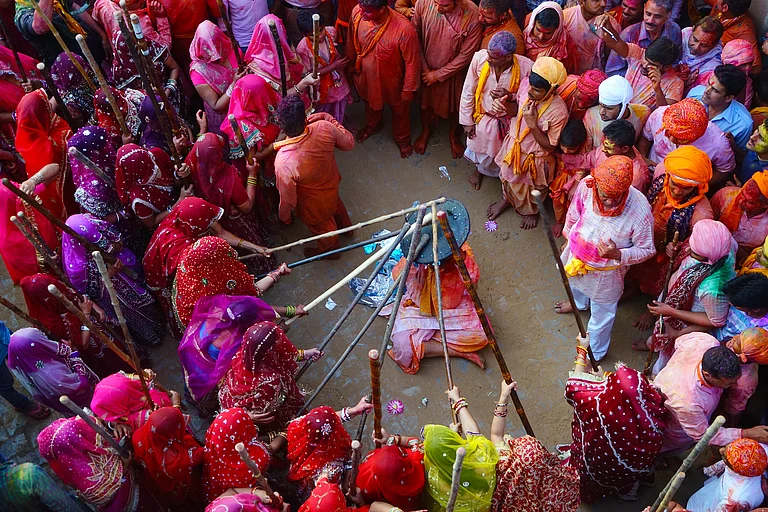
This is the headline act. By late morning, Barsana transforms into a pulsating stage. Men from Nandgaon arrive in groups, dressed in traditional white kurtas and turbans, singing provocative folk songs that echo Krishna’s teasing of Radha and her companions. They assemble in the temple courtyard and surrounding streets—and then the gopis arrive.
Armed with long wooden sticks (lath), the women of Barsana chase and symbolically strike the men, who crouch beneath shields to protect themselves. It’s dramatic, loud, and deeply performative—part ritual re-enactment, part community pride.
The air turns crimson as gulal is flung in thick clouds. Drums pound. Brass bands play. Elders sit in designated areas singing traditional samaj bhajans, anchoring the spectacle in devotion rather than chaos.
By afternoon, the energy peaks. If you plan to attend, reach before noon. Expect dense crowds near the Radha Rani Temple steps— vantage points fill up quickly. Wear sturdy footwear; the streets can get slippery with colour and water.
Advertisement
26 February 2026 – Nandgaon Lathmar Holi
The next day, the celebration shifts to Nandgaon, Krishna’s village, where the roles are reversed. Men from Barsana now arrive to be “welcomed” in kind. The setting is the Nand Bhawan Temple perched on a hill, offering dramatic views over the countryside.
The atmosphere mirrors Barsana but feels slightly more contained. Processions wind uphill as devotional songs accompany the action. Women line the courtyard ready to continue the playful retaliation.
Arrive in the morning; by early afternoon, movement through the temple complex becomes difficult. Transport between Barsana and Nandgaon can be slow during Holi week, so factor in extra travel time.
Phoolon Wali Holi: Vrindavan
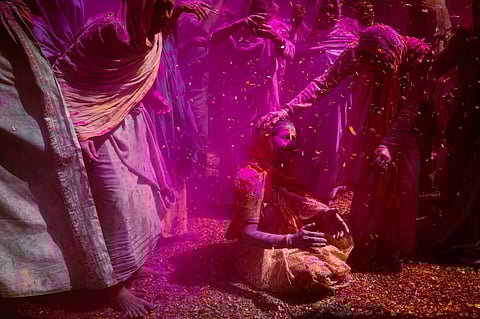
Phoolon Wali Holi replaces gulal with fragrant petals roshagulla/Instagram
If Lathmar Holi is theatrical and robust, Phoolon Wali Holi is lyrical. Celebrated in Vrindavan’s temples, this is where Holi feels devotional, intimate, and unexpectedly serene.
27 February 2026 – Phoolon Ki Holi & Rangbhari Ekadashi
At the heart of it all is the Banke Bihari Temple. Instead of coloured powders, priests shower devotees with fresh flower petals—marigolds, roses, and fragrant blossoms that rain down during bhajans and aarti. The atmosphere is heady with scent and song. Petals cling to hair and shoulders, gathering at your feet like a carpet.
Advertisement
Rangbhari Ekadashi, observed the same day, marks the ceremonial beginning of colour offerings to Krishna. It’s the spiritual prelude to the more exuberant days ahead.
Temple timings typically run from 8:45 am to 1:30 pm and 4:30 pm to 8 pm, but mornings are calmer and more immersive. By late morning, crowds swell dramatically. Entry is free, but access may be temporarily paused to manage numbers.
Beyond Banke Bihari, ISKCON Temple and Radha Raman Temple also host flower celebrations, each with a slightly different rhythm—ISKCON leans toward kirtans, while Radha Raman offers a quieter, more traditional aarti experience.
Rangwali Holi: Mathura & Vrindavan
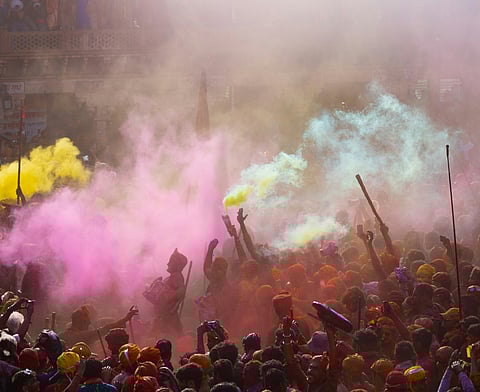
The main colour celebration, Dhulandi, falls on March 4, 2026 across Mathura and Vrindavan Unsplash
By early March, the crescendo builds toward the Holi most of India recognises—colour, water, and communal abandon.
3 March 2026 – Holika Dahan
On the eve of Holi, bonfires are lit across Mathura and Vrindavan, symbolising the triumph of good over evil. Major gatherings occur near Vishram Ghat and Dwarkadhish Temple in Mathura. Families circle the flames, offering prayers and grains, marking the spiritual cleansing before colour takes over.
Advertisement
Given that 2026 coincides with a lunar eclipse on this date, temple rituals may begin after sunset once the Sutak period ends. Confirm local timings closer to the day.
4 March 2026 – Dhulandi (Main Colour Holi)
This is the riot of pigment. From morning onward, Mathura’s Dwarkadhish Temple becomes a whirlpool of pinks, yellows, and blues. Drums echo across courtyards. Buckets of coloured water are tossed overhead. Devotees dance in tightly packed circles, faces indistinguishable beneath layers of gulal.
In Vrindavan, the lanes around Banke Bihari Temple come alive with spontaneous celebrations. Shopfronts close, streets turn into playgrounds, and strangers become temporary co-conspirators in colour warfare.
Arrive early—ideally by 9 am. By midday, movement becomes slow and visibility drops in the haze of powder. Carry minimal belongings and protect your phone or camera carefully.
5 March 2026 – Dauji Ka Huranga, Baldeo
The final act unfolds at the Dauji Temple in Baldeo, about 30 km from Mathura. Huranga is raw, energetic, and uniquely local. Women playfully tear at men’s clothing while colours are thrown in relentless bursts. Temple priests and extended families oversee the ritual, keeping its traditional structure intact.
Advertisement
Festivities begin around noon, but arrive by 10 am for a decent vantage point. This is less touristy than other events and feels intensely regional—which is precisely its charm.
Tips For First-Timers
Base yourself in Mathura: The town offers better hotel options, smoother connectivity, and makes for convenient day trips to Vrindavan, Barsana, Nandgaon, and Baldeo without constantly shifting luggage.
Start early every day: Mornings are devotional and atmospheric; by afternoon, the celebrations grow louder, denser, and significantly more chaotic.
Wear clothes you’re ready to part with: That pristine white kurta will not survive Braj Holi—consider it a colourful souvenir in the making.
Protect your valuables carefully: Keep phones, wallets, and cameras sealed in waterproof pouches or ziplock bags; coloured water has a way of finding everything.
Travel with company: The crowds can be overwhelming, especially for first-time visitors. Women, in particular, should avoid navigating packed lanes alone.
Respect temple protocols: Photography is often restricted, especially inside Banke Bihari Temple, and entry may be paused to manage crowd flow.
Go easy on the bhang: A glass of thandai is part of the tradition; several glasses can quickly derail your carefully planned itinerary.
Stay hydrated and sun-aware: March afternoons in Braj are warm, and hours in tightly packed crowds can be exhausting.
Participate rather than observe: Holi here is immersive by nature—step in, accept the colour, and allow yourself to be part of the celebration.
Carry your sense of humour: You will be splashed, smeared, jostled, and unexpectedly pulled into dance circles. Smile through it—that’s half the magic.
Advertisement
FAQs
1. When is the main Holi celebration in Mathura and Vrindavan in 2026?
The main colour celebration, Rangwali Holi (Dhulandi), will be observed on March 4, 2026, with Holika Dahan on March 3.
2. What is the difference between Lathmar Holi and Phoolon Wali Holi?
Lathmar Holi in Barsana and Nandgaon features playful stick rituals, while Phoolon Wali Holi in Vrindavan is a devotional celebration using flower petals instead of colours.
3. Where should first-time visitors go for the best Holi experience?
For tradition and spectacle, attend Lathmar Holi in Barsana. For a spiritual atmosphere, visit Banke Bihari Temple in Vrindavan. For full colour celebrations, head to Mathura on Dhulandi.
4. Is it safe to attend Holi in Mathura and Vrindavan?
Yes, but expect large crowds. Travel in groups, avoid isolated lanes, protect valuables, and follow temple and local guidelines.
5. How many days should I plan for Braj Holi?
Ideally, plan at least 3–4 days to experience Lathmar Holi, Phoolon Wali Holi, and the main Rangwali celebrations comfortably.
Advertisement
Published At: