So, how much further is the monastery? I ask Joginder, my cheerful Himachali driver-companion from Delhi, as he parks in front of the Banjara Resort, where were spending the night. Arrey, aapne dekha nahin... yehi to hai, (Didnt you see? This is it), he says, much amused, pointing beyond a cluster of nondescript tin roofs. I could hardly have been closer.
In The Wonderland Of Tabo In Himachal Pradesh
The 1,000-year-old Tabo monastery in Spiti valley of Himachal Pradesh is a snapshot of India's Buddhist past

Advertisement
I've just arrived after driving through 250 km of the most spectacular mountainscape this side of the moon, I've been craning at the crestline for the best part of an entire day, and out of sheer, well-fed inertia, I'm still staring at the surreal blue-green-brown of the ridges in the distance. Distractedly I wonder if Tabo was really only an excuse for the journey.
Antiquity has a hypnotic aura about it, but more often than not the secret of its hold on you is just that frail bridge across time, your inability to quite place it in its original context. But Tabo is not just a millennium-plus old. The prodigiousness, the exuberance, the refinement, the serenity of artistic expression within its deceptively austere exterior chokes description.
The wonder that is Tabo
The Tsuglakhang (the main temple) is the most poignant testimonial to this awesome creative energy. More than any of the other eight temples in the monastery complex (some created in more recent times), it is the Tsuglhakhang that announces the immense pious will of its founders. Art historians have lavished high praise on the sophistication of the philosophical construct that underlies this iconographic programme, and the clarity and finesse of its visual expression. But even a philistine will not miss the presence of a gifted prime mover someone who not only had the will to create a symbolically coherent space, but also the means to gather artists and material of the highest quality.
Advertisement
Tabo was founded by members of the royal dynasty of Purang-Guge in west Tibet. According to the most accepted stories of the foundation of this kingdom, upper Kinnaur, Spiti, Lahaul, Zanskar and Ladakh first came under the nominal rule of this Tibetan dynasty under its first two kings in the mid-10th century. In approximately the last quarter of the 10th century, the third king, Khorre, later known by his religious initiation name Yeshe Odbegan, led an intensive missionary campaign throughout his realm to reverse the setbacks Tibetan Buddhism had suffered in the 9th century CE.
Presumably, as a result of its dramatic geographic isolation (cut off from the rest of civilisation by high mountains and inaccessible passes), the diffusion of Buddhist thought in these parts was weak at the time. Ritual practices, in particular, were heavily influenced by local cult traditions. Yeshe-Od wanted to purge local Buddhist practice of its fringe folk influences, and his cleansing drive saw him enlist the help of scholar-monk Rinchen Tsangpo (958-1055), who had recently returned from Buddhist studies in Kashmir. These two men and later Yeshe-Ods (grandnephew) and successor Jangchub Od are the triumvirs associated with the founding of Tabo. While the first two are credited with the founding per se of the gompa in 996 CE, Jangchub Od was responsible for the extensive renovation that began 46 years later in 1042 CE.
Advertisement
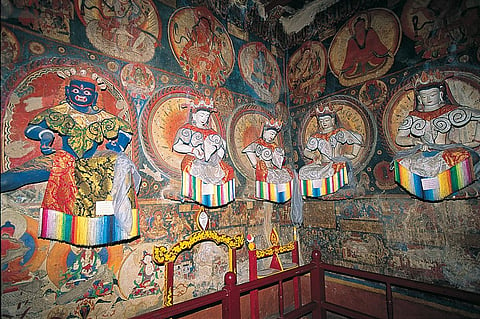
The sculptures arrayed mostly on the southern (left as you enter) and northern walls of the du khang (the assembly hall of the Tsuglakhang) are not just life-size. They are disconcertingly life-like. As I walked in from the sun-drenched courtyard into the antechamber and then shuffled unhurriedly into the du khang, I had this sense of falling into a wakeful dream. This is not real... I murmured to my goose bumps, as those stunning images swam into shape in the aromaladen darkness. For a few unreal moments before the spell broke, I stood transfixed, half-expecting an admonishing exit cue from the Bodhisattvas staring down at me from their perch on the wall. As it turned out, the exit cue came from another tourist, who let out a glorious wah, kya baat hai (now that's something) in his rich Punjabi-Hindi, as he walked in.
There are nine temples in all, scattered multi-axially within a walled enclosure. Easily the most fascinating of these is the 10th-century Tsuglakhang. Apart from the murals that array the walls and most ceilings of all the temples, the du khang contains a number of wall-mounted stucco clay sculptures for which the monastery is particularly famous. Thirty-two of these exquisite life-size statues are arranged on either side of a majestic four-bodied Vairochana (regarded in Vajrayana Buddhism as one of the five spiritual sons of the self-created primordial Adibuddha), depicted in a posture of turning the wheel of law (dharmachakra pravartana). These deities are arranged to form the vajradhatu mandala. Beyond the seated Vairochana image is a three-sided enclosure, the ambulatory around the inner sanctum, which houses a stucco Amitabha (one of the five Tathagata Buddhas) with two smaller acolyte Bodhisattvas, one on either side.
Advertisement
The murals in the du khang and fragments from the original wall paintings in the ambulatory demonstrate that when Yeshe-Od founded the monastery in 996 CE, the artistic culture had a provincial character, with influences deriving from Kashmir and Ajanta (which earned Tabo the epithet 'The Ajanta of the Himalaya') in India to Dunhuang in China. A totally new aesthetic was introduced in the 11th century renovation of the monastery under the patronage of Changchub-Od.
The other prayer halls in this complex mostly date from the 15th to the 17th century. Tabo, therefore, represents a full millennium in the evolution of western Tibetan art, with styles and influences ranging from Kashmiri to Nepalese, Chinese and Pala art from Eastern Buddhist strongholds of Nalanda, Vikramashila and Odantapura. From all of these emerged what is today recognised as Tibetan monastic art.
The Tsuglakhang awes and spoils and raises the bar. Nothing that you see next in the complex and there is a lotwill match up to the creative energy on display herebe that in terms of scale or the more abstract, yet palpable, wound-up missionary zeal that sustained this colossal enterprise. But they have to be seen, if only to understand the mind-numbing magnitude of the ambition that could create such rich spillovers.
Advertisement
Once believed to have been coated with a layer of gold dust, Ser-khang (Golden Temple) was extensively renovated by Senge Namgyal, the then ruler of Ladakh, in the 16th century. The Green Tara and goddess Usnishvijaya deservedly hog attention among the murals here. Kyil-khorkhang (The Mystic Mandala Temple) has an enormous Vairochana mural surrounded by eight Bodhisattvas, on the wall opposite the entrance. Its here that young monks are inducted into the order through ritual initiation. Byampa Chenpo Lakhang (The Bodhisattva Maitreya Temple) houses a 91/2-ft high statue of the Bodhisattva Maitreya (the future Buddha), symbolising the redefining of the Dharma in the next epoch. Dromton Lakhang lies on the northern edge of the complex, and is said to have been founded by Dromton-pa (1008-1064 CE), a disciple of Dipankar Sri Gyan Atisha (982-1054 CE), the pre-eminent Vajrayana Buddhist scholar from Vikramashila in Eastern India.
Zhalma (the Chamber of Picture Treasures) has a 17th-century entrance temple, where murals of the Buddha, his disciples and protective deities are recent and in pure Tibetan style. Masks, weapons and ritual costumes are stored in the Gonkhang, which is closed to visitors. Dromton Lakhang (the Large Temple of Dromton) is the second largest in the complex. The front wall depicts Shakyamuni Gautam Buddha, flanked by Shariputra and Maudgalyayana. The other walls have the eight Medicine Buddhas and the royal guardians. The presiding deity of Gon-khang (the Mahakala Vajrabhairava Temple) is the protector of the Gelugpa sect. The shrine is entered only after ritual protective meditation. It is also known as the Temple of Horror, an allusion to its fierce-looking deities. Despite its richly adorned walls, Karbyum Lakhang (the White Temple) is considered by many to be the least of all the shrines.
Advertisement
Although it is slowly surrendering itself to progress, the imprint of a millennium-old Tabo is still very much intact in its modern-day incarnation. That good fortune is owed to its isolation from the rest of India. It is still a subsistence economy, it is still sparsely populated (no more than 400 people), its Buddhist population still clings to its faith in the folk deities, and still practises the animistic rituals that had so alarmed their proselytisers in the olden days. The new tin roofs and tea bags, the post-millennium, post-Kalachakra publicity, the new resorts, the shooting of movies (Mahesh Bhatt's Paap) are the contra-indicators. The tourist discovery of exotic Tabo is a little threatening, but maybe that's another blinkered, self-serving tourist point of view.

The Tabo landscape
The Information
Getting There: Tabo can only be reached by road from Kaza, which is 50km away. Tabo is about 500km by road from state capital Shimla. Accommodation is limited. Also the mountainous roads are open subject to weather conditions. So for latest information, see here.
Advertisement
Foreign nationals travelling to Tabo need inner-line permits for North Kinnaur and onward into Spiti, broadly speaking, for any travel within 40 km of the Tibetan border. In theory, these can be obtained from the District Magistrates in Shimla, Keylong, Kullu and Chamba, or SDMs in Rampur, Kaza, Rekong Peo and Nichar. In practice, Rekong Peo is your best bet if youre travelling from Shimla, and Kaza if youre travelling from Manali. You'll also need 3 passport-size photos, a photocopy of the identity pages of your passport, an application form from the SDM's office and lots of patience. It could take an entire day for the permit to be issued.
Note: You may ignore the sundry bans on photography, travelling in groups of fewer than four, and camping. Photography is fine as long as you are not close to sensitive/ military areas (bridges, passes, checkpoints, etc), and camping too is okay as long as you are close to the main road. Travelling alone is not a problem either, nor do you need any special permits to drive a car or motorbike.
Advertisement
Around Tabo
Dhankar (35 km)
Once the capital of the Spiti waziri, Dhankar is now a tiny village. The early 16th-century fort-monastery Dhankar Gompa (12,763 ft), which once also served as a jail, is wedged between the pinnacles of a razor-sharp spur of crumbling rock and alkaline deposits. Today it has about 150 lamas in residence. It has a collection of Bhotia Buddhist scriptures, a four-bodied Dhyani Buddha and murals of Medicine Buddhas and protector deities. The gompa is a steep climb of about 2 hours from a point 2 km away, beyond Shichling on the main road. The motorable road is an 8-km detour from SH30 on the leg that connects Tabo with Kaza. Stay options are limited. A new monastery, built 1 km downhill from the old site, is a good place to find a local guide to show you around.
Much talked about for its carved wood panelling, Lhalung Gompa is another 9-km detour from SH30 on its Tabo-Kaza link. It can also be reached after a 2-hr, not-so-easy, not-quite-punishing trek from Dhankar.
Advertisement
Kaza (50 km)
The administrative centre and transport hub of Spiti sub-district is an excellent base for your explorations of the Spiti monastery circuit. The old town around the new bus stand is a maze of shops, hotels and whitewashed houses. The new town, across the creek, is a motley cluster of tin-roofed government buildings, including the sub-divisional magistrates (SDM) office, where foreign nationals can get the inner-line permits required for Spiti and Upper Kinnaur. There's an attractive one-day trek from here to Hikim and Kaumik villages.

May to early November is the best time to visit the region
Ki (54 km)
Possibly founded in the 13th century, Ki is certainly the largest monastery in Spiti. The prayer chambers are interconnected by dark passages, tortuous staircases and small doors. From a distance, it looks deceptively like the Thiksey Monastery near Leh in Ladakh, but the illusion fades as you get closer. Ki is best reached from Kaza (14 km), and has about 300 lamas in residence. At 13,504 ft, it is built, like most Buddhist formations of the time, at an elevation from the village. The gompa is an irregular heap of low rooms and narrow corridors sitting atop a monolithic, conical hill. Locals make the unlikely claim that this monastery too was built by Rinchen Tsangpo, a belief deceptively lent some credence by the fact that the Ki Gompa is now the seat of Lochen Tulku, the 17th incarnation of the revered founder. The gompa belongs (again like most monasteries in the region) to the Gelugpa sect of Mahayana Buddhism. It has withstood at least three documented Sikh and Dogra invasions in the 19th century (and presumably some before that), and an earthquake in 1975. Although it must have yielded some of its considerable art treasures to these marauders, it still has a priceless collection of thangkas and rare manuscripts, besides weapons and quite an array of wind instruments that feature prominently during the Chaam Festival, celebrated in June-July.
Advertisement
Published At:
Tags