Saraya Abdoul St. Laurent has steady hands.
Queening Out: What My First Drag Show Taught Me About Community Across Asia
What a Pride Month drag show featuring performers from Vietnam and India revealed about chosen families, cultural identity and resilience that shape queer communities across Asia

Advertisement
She was fixing her eye makeup, perfect arched wings outlined with precision. Every now and then, she would pause to inspect her work in the mirror before returning to our conversation without missing a beat.
"Darling! I’m all about multitasking!"
I was at The LaLiT Hotel one muggy June evening, looking forward to my first-ever drag show, scheduled for later that night at Kitty Su.
My preliminary introduction to drag, like most people, was watching episodes of RuPaul’s Drag Race. But here were queens from Vietnam getting ready to perform in India, and I was ready for my initiation to a real-life show.
As Saraya went on with her makeup, never once floundering in her answers, I asked what drew her to India.
Born in Morocco, she left at 24, moved to Turkey and eventually settled in Vietnam. Having spent much of her adult life moving between countries, travel shapes much of what she does. The traditions, the fabrics, the aesthetics of different places often find their way into her performances. Growing up in Morocco, she was surrounded by Indian films and music.
Advertisement
"Indian movies are huge in Morocco," she told me. Her favourite film remains Bajirao Mastani, and when asked which actor would make a great drag queen, Priyanka Chopra Jonas was the only correct answer. “The hair! Better than everyone else!” she quipped.
India Has Sisterhood
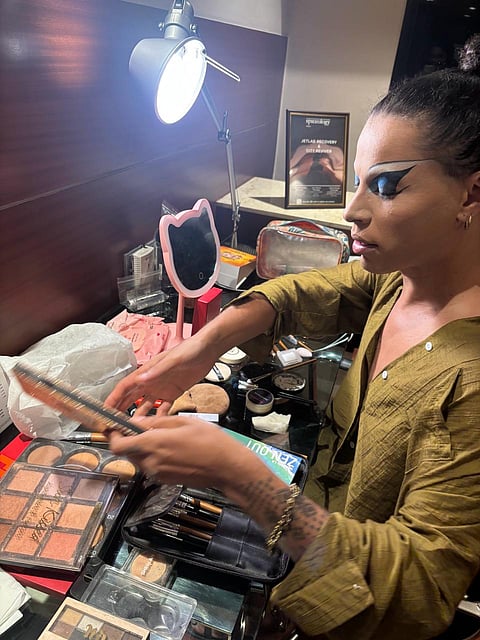
Saraya Abdoul St. Laurent getting ready for the show Antaraa Chatterjee
"India has sisterhood," Saraya said almost immediately when I asked how Delhi compared with Vietnam.
It wasn't a criticism of Hanoi's drag scene. Competition exists everywhere, she told me, and she believes it is necessary. But during her visits to India, she has been struck by how readily queens champion one another's successes. This observation popped up throughout the evening with every queen I spoke to, and I began to understand the sentiment as the night progressed. Behind the glamour, drag culture in both countries appears to run on the same fuel: people willing to teach, encourage and occasionally argue with one another.
From the outside, drag is easy to gauge as a spectacular performance. It is glamour, theatre and transformation. Yet backstage, the conversations were rarely about performance alone. Instead, they gravitated towards mentorship, support systems and the people who make drag possible. In many ways, the evening felt like a cautiously sweet extended family reunion.
Advertisement
The House Always Wins
Many drag artists around the world belong to houses, chosen families led by drag mothers who mentor younger performers. The concept emerged in Harlem’s underground ballroom culture in the 70’s but has since become a cornerstone of drag communities across the globe.
Saraya describes herself as a drag orphan.
When she first started performing in Turkey before eventually moving to Vietnam, she didn't have a drag mother guiding her through the process. Today, she has two drag daughters of her own and understands why those support systems matter. The learning curve can be steep. Drag is expensive, technically demanding and often built through trial and error.
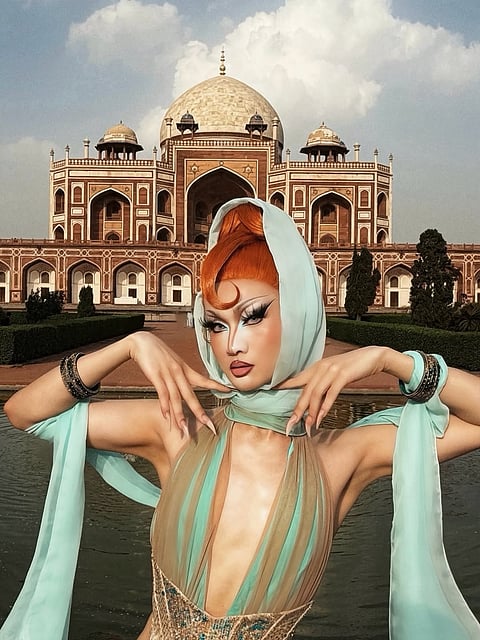
Irina The Diva from Vietnam Instagram
"If you don't have guidance, you end up buying the wrong thing and wasting your money," she said.
Across the room, another Vietnamese queen described a remarkably similar experience.
Irina, who began performing drag in 2023, is part of Wet Dynasty, one of Hanoi's drag houses. Adopted as the house's first daughter, she credits the community around her with helping her navigate everything from performance concepts to practical logistics.
Advertisement
"Drag is very difficult," she told me. "You cannot do it alone."
The more I listened, the more drag began to resemble an apprenticeship. The audience sees the finished performance, but what remains hidden are the countless hours spent learning makeup techniques, styling wigs, designing costumes and figuring out how to command a stage.
The parallels with India were impossible to miss.
Delhi-based queen Lush Monsoon described the early years of Indian drag in strikingly similar terms. Before houses and support networks became more established, many performers were effectively teaching themselves.
"We all started as bedroom queens at some point," she said. "We all had to be our own mothers."
Today, she belongs to a close-knit drag family in Delhi.
"We love each other, we hate each other, we fight with each other, but you always come back to each other. That's what real families are like."
The statement drew laughter from the room, but nobody disagreed.
Advertisement
Beyond RuPaul
All three performers mentioned RuPaul's Drag Race at some point during our conversations.
For Saraya, discovering the show while living in Turkey became a turning point. At the time, she was struggling with depression and spending most of her days moving between work and home. Then she came across clips online.
"The first queen I saw was Raja," she recalled.
One episode led to another. Fascination eventually became purpose, and finally, "It took me out of my depression. I knew this was exactly what I needed to do."
Irina's journey was different but similarly digital. Lush belongs to a generation of Indian performers who learned many fundamentals through YouTube tutorials and online drag content, since local examples were still relatively limited. She spoke about the tendency to compare local performers with international stars, a dynamic familiar to drag scenes across Asia.
Yet spending time backstage, it became obvious that none of them was interested in simply reproducing a Western template.
Advertisement
Saraya's outfit that evening was inspired by fabrics reminiscent of Morocco. “When I first saw this fabric, it just took me back home.” The garment had taken weeks to create and required more than 1,500 stones for embellishment, which she did all by herself. Travel often ends with her carrying home fabrics from wherever she visits. On previous trips to India, she found herself mesmerised by local embroidery and textile markets.
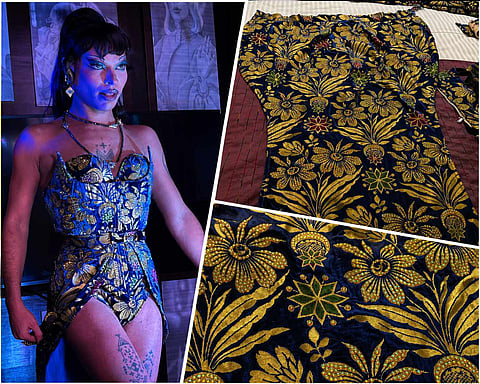
Saraya performing in the dress with 1500 stones, that she designed Antaraa Chatterjee
Lush spoke enthusiastically about sourcing fabrics from Delhi's markets and designing costumes from scratch with local tailors. The joy, she said, was in creating something that felt uniquely yours. She wore an orange outfit for her performance, which drew surprised, goading giggles from us. “This is me reclaiming this beautiful colour,” she said with a knowing smile.
Travel, culture and local aesthetics were woven into every costume in the room. And these clearly weren't copies of Western queens, but performers building their own visual languages from the places they called home.
Advertisement
Growing Up In Public
If the similarities between India's and Vietnam's drag scenes were striking, so were the differences.
Vietnam's drag scene remains relatively small but is growing steadily. According to Irina, there are only a handful of major drag houses in Hanoi, though visibility has increased significantly in recent years. Public understanding, however, still has some catching up to do.
Misconceptions remain common. Irina often encounters people who reduce drag to men dressing as women, overlooking the fact that drag is an art form rather than a gender identity. In practice, performers come from a wide range of backgrounds and approaches, using drag to explore everything from femininity and masculinity to humour, politics and self-expression.
India faces a different challenge. For Lush, visibility remains a major hurdle.
"People in Delhi don't know drag exists in Delhi," she said.
The comment surprised me. Delhi's queer nightlife appears increasingly visible from the outside, yet many performers still feel they are introducing audiences to drag for the first time. Yet some of Lush's most memorable performances have taken place far from Delhi.
Advertisement
She recalled performing at a women's college in Chandigarh during the early years of her drag career. At the time, she admits, she was nervous. Her previous experiences in the city's club scene had left her uncertain about how audiences would respond. Instead, she was met with curiosity, warmth and overwhelming enthusiasm.
"I was a baby drag queen then," she said. "But the amount of love we got from Chandigarh was amazing."
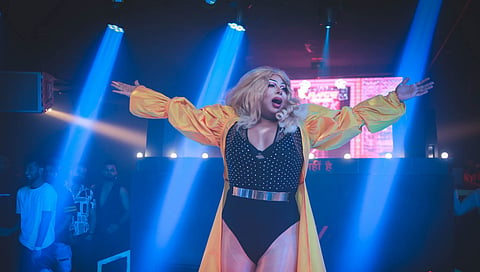
Lush Monsoon performing at a show
The experience challenged many of her assumptions about where drag can find an audience in India. Since then, she has performed across cities including Mumbai, Bengaluru, Hyderabad and Chandigarh, watching different communities engage with drag in their own ways. Some audiences arrive already familiar with the art form. Others encounter it for the first time. The response, she suggested, is often less predictable than people assume.
For all the conversations around visibility, drag in India appears to be growing through a patchwork of local experiences rather than a single national narrative.
Advertisement
Pride, Resilience, And Showing Up
At one point, I asked Saraya what Pride means to her in 2026. Her answer came quickly. "Resilience."
It was not the response I expected, but it was perhaps the most revealing.
Across all three conversations, resilience surfaced repeatedly, even when the word itself wasn't used. It appeared in discussions about building careers in an art form that rarely guarantees financial stability. It appeared in stories about finding community, navigating identity and creating spaces where people feel understood.
Irina spoke about seeing more people in Vietnam openly exploring gender identity and transition than ever before. Lush reflected on the importance of queer spaces and the role they have played in helping people find one another.
The contexts were different, but the underlying belief felt remarkably similar. Progress may not look the same everywhere, but then again, neither does resilience.
The Real Show Happens Backstage
Later that night, when Saraya finally stepped onto the stage, the transformation felt almost secondary. The makeup was flawless. The costume shimmered under the lights. The confidence seemed effortless.
Advertisement
But I found myself thinking about everything that had happened before the performance began.
I thought about a Moroccan queen who discovered drag while living in Turkey before eventually building a life in Vietnam. I thought about a young performer helping shape Hanoi's growing drag community. I thought about a Delhi queen describing her drag sisters with the same mixture of affection and exasperation found in most families.
Before attending my first show, my understanding and fascination were primarily about the performance. But the built community, as much as the artistry, is the true lure of the culture. The wigs and sequins are the visible part. The culture, stitched together through mentorship, friendship, and an ongoing willingness to make space for one another, makes the performance possible.
Pride Month often celebrates visibility, but listening to the queens made me glimpse into the network of care which allows that visibility to exist in the first place. And that is something worth celebrating, too.
Published At: