Tourists coming to the city would be enchanted by Faridkot&rsquos French connection, and the influence of Gothic architecture on its palaces, guest houses, inner fort structures and some public buildings. A connection that has no link with its Chishti Sufi guest&mdashSheikh Farid-ud-din Ganj-i-Shakar better known in Punjab as Baba Farid&mdashwho arrived here in the 12th century and after whom the city changed its name from Mokalhar to Faridkot. Dr Subhash Parihar, Punjab&rsquos architecture historian, recounts how in Europe the term &lsquoGothic&rsquo in the 17 and 18th centuries was used in a disparaging sense to describe &lsquotasteless and bizarre&rsquo architecture that became emblematic of the East Germanic tribes. Its unique features include pointed arches and sharply tapering spires. However, as Parihar says, &ldquoWhat is considered tasteless and bizarre at a particular time may be found attractive at another point.&rdquo It became fashionable in 17&ndash18th century France and was given the term &lsquoGothic Revival&rsquo. A hundred years later, the rulers of Faridkot replicated it in this little-known capital of the Sikh state.
Punjabi Goth Explore Faridkots French Connection
Tourists coming to the city would be enchanted by Faridkots French connection, and the influence of Gothic architecture on its palaces, guest houses, inner fort structures and some public buildings

Go Goth
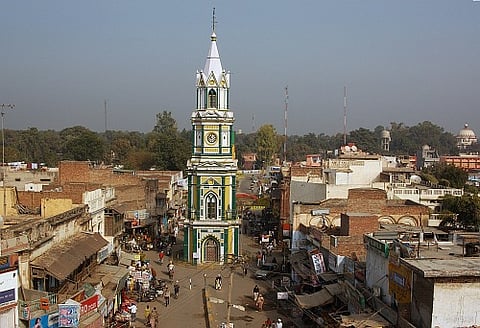
Among the structures that are freely accessible to the public is the Victoria Clock Tower at the junction of Old Jail Road and Main Bazaar road. This four-storied tower is a mix of Mughal, Gothic Revival and Neo-classical architectural styles. As you stretch your gaze from its typical Mughal gate at eye level, to the narrower arch above, the circular clock and finally the bell tower topped with a conical spire, you encounter an unusual synthesis of East and West. The clock was made by Joyce Whitchurch, in Shropshire, the UK in 1929.
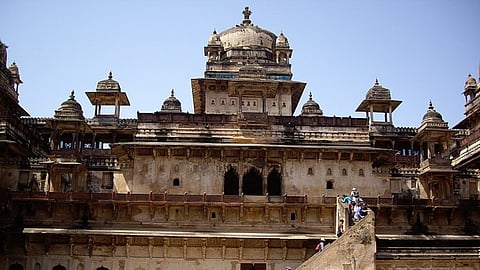
The Raj Mahal or the Royal Palace on the Circular Road has been renamed the Maharani Mohinder Kaur Memorial Library. It is open to the public on working days, except national and state holidays and Sundays. It was built by Maharaja Balbir Singh over 15 acres and consists of the main palace, tasveer ghar (cinema theatre), a baradari, a gurudwara, some pavilions and swimming pools. The building is adorned with floral arabesques with parakeet figures. The Faridkot State Coat of Arms can also be spotted. This building was used as Balbir Hospital before being converted into a library.
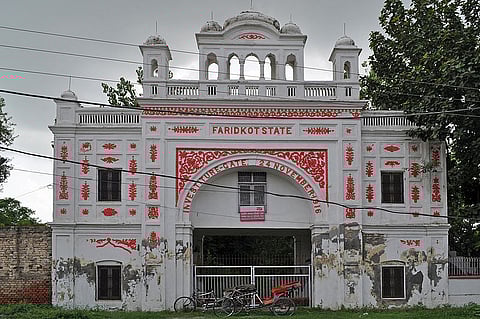
The third freely accessible building, which stands on SH 15, Darbar Gunj, was constructed in 1910. It&rsquos a beautiful bungalow with a well-laid-out garden. It is now used as a PWD Guesthouse. Of special note here are its pillars, pointed arches and pinnacles, especially the upper arcade of Gothic pointed arches flanked by octagonal spires. The cast iron grill in the front of the house has beautiful floral designs and depicts the Faridkot Coat of Arms. But the most amazing secret of this place is the marble statue of Three Graces in the garden. The statue depicts three women with flowing dresses, with one of them wearing a chic 19th-century sari blouse.