The 2026 conflict involving the United States, Israel, and Iran has triggered one of the largest global energy shocks in decades. Disruptions across the Gulf, including a near standstill at the Strait of Hormuz—which handles roughly a quarter of the world’s oil—have forced production cuts in Iraq, Kuwait, and the UAE, sending crude prices soaring and exposing the world’s deep reliance on fossil fuels.
Off-Grid Hotels On The Rise: Why Green Energy Is Powering The Future Of Hospitality
Amid the West Asia energy crisis, India’s solar- and biogas-powered hotels show how off-grid, renewable energy can ensure resilience, sustainability, and energy independence, offering a model for hospitality in a volatile, fossil fuel-dependent world

Advertisement
For countries that rely heavily on imported fuel, like India, the effects have been felt right away—spiking prices, tight supplies, and growing worries over energy security. Reports suggest that hotels and restaurants across India may be forced to temporarily close as kitchens struggle with a shortage of cooking gas. Industry associations and hoteliers have warned that the continued unavailability of gas, exacerbated by the ongoing West Asia conflict, could force many establishments to suspend operations.
The situation makes it clear how risky it is to depend on fossil fuels and reinforces the need to develop local, renewable energy options that are both environmentally friendly and more reliable.
Several hotels and retreats across India are setting the pace in green energy. ITC Hotels, which is LEED Platinum-certified, has invested heavily in solar and wind power, while CGH Earth’s Spice Village runs almost entirely on solar. Other notable examples are IHCL’s Taj hotels, which draw over a third of their energy from renewable sources; The Park Hotels, which rely on wind power; and Dune Eco Village, recognised for its environmentally conscious approach.
Advertisement
Across Europe, however, many hotels and restaurants are already operating on alternative energy systems, ranging from zero-energy boutique properties to large chains using solar, geothermal, and biomass power. Pioneering examples include the Boutiquehotel Stadthalle in Vienna, which operates on a zero-energy balance using a groundwater heat pump, solar panels, photovoltaic technology, and wind turbines, and Hotel Rural Vale do Rio in Portugal, which runs entirely on renewable energy through a mix of mini-hydropower, biomass boilers, and solar photovoltaics.
From Resilience to Sovereignty

iThe shift to alternative energy is increasingly a story of resilience and sovereignty Shutterstock
For off-grid properties, the shift to alternative energy is increasingly a story of resilience and sovereignty, not just environmentalism. Amid regional instability in West Asia, these systems allow properties to operate as self-contained “islands” of stability.
Geopolitical Resilience: Centralised grids can be disrupted by conflicts or targeted attacks. Off-grid solar, wind, and battery systems let properties operate independently of imported fossil fuels and fluctuating energy prices.
Local Control: Generating power on-site removes the risks associated with long-distance transmission lines, which can fail or be damaged during crises.
Advertisement
Integrated Systems: Today’s off-grid properties go beyond simple solar panels:
Hybrid Microgrids: Combining solar, wind, and battery storage ensures a steady supply even when sunlight or wind is intermittent.
Zero-Emission Hotels: Coordinated management of HVAC and batteries can almost entirely replace diesel backups.
Productive Use: Renewable energy powers essential services:
Water Security: Solar pumps provide consistent, clean water without relying on the grid.
Connectivity: Satellite internet paired with off-grid power keeps guests and staff connected to the outside world.
Improvising in a Fuel Crisis
Meanwhile, the ongoing LPG crisis has pushed some properties to consider shifting their kitchens to electric cooking. One such example is Sitla Estate in Mukteshwar. Its owner, Vikram Maira, initially thought he might have to shut down operations until the situation improved. Instead, he decided to switch to electric cooking, allowing the hotel to continue functioning.
“There was no advance warning,” says Maira. “We went to refill our cylinders, as we usually do, and were suddenly told there was no supply. We went into panic mode—but we couldn’t really panic. We had to do something about the situation.”
Advertisement
With guests already booked, the team had to improvise quickly. “I got an electrician to install heavy electrical wiring in the kitchen because induction cookers draw a lot of load,” he explains. “We placed stone slabs over our gas chulhas and set induction cookers on top. We also had to buy an entirely new set of induction-friendly utensils. Everything happened in frantic mode because induction cookers were also flying off the shelves.”
Maira reflects on how dramatically things have come full circle. “I started Sitla Estate in May 1998. It’s in a remote place, and at that time we had neither gas nor electricity. We cooked all our meals on lakdi ka chulhas. In some ways, this crisis feels like going back to day zero.”
For Maira, the situation is also a wake-up call. “Theoretically, switching to alternative energy makes a lot of sense,” he says. “But what are the viable alternatives? Solar cookers are fine for basic cooking—it will cook my dal, but what about the tadka? Biogas would be an excellent option, but to run a biogas plant I would need a whole flock of cattle.”
Advertisement
He adds that while small properties are open to adopting alternative energy, systemic support is needed. “We use grid electricity, and we also generate a fair amount of solar power that we supply back to the grid. But this is not something small property owners can solve on our own. We need intervention at the government level—research into viable alternative energy sources and the infrastructure to support them. If we have to invest in those systems, we will. But determining what kind of alternative energy will work for the country—that’s not something we can do alone. We’ve done the best we can.”
A Retreat That Chose to Stay Off the Grid
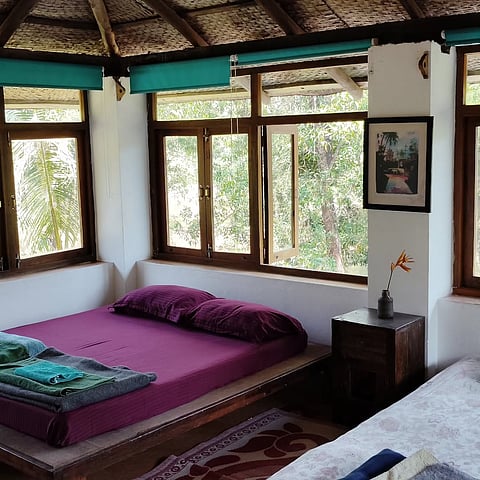
Off The Grid is a sustainable, solar-powered jungle retreat farmoffthegrid/Instagram
At the other end of the spectrum are smaller, low-traffic retreats that host relatively few guests through the year, making it easier for them to experiment with off-grid and alternative energy systems.
One such example is Off The Grid, a sustainable, solar-powered retreat in Dandeli, Karnataka, founded by Sylvia Kerkar and John Pollard. Designed as a low-impact escape deep in the forest, the property operates without grid electricity or phone connectivity. The retreat runs entirely on solar, uses natural spring water, and grows some of its own produce on a small farm.
Advertisement
The retreat runs entirely on solar power, uses natural spring water, and grows some of its own produce on a small farm. “All our lighting, fans, washing machine and fridge run on solar energy,” says Kerkar. “We use firewood for cooking and for heating water when needed. We do have gas stoves, but we could rely solely on wood if necessary.”
Kerkar explains that the decision to remain off-grid has always been deliberate. “We’ve always used solar energy and even refused an electric connection when we had the chance a few years ago. We didn’t want to become dependent on the grid. We prefer to keep operations simple, less consumerist, and remain conscious of how we generate and use energy.”
Operating off-grid also makes practical sense in a forested region. “Overhead electric lines in forests can be dangerous. Live wires often fall during heavy rains, and power cuts can last for days. Solar allows us to avoid those problems.”
Advertisement
The retreat’s philosophy extends to its creative work as well. Kerkar produces ceramic art without electricity, using kick wheels, hand tools and a wood-fired kiln. “It’s an alchemy that always surprises me,” she says.
Given today’s global energy challenges, she believes renewable alternatives have enormous potential. “Solar energy can definitely be used much more widely. With frequent power cuts and overloaded grids, it makes sense to explore options like solar, gobar gas and other renewable systems.”
An Eco-Retreat Rooted in Regeneration
While Off The Grid demonstrates how a retreat can function entirely outside conventional power systems, other eco-lodges are exploring hybrid approaches—combining renewable energy with sustainable land-use practices. One such example is the Rainforest Retreat at Mojo Plantation in Coorg, Karnataka, a pioneering eco-lodge that has relied on alternative energy systems for over two decades, integrating hospitality with organic farming and conservation.
For over two decades, the retreat has minimised its ecological footprint through renewable, eco-friendly systems. Part of Mojo Plantation—a certified organic spice farm—it was founded in 1994 by Sujata and Anurag Goel. Sujata, a PhD in Botany from Delhi University, and Anurag, a PhD in Molecular Biology from Toronto, have been recognised for their conservation work by the Carl Zeiss Foundation. Sujata, an active member of the Organic Farmers Association of India (OFAI), hosted the World Organic Congress in Delhi in 2017 as its president.
Advertisement
“We use solar power for lighting, and biogas is used partially to supplement the supply from the Karnataka Electricity Board,” says Sujata Goel. “It works well. Biomass energy is very effective if one has an adequate number of cows, which is difficult for most households. We do have some cows, but not enough to meet the complete fuel requirements of our kitchen.”
She adds that a promising option for a future focused on alternative energy would be for municipalities to explore biomass systems linked to urban sewage treatment plants in India. “Decentralised systems could use organic waste to generate cooking gas that can then be piped directly to household kitchens. The technology already exists, but what’s missing is government planning and the infrastructure to implement it. Similar systems were used in Okhla in Delhi in the 1970s. They worked very well and even supplied free piped cooking gas.”
These examples show that going green isn’t just about being eco-friendly—it’s about staying independent and prepared. Hotels and eco-resorts across India are already running on solar, biogas, and off-grid systems, showing that it works in practice. Beyond resorts, city-level biomass and other local energy solutions could give communities the same kind of reliability, if the right planning and infrastructure are in place.
Advertisement
FAQs
Why are some hotels and retreats moving to renewable energy?
To reduce reliance on fossil fuels, lower carbon footprints, and ensure energy independence during global supply shocks.
Which types of renewable energy do these hotels use?
Solar, wind, and biogas are the most common, with some properties using hybrid microgrids and battery storage.
How do off-grid hotels maintain operations during power cuts?
By generating their own electricity on-site using solar panels, biogas systems, and batteries, making them self-sufficient.
Are these systems expensive to implement?
Costs vary, but many hotels find long-term savings from lower energy bills and reduced dependence on imported fuel.
Can communities adopt similar renewable solutions?
Yes. Urban biomass systems, solar microgrids, and local energy projects can provide reliable, sustainable power if infrastructure and planning are in place.
Published At: