Dappled sunlight filters in through trees, scattering warm patches across the orange walls of the Bauddha Dharmankur Sabha. A few people wander slowly, eyes tracing the curves of the golden Buddha, pausing to bow or whisper a greeting. From the street, the temple is easy to miss, tucked cheek by jowl with Bow Barracks—home to Kolkata’s Anglo-Indian community for more than a century. Inside, the air carries the faint scent of incense and old wood. The walls, painted a deep saffron, are lined with photographs and plaques, each telling the story of a city that has always welcomed people of many faiths.
From The Latest Issue: Pali, Prayer, And City Streets
In Kolkata’s bylanes, Buddhist temples, Pali texts, and communities quietly sustain a rich heritage

Advertisement
Yet, despite its discreet exterior, the Sabha is a repository of history. Founded in 1892 by Kripasaran Mahasthavir to revive Buddhism in India, its Dharmankur Vihara, built in 1903, would go on to play a pivotal role in the Buddhist revival, even helping to establish the Pali department at Calcutta University in 1907. Today, it remains a living cultural landmark, publishing the journal "Jagajjyoti" since 1908, a testament to the city’s often-overlooked Buddhist heritage.
Buddhism in Kolkata feels like a layering of histories. The city is not where the faith was born, yet over the last century, it has become a hub for Chinese, Japanese, Burmese, Tibetan, and Bengali Buddhists. Beneath this modern presence lies a far older story. Bengal once flourished under the Mauryan and Pala dynasties, when monasteries and scholars drew visitors from across Asia. During the Pala Empire, Bengal was a major centre of Mahayana Buddhism, with important institutions like Somapura Mahavihara and Vikramapura. After the fall of the Palas in the 12th century, however, Buddhist institutions gradually declined across the region. Over time, Buddhist artistic and sculptural forms in regions such as Murshidabad’s Kandi area were absorbed into Hindu worship and reinterpreted as Shiva and other deities.
Advertisement
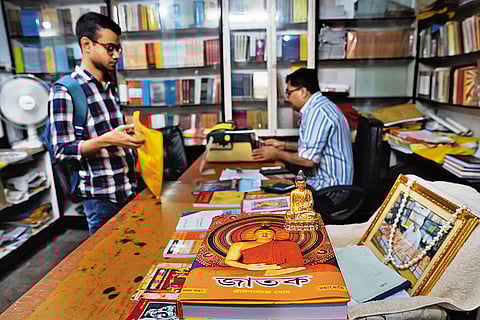
Books for sale at the Society Sandipan Chatterjee
Sacred Scripts
Among these layers, Pali—the sacred language of Theravada Buddhism—holds a special place. In Kolkata, it exists largely as an academic and liturgical medium rather than a spoken tongue, yet its presence is woven through the city’s temples, monasteries, and scholarly traditions.
In the late 19th and early 20th centuries, Bengali-speaking Buddhists migrated to the city, forming enclaves and using Pali studies to mark a distinct identity. Institutions such as the Bengal Buddhist Association (Bauddha Dharmankur Sabha) became pivotal, while scholars established Kolkata as a centre for Buddhist studies. The Asiatic Society preserves epigraphs and architectural remains from the sixth to 12th centuries, and the University of Calcutta’s Department of Buddhist Studies offers a structured academic exploration of the religion’s history in eastern India.
“This is the first department of its kind in India,” said Prof. Saswati Mutsuddy, Head of the Department of Pali at the University of Calcutta. “Several distinguished scholars have been associated with it, including Prof. Benimadhab Barua, the first professor.”
Advertisement
A pioneering Bengali Indologist and Pali scholar, Barua became the first Asian to earn a Doctor of Literature from the University of London in 1917. Mutsuddy also referred to the Charyapada, the earliest surviving verses of Bengali literature (8th–12th century). They reflect Tantric Buddhist traditions and were composed in early languages such as Apabhramsa and Prakrit, which gradually evolved into Bengali.
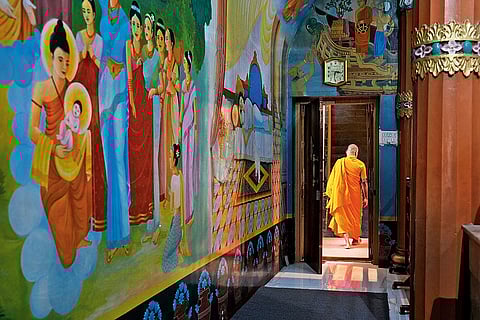
A monk walks past brightly painted walls inside the Society Sandipan Chatterjee
Echoes Beneath The City
Many neighbourhoods in present-day Kolkata still carry traces of a Buddhist past beneath their modern urban landscape. This layered history appears in unexpected corners—for instance, a modest building on Chittaranjan Avenue houses the nearly century-old Myanmar Buddhist Temple near Eden Hospital Road, marked quietly by English and Burmese signboards. It has also been mentioned in Amitav Ghosh’s "The Glass Palace."
It is this sense of continuity that travel writer and photographer Rangan Datta explores on his guided heritage walks to the city's hidden Buddhist corners. “Walking these lanes, you uncover layers of history few notice. Each temple and monastery tells its own story,” he said, pointing to how these spaces continue to preserve living traditions within the city.
Advertisement
Buddhist Landmarks Of Kolkata
The Maha Bodhi Society (1891)
Founded by Anagarika Dharmapala to revive Buddhism in India and restore the Maha Bodhi Temple at Bodh Gaya, the Society has been headquartered in Kolkata since 1892. It houses a sacred relic believed to be the Buddha's tooth.
Nipponzan Myohoji Temple (Dhakuria, 1935)
A Japanese monastery near Rabindra Sarobar, known for its white stupa-like structure and daily prayers for peace.
Myanmar Buddhist Temple (Central Avenue, 1928)
Established by U San Min, this Burmese temple houses a rare gilded Buddha statue designed to be dismantled into five pieces for transport.
Calcutta Karma Gon Monastery (Paddapukur, 1937)
Founded by Tibetan traders, this Karma Kagyu or Gon temple features a colourful prayer hall and a statue of the 16th Karmapa.
Fo Guang Shan Buddhist Temple (Tangra, 1998)
A Mahayana temple established by the Taiwan-based Buddha Light International Association, centred around a grand Buddha statue.
Hsuan Tsang Monastery (Chowbaga, 1968)
Founded by Chinese monk Wu Chien, this monastery honours the traveller Xuanzang and serves Kolkata’s Chinese Buddhist community.
Advertisement
Looking for more such exciting and meaningful stories? Grab our latest issue on Amazon.

Published At: