Much like its longtime bête noire, aka tea, coffee in India has never been just a drink. It is that single (or triple) pause button pressed gently into the day as an act of slowing down. Both beverages carry within them a tacit permission: to linger, to gather one’s thoughts, to sit a moment longer as life rearranges itself around us.
From The Latest Issue: Between Two Brews
India’s coffee culture inhabits parallel worlds—one rooted in affordability, the other in craft. From Kolkata coffee houses to roasteries in Bengaluru, the cup has evolved, even as its social role remains intact

Advertisement
But today, there is a heightened awareness around coffee. Across cities and towns, India’s coffee culture is unfolding into two distinct, overlapping realms—one anchored in legacy and lived habit, the other shaped by a growing appetite for craft, provenance and experience.
Coffee here can arrive as a V60 pour over, a cold-brew steeped overnight, or a flat white crowned with glossy microfoam. Water temperature is monitored. Extraction time is discussed. Milk has alternatives. Sugar is almost embarrassing. And latte art? Exalted
What we are witnessing is not a departure from tradition, but its evolution—an inflection point in what is now widely called “The third wave of coffee.”
According to the Coffee Board of India, domestic consumption touched 91,000 tonnes in 2023, up from 84,000 tonnes in 2012. This steady rise reflects a paradigm shift: coffee entering more homes, cities and identities.
The Long Pour
Spaces like the almost 400 Indian Coffee Houses scattered across the nation continue to anchor this culture. Their menus remain unchanged, their pricing accessible, their purpose intact. “Indian Coffee Houses can be considered to be the 'living rooms' of our intellectual and political history. They are places of affordable endurance where the coffee is a kind of fuel for a three-hour debate,” said Bhavi Patel, beverage writer, coffee aficionado and India AeroPress ambassador.
Advertisement
These establishments function as what might be called a liminal space—neither entirely private nor fully public, but somewhere in between. Here, time stretches, conversations deepen, and the act of drinking coffee is secondary to being present.
India’s coffee culture is unfolding into two distinct realms—one anchored in legacy, the other shaped by a growing appetite for craft
“The Indian coffee market is large and quite vibrant, with space for everything from commercial blends to speciality coffee,” said Dushyant Singh, founder of the five-outlet-strong Jaipur-based Coffee Sutra. “A basic cup like a cappuccino can range anywhere between Rs 80 to Rs 400, depending on the café and its positioning.”
That wide pricing spectrum captures the coexistence at play. Singh added, “With the rise of speciality cafés, more people are slowly moving towards premium coffee. However, classic places like Indian Coffee House will always hold their old-world charm and continue to have a loyal following.”
Advertisement

The coffee experience is what brings people in and keeps them engaged
New Grounds
“We don’t see legacy coffee houses and modern speciality cafés as opposing systems; they serve different but equally important cultural roles,” said Wayne Oberholzer, head of coffee and operations director at Subko Coffee. “One preserves the ritual of coffee as a social equaliser, while the other evolves coffee as a craft-led experience. The coffee is always the foundation, but the experience is what brings people in and keeps them engaged.”
Across India, the branded café market has expanded to over 5,300 outlets, growing at 12.7 per cent annually, according to the Project Café India 2025 report.
At places like Blue Tokai and Subko, beans are traced to estates, brewing methods are specified, and the act of drinking becomes immersive.
This shift has also reshaped consumer behaviour. “The Indian palate has undergone a quiet, delicious revolution,” said Patel. “Today, we have moved from passive consumption to active appreciation. Now, this is a deliberate, nuanced choice.”
Advertisement
Yet the café remains social, if differently so. “The modern café has pivoted from being a ‘public sitting room’ to an ‘experiential stage’,” said Patel. Conversations persist, but they now share space with laptops, meetings and solitary rituals.
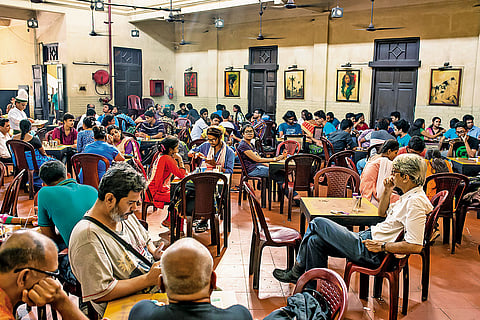
Indian Coffee House in Kolkata Shutterstock
From South to Northeast
While consumption evolves, production tells its own story. According to the aforementioned Coffee Board of India report, nearly 75–80 per cent of India’s coffee consumption remains concentrated in the south, and historically, so has its production. Karnataka, Kerala and Tamil Nadu continue to define the country’s coffee identity.
“Coffee has changed from being the beverage made at home to what it is now,” said Rohan Kuriyan of Balanoor Plantations in Chikmagalur and a sixth-generation coffee farmer. “There is no competition, really. The market is big enough for everyone.”
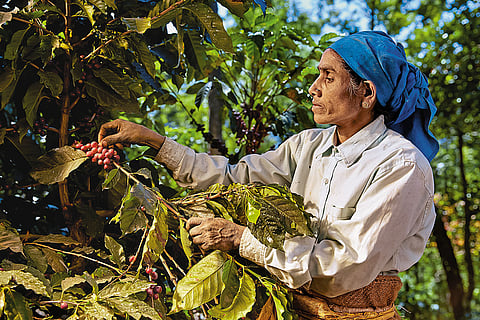
Karnataka, Kerala and Tamil Nadu, the major coffee-producing regions in India, continue to define the country’s coffee identity
Kuriyan also points to a key shift in taste, particularly among younger drinkers seeking clarity of flavour. “The average Indian enjoyed a milk and sugar-based beverage, and many still do. But now, we are also seeing an increase in the number of consumers enjoying a black coffee made with an AeroPress or pour-over.”
Advertisement
At the same time, new regions are beginning to shape the map. “I don’t see them competing at all. If anything, they make the overall culture richer,” said Grace Muivah of Gurugram-based Ngarum Coffee, which fittingly means “coming together” in the Tangkhul Naga language.
Working with 35 small growers across Nagaland and the Assam hills, Muivah represents a subtle shift. “These are regions that haven’t been explored much for coffee, and that’s what makes them exciting. The way things grow there, the terrain and microclimate, shape the cup in a very distinct way. People are definitely more curious now. They want to know where it’s from, how it’s brewed,” she added.
That curiosity binds both ends of the spectrum—the old cup and the new brew.
One thing is clear: India’s coffee narrative is no longer linear. It is layered. One cup invites you to stay, the other invites you to discover. Between them lies the story of a country negotiating tradition, novelty and taste—one sip at a time.
Advertisement
Looking for more such exciting and meaningful stories? Grab our latest issue on Amazon.
Published At:
Tags