Every autumn, Kolkata bursts into life, its streets and neighbourhoods transformed into a vibrant canvas of colour, light, and imagination. For Bengalis, Durga Puja is far more than a festival; it is a powerful expression of the city’s collective creativity and spirit. Over a few unforgettable days, Kolkata becomes one of the world’s largest and most dynamic public art installations.
Durga Puja 2025 In Kolkata: A Celebration Of Culture, Craft, And Community
Kolkata’s Durga Puja is a vibrant showcase of creativity, where the city’s streets become living galleries of spectacular art. This collective effort of thousands of artisans is why UNESCO honoured it as an Intangible Cultural Heritage of Humanity

Advertisement
Each year, lakhs of artisans and workers come together—idol makers, sculptors, lighting experts, textile craftsmen, painters, and installation designers—many preserving traditional crafts that survive solely because of this festival. It is this rich fusion of artistry, craftsmanship, and community collaboration of Kolkata's Durga Puja that led UNESCO to inscribe it on its Representative List of the Intangible Cultural Heritage of Humanity in 2021, making it the first Asian festival to receive this prestigious honour.
This recognition celebrates the cultural vitality that transforms Durga Puja into a living, breathing masterpiece shaped by an entire city. Here’s a closer look at the diverse art forms—and the extraordinary people—who unite to create one of India’s most ambitious and imaginative festivals.
The Idols
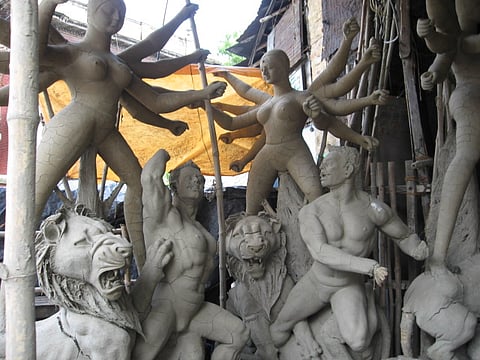
At a clay artists' workshop in Kumartuli PK Niyogi/Wikimedia Commons
The potters of Kumartuli form the community behind one of the most important elements of Durga Puja—the magnificent clay idols of the goddess. For generations, these skilled artisans have dedicated months of labour to handcrafting each idol in family-run workshops, preserving a centuries-old tradition. The name Kumartuli itself, derived from the Bengali words “Kumar” (potter) and “Tuli” (colony or locality), speaks to its identity as a potters’ enclave.
Advertisement
Nestled along the banks of the Hooghly River in North Kolkata, Kumartuli benefits from access to the river’s soft, unique clay—an essential material for these sculptures. Located between Ahiritola and Shobhabazar, and bordered by Rabindra Sarani (formerly Chitpur Road), its narrow lanes fill with rows of drying idols as the festival draws near.
If you visit Kumartuli before Durga Puja, you can watch these artisans at work in their studios, shaping clay with practiced hands. The potters’ process unfolds in stages: constructing a bamboo and wooden frame, layering it with clay from the Hooghly, and adding intricate colours and decorations.
The Pandals

A Durga Puja pandal featuring a striking monochrome theme, adorned with black-and-white sketches and artworks on its walls, blending seamlessly with the surrounding festive neighbourhood atmosphere Durga Puja Hatibagan/Instagram
Across Kolkata, Durga Puja pandals transform the city into a sprawling open-air gallery. These intricate temporary structures—crafted from bamboo frames and cloth—house the goddess’s idol and serve as vibrant centres of celebration. In recent decades, pandals have transformed into thematic artworks, showcasing everything from Bengal’s fascination with literary detectives like Satyajit Ray's Feluda to indigenous rights, and even elaborate recreations of global landmarks such as the Paris Opera House.
Advertisement
The creative teams behind these installations are diverse collectives of local artists, sculptors, and decorators, increasingly collaborating with international talent. For instance, contemporary German artist Gregor Schneider, renowned for his installation art, worked with Indian artisans to integrate his thematic piece ‘Haus u r’ into the Ekdalia Evergreen Club pandal in Gariahat. French installation and fresco artist Jean-Xavier Renaud has also joined forces with local creators to design a Durga Puja pandal and idol. These collaborations highlight Durga Puja as more than a festival—it is a dynamic platform for cross-cultural artistic exchange and public art.
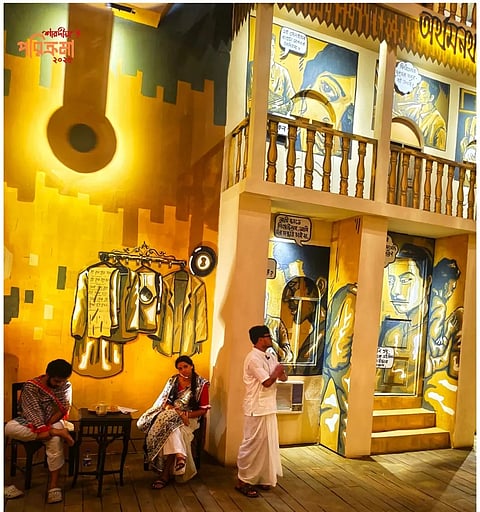
A Durga Puja pandal in Kolkata centred around Byomkesh Bakshi, a fictional detective created by Bengali author Sharadindu Bandyopadhyay july__kundu/Instagram
The Lights
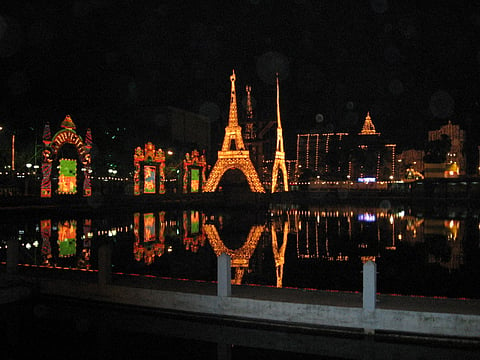
Durga Puja lighting at pandals in College Square in Kolkata Wiki Commons
The elaborate, animated illuminated panels that define Durga Puja in Kolkata originated in Chandannagar, a former French colony in West Bengal known for pioneering electric light decorations. Mid-20th-century artisans crafted intricate designs using miniature bulbs on bamboo grids, creating dynamic light shows that became a festival hallmark.
These panels, made with low-voltage bulbs often wrapped in coloured paper, are arranged on bamboo frames and lit in timed sequences to create the illusion of movement. Themes range from children’s stories and mythological scenes to current events and popular films. Initially used to adorn temporary pandals during Durga and Jagadhatri festivals, the craft flourished with many skilled contractors in Chandannagar.
Advertisement

The Strand, Chandannagar Indraneel Majumdar
Though LED lights have mostly replaced traditional bulbs, the artistry gained international acclaim. Chandannagar’s light creations have been exhibited globally, including a giant peacock-shaped barge at London’s Thames Festival in 2003 and a storytelling exhibit at Belfast’s festival in 2001. Despite this, the traditional craft faces decline amid changing technologies.
Sholapith
Sholapith, a milky-white sponge-wood harvested from the shola plant in West Bengal’s marshy regions, has been used for centuries to craft delicate adornments for Durga idols. The cottage industry in Uluberia, dating back over 200 years, began under British patronage when sholapith was fashioned into the famous lightweight ‘sola topees’ worn by colonial officials. Today, artisans create intricate shola flowers and decorations for export, including gift packaging, Christmas ornaments, and even shola Santas. Derived from the dried cortex of the Aeschynomene aspera plant, it is expertly shaped by craftsmen known as Malakars—“makers of garlands.” These artisans transform shola into everything from the goddess’s attire and jewellery to decorative hangings and thematic pandal installations. It has been showcased globally, including at the Edinburgh Festival where Bengal’s artists reimagined this fragile craft as a durable, waterproof gateway. Mounted on a specially designed plastic frame and sealed for protection, the shola gateway marked the entrance to the Edinburgh Mela, bringing this unique art to a global audience.
Advertisement
Sholapith craftsmanship, once central to Kolkata’s Durga Puja, is gradually fading as many pandals experiment with new materials, themes, and modern designs. However, this delicate art form still endures in some of the pujas, including those held at 'bonedi baris'—the ancestral mansions of aristocratic families in Kolkata.
Decorative Arts

A special tram decorated for Durga Puja @trams_of_calcutta/Instagram
Durga Puja brings art and craft to life in many creative ways. A few years ago, Kolkata’s tram cars were transformed into moving canvases, beautifully decorated with hand-painted scenes celebrating the festival’s spirit. These artworks depicted some puja rituals, the idol-making process in Kumartuli, and iconic local landmarks. The trams featured themed interiors adorned with installations and traditional Alpona designs, turning them into rolling tributes to the city’s rich heritage. Running along routes near major Puja pandals, these trams also included QR codes, offering passengers interactive stories and insights into Durga Puja, blending tradition with technology in a unique celebration of culture.
Advertisement
FAQs
Why is Kolkata's Durga Puja recognised by UNESCO?
Durga Puja in Kolkata is a dynamic cultural phenomenon that transforms Kolkata into a sprawling canvas of artistic collaboration. It integrates handcrafted idols, intricately designed pandals, traditional music, and active community participation. UNESCO recognises it as an Intangible Cultural Heritage for its unique fusion of art, ritual, and social expression that evolves annually.
What are the principal art forms involved in Durga Puja?
The festival showcases a rich variety of crafts, including the sculpting of idols, architectural design of pandals, elaborate lighting installations, and traditional crafts like sholapith work.
Where are the iconic Durga idols created?
The majority of Durga idols are meticulously crafted in Kumartuli, Kolkata’s historic potters’ quarter, where artisan families have preserved this heritage for generations.
What exactly are pandals?
Pandals are temporary yet elaborately decorated structures that house the Durga idols and serve as focal points of the festivities. Many are designed around creative themes, blending traditional and contemporary artistry.
Advertisement
How do lighting displays enhance the festival?
Artisans from Chandannagar craft animated illuminated panels, turning the city’s streets into vibrant visual narratives that reflect social, cultural, and mythological themes during the celebration.
Published At: