You need not be a linguistics professor to notice it. Just a passing familiarity with the local Hindi dialect is enough. People here compulsively inflect and attenuate verbs. Several actions that ought to be described in the simple past are used in transitive, in continuum. Past Continuous is the tense of choice. And what a substantial past 2,600 years at the very least. In the congested lanes of Banaras the here-and-now becomes fluid.
Banaras: A Space Beyond Time
There is more to the city than death. In fact, Varanasi is overwhelmed by life...

Advertisement
But it isn't easy being the religious capital of Cowbelt Country. Hinduism's holiest is also one of its filthiest. The mythical Kashi was restricted to the Ganga's west bank, and that's the way it still is. But everything else has changed in the past decade. The clichéd holy cows on the street, the teeming devout, the graffiti of garbage that only the Hindu transcendental imagination can overlook - has been replaced by concretised ghats, clean walkways and murals adorning every possible public wall.

Temples in Varanasi Shutterstock
Why Come Here At All?
I begin finding my reasons just before daybreak. Poets have described Banaras as the best place to be at dawn. (Lucknow is the place for evenings, Malwa being the preferred place to spend a night.) In the dark, several regulars walk towards the tongue-twisterly Dashashwamedh Ghat. The sin-washers have their quick dips, but the hardcore linger. They soak in the surroundings. The surroundings soak them in. An easeful reunion with the river that springs from the head of Shiva, founder of Kashi and the greatest challenge to notions of time-space.
Advertisement
The sun rises with ritual ease. Absence of habitation on the east bank means the view is splendid. I hire a boat and reach the east bank. The water is definitely cleaner. As I turn, with the rising sun behind me, the horizontal light bathes the famous ghats. Is that it? Does this city look good only from a distance? I decide to find out.
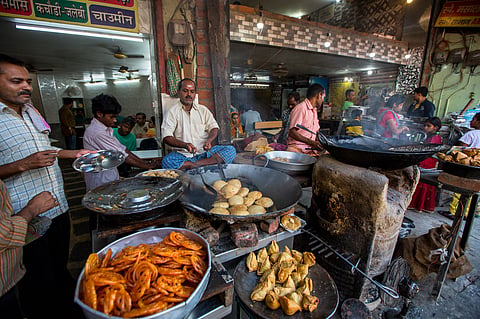
Food shops in Varanasi Shutterstock
Back on land, I head straight for Pukka Mahal, the non-formal title for the concrete city area that grew west of the ghats in medieval times. Along the main road that runs parallel to the Ganga, I turn east into a narrow lane called Kachauri Gali. The name is justified at the entrance itself. I decide to sample the typical small kachauri. Four rounds later, I am convinced that it ranks with the best I've had, ever. I press on. The platform in front of every house - a mandatory presence between the narrow lanes and the house walls - is the main stage of community life. From highly charged games of chess to the casual paan-kachauri-tea-sweets routine, it all happens here. As an old man insouciantly sends two kachauris along to their rightful destination, a small procession of mourners walks by to consign the body of a loved one to the flames. For Kachauri Gali leads to Manikarnika Ghat - every self-respecting Hindu wants to be cremated here.
Advertisement

A panoramic view of Dashashvamedha Ghat in Varanasi Shutterstock
In half an hour, five bodies have passed me by on their way to liberation from the birth-death cycle. The daily average is around 100 bodies - the sacred fire burns round the clock. Yet Kachauri Gali isn't morbid. It never smells of death. Without being unmindful of the ephemeral, it retains a centuries-old good taste that shows despite the filth. The deliciously temporal kachauris are at neighbourly peace with moksha. At Manikarnika Ghat, a couple of pyres burn under the watchful eyes of the doms. An aghori sadhu, dressed in ashes and little else, meditates - his eyes are open, his face bereft of expression. Boatloads of wood arrive from distant places. In the background, a young pehalwan does his pushups. The day gets busy. And I get curious about paan.
On To Paan Dariba, Banaras's Paan Mandi
I learn that the famous Banarasi "patta" isn't grown here betel leaf "becomes" Banarasi only after it is seasoned to acquire that unmistakable whiteness of colour and that softly pungent taste. But Banarasi is not the favourite here. That honour goes to Magahi, which comes from Gaya, Bihar. A seasonal delight, it arrives a little after Diwali. I get to sample the pre-season produce at Babu Nandan's in Thatheri Bazaar, a reputable paan shop. Before I can fully appreciate the flavour, the betel leaf begins to melt between tongue and teeth.
Advertisement

Paan is a love language in Varanasi Shutterstock
The true Banarasi paan has very few contents. What marks it out is the quality of the kaththa, which is prepared in accordance with a process guarded zealously through generations. The true Banarasi takes his/her paan very seriously, and is wont to break into a fury if the proportion of condiments does not live up to expectations. Old-timers rue that the stains of betel juice spit on walls are a product of more recent times. In particular, they blame the appearance of paan masala in plastic sachets.
The refinement accorded to objects of sensual pleasure verges on the kind of decadence associated with the princely states of pre-independence India. What redeems it here is the fact that it exists in every sphere of life, every class, every community - visible only if you are willing to take off the metropolitan Ray-Bans that prevent you from looking beyond the filth. Banaras can be described as a cultural refinery where the dross is separated from the "ras". The famous Banarasi, Bismillah Khan, has said several times that the beauty of his music has to do with the fact that he had been brought up on this juice - "hamein to banaya hi ras ne hai," says every Banarasi worth his non-iodised salt.
Advertisement
A Glimpse Into The Ancient Communities
I visit one of the Muslim families that weave the celebrated Banarasi saree. Moving their slim hands with a studied elegance, they emphasise that this isn't a job for a muscleman - just by the way, bodybuilding, too, is an obsession in Banaras - as the slightest excess of pressure can undo weeks of labour. At one of the famous dealers of Banaras's most famed export, I see sarees that take up to five months to weave and cost Rs. 50,000, sometimes more. If such attention is showered on covering the body, it is bound not to be denied to what goes in.
Back at the Thatheri Bazaar, we stop at Ram Bhandar, a mithai shop with an excellent reputation. The goods live up to it. A little further, and I stand in front of a large mansion that belongs to the Mitras who came from Bengal as the agents of the East India Company when Warren Hastings was governor-general. I peek in. The walls beyond the large gate are clearly looking for an excuse to collapse - chances are they won't because of the numerous neighbouring walls. One of the Mitras appears from within on a moped. Warren Hastings would have been disappointed. The house where Bhartendu Harishchandra, one of the first Hindi litterateurs, used to live in the mid-nineteenth century, too, has seen better days. I meet one of his direct descendants, who takes me around the house. In everyday conversations, families are discussed in terms of generations. Time is measured in decades and centuries.
Advertisement

Streets of Varanasi Jorge Royan/Wikimedia Commons
The lane swerves left. Hidden behind more recent constructions is the Chaukhamba mosque with a colonnade of four pillars and four pomegranate trees that give the locality its name. A little ahead is one of the most visited temples here Gopal Mandir. A passageway leads us to what looks more like a rich trader's house than a temple. I hear a man singing what sounds like an alaap, but I can't see where. Enquiries reveal the music form is Dhrupad. Before entering the temple, I decide to go around the temple to the place where Goswami Tulsidas wrote his celebrated Vinay Patrika.
By the time I return to the stairs leading to the sanctum sanctorum, the alaap is over and the bandish has begun. I eagerly trace the source of the music and reach the door to the sanctum, which has two elegantly sculpted elephants on either side. Between the elephants sits an old man, singing to the accompaniment of a bearded pakhawaj player and a thin man on a harmonium. The deep, resonant cross-rhythms of the low-tone percussion evoke the old metaphor of the pakhawaj sounding like an elephant's walk. Or the sound of distant thunder. The singer recites verses in the Braja dialect which I can't understand, but the music is irresistible for its sheer intensity - Dhrupad is devotional music and words have little meaning in it. The powerful voice of the singer is as moving as it is driven. The music is to amuse the Boy Krishna while he is dressed, lest he get restless. Eight times every day, the deity is cajoled with music befitting the hour. This is one of the very few places where Dhrupad, the oldest form of Indian classical music, lives on. The sound has the weight of centuries, yet it lightens the morning. The music continues to play in my head for the rest of the day.
Advertisement
The labyrinthine lanes of Banaras have several little black holes - time-space warps can transport you to dimensions unknown, to several moments of completion, in which all the materially oppressive loses import. Banaras is no vacation. But you should be here. And don't wait till you die.
The Information
Getting There
Lal Bahadur Shastri International Airport, located 26 kilometers from the city center has daily flights to Delhi and Mumbai. Taxis and buses are available from the airport. Alternatively, Varanasi Junction is a major railway station with connections from cities like Delhi, Mumbai, and Kolkata. For road travel, numerous buses and taxis run from nearby cities. The city is also accessible via the National Highway 19.
Where To Stay

Nadesar Palace Taj Hotels
The most luxurious place to stay is the heritage Taj Nadesar Palace (from INR 30000) or Taj Ganges (from INR 9500 , Website). Brij Rama Palace offers an uber luxurious, heritage style accommodation on the Ganges (from INR 19500 per night Website). There's also the Radisson (from INR 6500 , Website) at an affordable price. For budget options, try Hotel Alka (from Rs. 1300 , Website) or the hotels and hostels along the ghats and near the Vishwanath Mandir.
Advertisement
Published At: