The first crunch of pastel de nata at Lisbon’s city-centre hotel, Martinhal Chiado, is a sensory experience—the crisp exterior dissolving into warm custard, tiny flakes soiling the top of your shirt, sugar clinging to fingers, making it hard to dust off. That sensory surrender was further amplified with Lisbon easing into its evening spirit. The melancholic tunes of Fado glided through the cool winds, seamlessly giving way to the metallic sounds of cutlery as nearby restaurants readied for a busy Saturday night. In the distance, the rattling of a tram and murmurs of people walking uphill to watch the sunset at Miradouro de Santa Catarina filled the evening air. The city felt alive, yet still.
Travelling With A Baby Is Work—Until Your Hotel Shares The Parenting Load
A holiday with an infant rarely offers any rest. But in certain pockets of the hospitality landscape, some of that invisible labour is being taken on, giving parents a much-needed break

Advertisement
And then, the sudden cry of a toddler cut through my zen-like state.
It was from the adjacent table where an Indian couple sat with their restless child. It was a familiar sight: parents awkwardly rummaging through the bag to retrieve a milk bottle or a musical toy as they distract the child from crying.
We exchanged glances, the couple almost apologising. But there was no panic on their faces. Caressing their child, they discussed their evening plans: a visit to Livraria Bertrand, the oldest bookstore in the world, followed by drinks and dancing at Bairro Alto, the city’s famous bohemian neighbourhood.
I asked, surprising myself, “Isn't that a bit too ambitious with a baby?”
Not offended at all, the mother said, “We are not taking him.” Almost nonchalantly, she continued, “We are dropping him here,” pointing towards the kids’ club on the property.
“It’s been ages since we had a date night,” she said.
Advertisement
A little later, I watched them wheel their toddler to a colourful room where a caregiver greeted them warmly. The child was immediately drawn towards the excitement prevalent in the room–other kids and toys, the space resembling an indoor playground.

Children's play area at Martinhal Chiado Viren Naidu
The couple did not rush and stayed on for a few minutes to ease the transition, allowing their child time to settle into the new environment. In the meantime, they shared instructions and confirmed contact details in case of an emergency. Earlier, the mother mentioned that the hotel had conducted a detailed admission process, during which it noted routines, habits and sleep patterns. The child was then gently escorted to the Pyjama Club, an extension of the kids' club, equally colourful but designed to soothe rather than stimulate, drifting children into a gentler end-of-day rhythm. The attendant, in hushed tones, pointed towards another child napping under a cosy tent.
And then, the parents stepped out of the hotel’s premises. Not in a rush, but relieved. They simply walked into the evening — something that, for once, did not revolve around their child.
Advertisement
Vacationing With Kids
For parents travelling with infants, a holiday rarely seems like a break— the challenge beginning long before arrival. While I explore a city wearing a compact sling bag, parents pack an entire ecosystem — sterilisers, snacks, diapers, bottles, toys — crossing things off a meticulously curated checklist meant to keep the routine intact even in unfamiliar hotel spaces and surroundings. You forget one item, and the consequences of that logistical oversight are dire — disrupted sleep schedules, difficulty adjusting to new weather, poor eating patterns, and, most importantly, tantrums that refuse to end.
However, a little help towards offloading that parenting burden can go a long way. Experts believe that by sharing some of that invisible caregiving labour, a hotel can offer parents not only the ability to travel with a child but also the luxury of enjoying it.
What Experts Say
Dr Debmita Dutta, a parenting consultant who uses applied neuroscience to help families navigate early childhood, feels that the burden is also neurological. “Infants read the world through their mother’s nervous system, and often register excitement as anxiety, causing a sense of unfamiliarity and irritation in them.” When travel does not respect that biology, she says, parents quickly fall into a cycle of guilt, embarrassment, and constant vigilance.
Advertisement
Infants are accustomed to their routines. “And any shift can create disturbances in their behaviour and parents’ stress to escalate," she says.
“Support doesn’t just make travel easier,” Dutta adds. “It makes it possible.” When there is assistance, the shift from constant monitoring to being fully present shapes their travel experience, a sentiment which a select few hospitality properties are responding to.

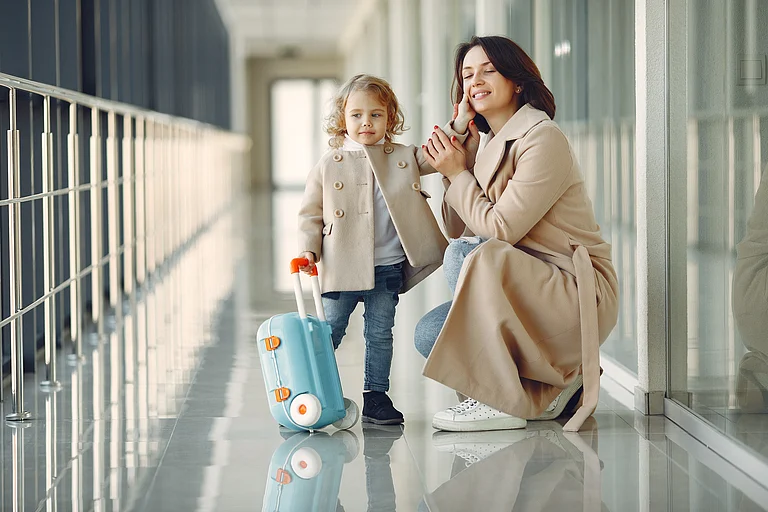
Support makes travel easier Unsplash
“A few years ago, there was almost an accepted wisdom that you put serious travel on hold once you had a baby,” says Tom Marchant, co-founder of luxury travel planner Black Tomato. “What we’re seeing now is a generation of parents, often in their late thirties and used to travelling well, who simply refuse to do that.”
What they want is for the logistical friction to be removed so that the experiences can really shine. “When you’re travelling with an infant, the mental load is enormous. Every decision that hasn’t been thought through in advance becomes a stressor,” Marchant says. Therefore, the value of a property that already anticipates those needs is immeasurable.
Advertisement
And that drives decision-making. He says clients sometimes choose a destination specifically because, as planners, they were able to confirm that a particular property had the right infrastructure for their baby. “And equally, destinations that should be high on their radar get dismissed early because the logistics feel too uncertain.” If a property can guarantee that equipment is already there, sourced well, and in good condition, that removes a meaningful barrier.
At Martinhal, this approach is devised around a service–child concierge that allows parents to pre-book essentials such as warmers, safety gates, baby cots, and door protectors. “There is an increasing demand for larger essentials too, such as pushchairs, bottle sterilisers, baby monitors and bed protections,” says Chitra Stern, founder-CEO, Martinhal Family Hotels & Resorts.
However, preferences have evolved significantly over time. It is no longer just about equipment; it is about integrated services. This includes baby menus, dedicated nursery facilities and supervised kids’ drop-off for children as young as six months.
Advertisement

Pyjama Club at Martinhal Chiado, Lisbon Viren Naidu
That approach now extends beyond just infrastructure, which Marchant refers to as “pre-arrival intelligence.”
“Parents now expect that by the time they walk through the hotel door, everything has already been considered– the right baby formula is stocked, snacks within reach, the temperature of the room has been adjusted,” he says. “It sounds detailed because it is, but it is this personalisation that differentiates a child-welcoming property from simply a child-friendly one,” says Marchant.
Childcare Assistance In Luxury Hospitality
While still rare, this form of childcare assistance is resurfacing in parts of the luxury hospitality sector, and luxury advisors feel that such travellers are not just influencing amenities, but also design. “They even demand baby-proof screen doors, anti-slip bath mats, fences added around plunge pools,” says Kiki Humes, an advisor with Virtuoso, a global network of agencies specialising in luxury and experiential travel.
“It's really convenient for parents to hop on a plane knowing the hotel can support all of their unique needs for a stay, without having to carry the additional luggage,” she says.
Advertisement
However, this has not yet been established as an industry standard, as many treat childcare as a peripheral service limited to play areas or gardens rather than something more holistic.
But in the few places where it is integrated, the shift is difficult to overlook: a meal relished without any tantrums, an introspective visit to the museum, and a leisurely evening sipping coffee, devoid of negotiation. “Travelling with infants can be overwhelming for parents, largely because of the volume of essentials they need to bring on holiday,” says Stern. But by anticipating what both parents and children need, she says, a mother can enjoy her cappuccino with the foam still on it.
It signals a new way of thinking — one where the labour of child care is not ignored but shared. And that still counts for something when on a holiday.
FAQs
1. Are there hotels that provide childcare for babies?
Advertisement
Yes, some family-focused and luxury hotels offer childcare services, including supervised kids’ clubs, babysitting, and even infant care facilities.
2. What should parents look for in a baby-friendly hotel?
Look for amenities like baby cots, sterilisers, kids’ clubs, childcare staff, baby menus, and pre-arrival customisation based on your child’s needs.
3. Is it safe to leave babies in hotel childcare services?
Reputed hotels follow strict safety protocols, trained staff supervision, and detailed onboarding processes, making them generally safe for short durations.
4. How do hotels make travelling with infants easier?
They reduce the mental and physical load by providing essential equipment, childcare support, and personalised services that maintain the baby’s routine.
5. Are luxury hotels better for travelling with babies?
Luxury hotels often offer more comprehensive childcare services and infrastructure, but some boutique and family-focused properties also provide excellent support.
Published At: