For years, Ladakh has been the sort of place travellers dream about. Stark mountains. High-altitude lakes that look almost unreal. Monasteries clinging to rocky cliffs. Every summer, once the roads reopen and the snow retreats, the region fills with visitors eager to experience its dramatic landscapes. But 2025 told a different story.
Tourist Arrivals In Ladakh Dip Sharply In 2025, Government Data Reveals
From geopolitical tensions to heavy rainfall, multiple disruptions led to a noticeable fall in tourist arrivals in Ladakh in 2025

Advertisement
New data shared by the Union government in Parliament reveals that tourist arrivals in Ladakh dropped significantly compared to the previous year. The downturn came after a turbulent stretch marked by security concerns, geopolitical tensions, weather disruptions, and logistical challenges—events that collectively unsettled travel plans and cut short the region’s peak tourism season.
Visitor Numbers Dip
The numbers show a clear slowdown. Domestic tourist arrivals in Leh fell from 2,92,836 in 2024 to 2,12,799 in 2025, a decline of about 27.3 percent. The drop was far sharper in Kargil, where domestic tourism plunged from 3,20,432 visitors in 2024 to just 93,389 in 2025—a steep fall of more than 70 percent.
Foreign tourist arrivals also slipped during the same period, though the decline was more gradual. Leh recorded 29,049 international visitors in 2025 compared with 34,915 the previous year. In Kargil, foreign arrivals fell from 4,215 to 3,072.
While the numbers still represent a substantial volume of travellers, the decline has been significant enough to worry local businesses. Tourism in Ladakh runs on a tight schedule. Winters are long and harsh, and roads remain closed for months due to heavy snowfall. That means the summer season—often just four to five months—has to sustain much of the year’s earnings. When visitor numbers drop during that window, the impact is immediate.
Advertisement
A Season Of Disruptions
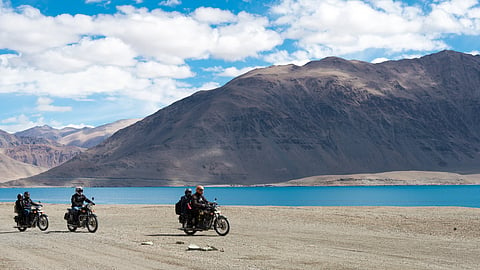
A bunch of travellers near Pangong Lake in Ladakh Shutterstock
Several developments during 2025 contributed to the slowdown. In April, a terrorist attack in the Baisaran Valley near Pahalgam shook the wider region. The attack, one of the deadliest on civilians in recent years, raised security concerns and triggered heightened tensions along the border.
India subsequently launched Operation Sindoor targeting terror infrastructure across the border, further escalating the situation for a brief period. Although Ladakh itself was not the direct site of these events, the broader geopolitical tension affected travel sentiment across the region.
The aftermath also saw several countries—including the United States, the United Kingdom, and Australia—issue travel advisories for parts of Jammu and Kashmir and Ladakh. International travellers tend to respond quickly to such advisories, and cancellations soon followed.
Then came the weather. Heavy monsoon rainfall damaged and disrupted key access routes into the region during the peak travel months. For a destination that already depends heavily on limited road and air connectivity, even temporary closures can quickly ripple through the tourism sector. Put together, the result was a shorter and far more uncertain tourist season.
Advertisement
The Industry Feels A Strain
The effects have been felt across Ladakh’s tourism ecosystem. Hotels, guesthouses, taxi operators, tour guides, and small businesses all depend on the steady stream of summer visitors. In recent years—particularly after the pandemic—many entrepreneurs expanded their operations, encouraged by a surge in domestic travel. New vehicles were purchased, more rooms were built, and tourism infrastructure grew rapidly.
But when the expected tourist numbers did not materialise in 2025, many found themselves facing financial pressure.
Recognising the strain on businesses, the Ladakh administration issued a notification in September 2025 enabling banks to extend relief under the Reserve Bank of India’s framework for areas affected by natural calamities. A committee consisting of State Bank of India, Punjab National Bank, and Jammu & Kashmir Bank later prepared a rehabilitation plan for borrowers affected by the downturn.
The measures include loan restructuring, extended repayment timelines, moratorium options, and the conversion of accrued interest into funded interest term loans. Borrowers may also receive additional working capital loans of up to 15 percent of their existing credit limits.
Advertisement
At the same time, the Centre has pointed to longer-term initiatives aimed at strengthening tourism-linked livelihoods. Under the Pradhan Mantri Janjatiya Unnat Gram Abhiyan, the government plans to support the development of 1,000 homestays across tribal regions. States and Union Territories—including Ladakh—can receive assistance of up to ₹5 crore to develop homestay clusters in villages.
Additionally, the Union Budget 2025–26 introduced collateral-free institutional credit through Mudra loans to encourage the creation of homestay businesses across the country.
For Ladakh, tourism remains both an economic lifeline and a delicate balancing act. The region’s dramatic landscapes, monasteries, high-altitude lakes, and emerging attractions such as astro-tourism in Hanle continue to draw travellers from around the world.
And despite the difficult year, many in the industry believe the destination’s appeal is unlikely to fade anytime soon. Once stability returns and travel conditions improve, Ladakh’s familiar summer rhythm of visitors and adventure may well pick up again.
Advertisement
FAQs
1. Did tourist arrivals in Ladakh decline in 2025?
Yes. Government data shows a noticeable drop in tourist arrivals across both Leh and Kargil in 2025 compared to 2024.
2. How much did tourism decline in Leh in 2025?
Domestic tourist arrivals in Leh fell by about 27.3 percent, from 2.92 lakh in 2024 to around 2.12 lakh in 2025.
3. Which region in Ladakh saw the sharpest drop in tourists?
Kargil recorded the steepest decline, with domestic tourist arrivals falling by more than 70 percent in 2025.
4. What caused the decline in tourist arrivals in Ladakh?
Security concerns, travel advisories after the Pahalgam attack, geopolitical tensions, and heavy monsoon disruptions affected travel.
5. What measures has the government taken to support the tourism sector?
Authorities have introduced loan restructuring, repayment relief, and tourism livelihood schemes including support for homestay development.
Published At: