Global tourism is clearly shifting in 2026, with travellers prioritising safety and stability over cost. According to the United Nations World Tourism Organization (UNWTO), international tourist arrivals have crossed 130 crores, but where people are travelling is changing significantly.
Spain, Portugal, And Southern Europe Lead 2026 Travel Surge As Global Tourism Shifts To Safer Destinations
As safety becomes a key factor, travellers are choosing Southern Europe over conflict-affected regions in 2026

Advertisement
Ongoing conflicts in parts of the Middle East and eastern Mediterranean are pushing travellers to rethink their plans. Instead of cancelling trips, most are choosing alternative destinations that feel safer, mainly in Southern and Western Europe.
Southern Europe Sees Strong Rise In Travel Demand

National Palace of Queluz in Portugal Shutterstock
Spain and Portugal are seeing the biggest travel surge as travellers shift routes. Both countries are reporting sharp increases in flight bookings and hotel searches ahead of the summer season.
According to Sojern, a travel marketing platform, summer flight bookings to Spain have jumped 32 per cent year-on-year, while hotel searches are up 28 per cent. Portugal is also seeing strong growth, with flight bookings rising 21 per cent and hotel searches up 16 per cent.
Travel data firm Mabrian also noted that tourists are pulling back from Middle Eastern destinations and choosing southern European countries instead. Spain, already one of the most visited countries globally, is emerging as the biggest beneficiary of this shift.
Advertisement
Industry group Exceltur has slightly upgraded Spain’s tourism outlook, now expecting the sector to generate EUR 227 billion in 2026. It also estimates that redirected demand could add around EUR 4.2 billion to that total.
Middle East And Eastern Mediterranean See Drop

Flights have been cancelled, delayed, and rerouted following widespread Middle East airspace closures triggered by the escalating Israel–Iran conflict (representative photo) Shutterstock
The increase in the number of travellers to Europe is coming at the cost of destinations in and around the Middle East and eastern Mediterranean, which usually attract around 18.1 crore tourists each year.
Recent tensions and conflict in the region have led to cancellations across several destinations, including Cyprus. The impact is not limited to leisure travel; it is also affecting major transit hubs, creating uncertainty for long-haul travellers.
Experts warn that continued instability, along with rising fuel prices, could further reduce travel demand to these regions in the coming months.
Schengen Countries Become Global Travel Hub
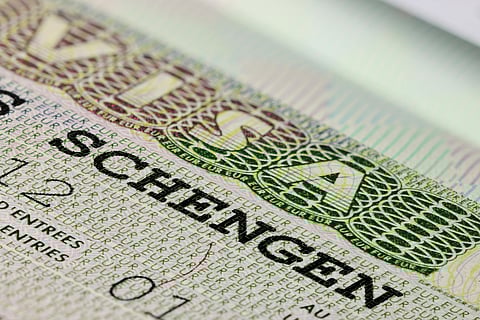
Schengen Visa BjoernWylezich/Shutterstock
Countries across the Schengen Area, including Spain, Portugal, France, Italy, Greece and Croatia, are now seeing record demand, making Southern Europe the centre of global tourism in 2026.
Advertisement
At the same time, Europe has introduced its new Entry/Exit System (EES), which replaces passport stamping with biometric checks. Travellers now need to provide fingerprints and facial scans when entering Schengen countries for the first time.
While the system is meant to improve security, it has also led to longer queues at major airports such as Lisbon, Paris, and Rome during the initial rollout.
Rising demand is also pushing up travel costs. Airlines have increased capacity, with seat availability up nearly 6 per cent year-on-year, especially on routes from the US and UK. However, higher fuel costs and congestion are driving up the cost of flights and accommodation.
As a result, travellers are changing how they plan trips. Many are choosing “slow travel,” staying longer in one place instead of visiting multiple cities. There is also a growing preference for shoulder-season travel, with April and May becoming more popular than peak summer months.
Advertisement
(With inputs from various sources)
FAQs
1. Why are Spain and Portugal seeing a travel surge in 2026?
Spain and Portugal are experiencing increased demand as travellers prioritise safety and stability. Ongoing geopolitical tensions in parts of the Middle East and eastern Mediterranean have led tourists to choose alternative destinations that feel more secure.
2. How much has travel demand increased in Southern Europe?
Recent data shows significant growth, with Spain seeing a 32% rise in flight bookings and a 28% increase in hotel searches. Portugal is also witnessing strong growth, with bookings and searches rising by over 20% and 16% respectively.
3. What regions are seeing a decline in tourism?
Destinations in the Middle East and eastern Mediterranean are seeing reduced travel demand due to ongoing conflicts and uncertainty. This includes both leisure destinations and transit hubs.
4. What is the Schengen Entry/Exit System (EES)?
The EES is a new digital border control system in Europe that replaces passport stamping with biometric data collection, including fingerprints and facial recognition. It aims to improve security but may cause longer airport wait times initially.
Advertisement
5. How is the travel surge affecting costs?
Increased demand is pushing up flight and accommodation prices. While airlines have added more capacity, rising fuel costs and congestion are contributing to higher travel expenses.

Published At: