The elusive caracal, one of India's most threatened wild cats, has been recorded in Madhya Pradesh's Kuno National Park after decades, marking a significant milestone for wildlife conservation in the region. Captured on a camera trap and announced on World Environment Day, the sighting has renewed attention on the park's evolving ecosystem, which has undergone extensive restoration efforts in recent years.
Rare Caracal Returns To Kuno National Park After Decades
A rare camera trap image has confirmed the return of the elusive caracal to Kuno National Park after decades. Conservationists see the sighting as a sign of improving habitats and growing biodiversity in India's flagship wildlife landscape

Advertisement
A camera trap survey conducted in Kuno National Park recently recorded the presence of a caracal, a species that has become increasingly rare across India. The sighting is particularly significant because the species has not been documented in the Kuno landscape for decades.
Often called the "flying cat" for its remarkable ability to leap into the air and catch birds mid-flight, the caracal is native to parts of Africa, the Middle East and Central Asia. In India, its historic range once extended across western and central regions, but habitat degradation and shrinking grasslands have pushed the species to the brink, making sightings exceptionally uncommon.
The latest record from Kuno comes nearly ten months after another caracal was reported from Gandhi Sagar Wildlife Sanctuary, another important conservation landscape in Madhya Pradesh that has also become part of India's expanding cheetah conservation efforts.
Conservation Efforts Showing Wider Ecological Impact
Wildlife experts and state authorities view the return of the caracal as evidence that conservation initiatives in Kuno are benefiting a broader range of species beyond the African cheetahs introduced under Project Cheetah.
Advertisement
The project was conceived not only as a cheetah reintroduction programme but also as a landscape-level conservation effort aimed at restoring habitats, improving biodiversity and strengthening ecological processes. Officials noted that the presence of a top predator such as the caracal suggests healthier prey populations, improved grassland ecosystems and better overall habitat quality.

Kuno National Park Wikipedia Commons
Over the past few years, Kuno has witnessed extensive habitat management and protection measures. Improved water availability has been a key component of these efforts, with solar-powered systems supporting water distribution across the landscape. Water from the Kuno River is now channelled through a 15-kilometre pipeline to recharge ponds situated at higher elevations within the park.
Kuno Emerging As A Biodiversity Hotspot
The caracal sighting is the latest in a series of notable wildlife records from Kuno National Park. Before the arrival of cheetahs from Botswana, the park recorded its first-ever sighting of the endangered Forest Owlet, a bird species once believed extinct before its rediscovery in the late 1990s.
Advertisement
The park has also reported the presence of species such as the Indian wolf and the dhole, or Asiatic wild dog, both indicators of a functioning ecosystem. Conservation managers attribute these sightings to improved protection measures, habitat restoration and enhanced water security across the landscape.
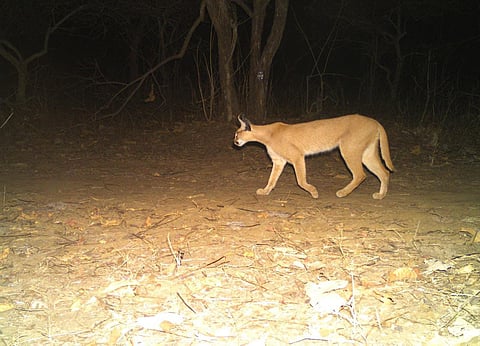
The caracal was caught on a camera trap (representational image) @Sanjay4India1/x
Wildlife officials say Kuno is increasingly being recognised for more than just its cheetah population. The reintroduction programme has acted as a catalyst for broader ecological recovery, creating conditions that support a diverse range of species, including some of India's rarest predators.
The return of the caracal, therefore, is being seen not merely as an isolated wildlife sighting but as a powerful indicator that conservation interventions in Kuno are helping restore ecological balance across one of India's most closely watched protected areas.
(With inputs from various sources)
FAQs
1. What is a caracal?
The caracal is a medium-sized wild cat known for its distinctive tufted ears and remarkable jumping ability. It is one of India's rarest and most threatened feline species.
Advertisement
2. Why is the caracal sighting in Kuno National Park significant?
The sighting marks the return of a species not recorded in the Kuno landscape for decades and suggests improving habitat quality and ecological health.
3. Where is Kuno National Park located?
Kuno National Park is located in Madhya Pradesh and is best known as the home of India's African cheetah reintroduction programme.
4. How is Project Cheetah helping biodiversity in Kuno?
Beyond cheetah conservation, habitat restoration, water management, and protection measures have improved conditions for many species, including wolves, dholes, forest owlets, and now caracals.
5. Are caracals endangered in India?
Caracals are among India's most threatened wild cats. Habitat loss, shrinking grasslands, and human pressures have led to a significant decline in their population and range.
Published At: