The Outlook Traveller Awards ceremony, held on November 22 at the Hyatt Regency in New Delhi, played out with visible excitement, drawing together destinations and voices influencing the direction of modern travel. The 2025 edition recognised standout destinations across key categories while also honouring individuals for their social media influence, underlining the shifting ways travellers discover and choose where to go.
Outlook Traveller Awards 2025: Kannur International Airport Showcases North Malabar’s Tourism Power
Named Silver Partner at the Outlook Traveller Awards 2025, Kannur International Airport showcased North Malabar’s rich history, culture, and landscapes, underlining its growing role in connecting Kerala’s northern region with India and the world

Advertisement
This year, the awards placed special emphasis on countries and destinations that are actively engaging with Indian travellers—those that recognise India’s expanding traveller base and are adapting experiences to suit its changing preferences and spending power. Capturing this dual focus, the 2025 tagline read, “Celebrating India, Celebrated By The World.”
At the Outlook Traveller Awards 2025, Kannur International Airport was named Silver Partner, marking its growing prominence on India’s aviation and tourism map.

Pavithran, Head of ARFF Deposit Photos
Representing Kannur International Airport, Pavithran, Head of ARFF, used the platform to take the audience on a detailed journey through Kerala’s northern Malabar region, situating Kannur within a larger historical, cultural and tourism narrative. He began by placing Kerala geographically and symbolically, describing it as a small yet strikingly diverse state located around 2,500 kilometres south of Delhi. Despite covering only about 38,000 square kilometres, Kerala stands out for having four international airports, enabling strong connectivity not just with the world but across India as well.
Advertisement
Kannur International Airport, he explained, is located in the northern part of Kerala, in the region known as North Malabar. This region, according to Pavithran, offers everything a traveller could seek—from heritage and history to beaches, waterfalls, mountains and adventure. North Malabar is home to driving beaches, multiple forts, including Payyannur Fort, and a range of landscapes that cater to varied travel interests.
Kannur is also known for what Pavithran described as the “three Cs”—cake, cricket and circus. The city holds a unique place in India’s culinary and sporting history. The first cake made in India was baked here in 1883 by the Royal Biscuit Factory. Cricket, too, has deep roots in Kannur; it was first played in India in this region during the 18th century, introduced by Sir Arthur Wellesley, who later became the Duke of Wellington.
Adding to this legacy, the first circus academy in India was established in Kannur in 1901, cementing the city’s association with the art form.
Advertisement
Beyond these milestones, Kannur is also known as the land of looms and lores (Theyyam), locally referred to in Malayalam as “Tharikaludeyum Thirakaludeyum Nadu.” Theyyam is a distinctive ritual art form characterised by elaborate facial painting and vibrant red hues. Popular culture has brought renewed attention to this tradition; the art form featured in the film 'Kantara' originates from this very region. The loom tradition is equally significant, with Kannur’s handloom textiles recognised and admired across the world.
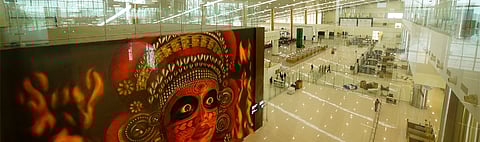
A Theyyam-themed artwork inside Kannur International Airport Supplied
The region is also the birthplace of Kalaripayattu, one of the oldest martial arts in the world. Originating in this area, Kalaripayattu involves the use of sticks, swords and other weapons, and the term itself refers to the school or space where the art of defence and combat is taught. It is pertinent to mention that the famous freedom fighter Pazhassiraja fought the war against the Britishers using this martial arts form, Kalaripayattu. This tradition continues to draw interest from practitioners and wellness travellers alike.
Advertisement
Among Kannur’s natural highlights is Asia’s longest drive-in beach at Muzhappilangad, stretching across four kilometres. Located close to Kannur International Airport, the beach allows visitors to drive vehicles along the sand while enjoying the sea breeze and open shoreline.

An aerial view of Kannur International Airport Supplied
Tracing Kannur’s historical significance, Pavithran noted that the region had a functioning port as early as 1881. This port played a role in British East India Company operations, while a railway station at nearby Chirakkal, established in 1908, facilitated trade with Britain, America and European countries via Bombay ports. Although Kannur International Airport was officially commissioned in 2018, the region had already found a place in Indian aviation history in 1935. At the time, Tata Airlines operated flights from Bombay to Thiruvananthapuram, with stopovers at Goa and Kannur, then known by a different name. Aircraft landed at a ground called Kottamaidanam, which functioned as an early airstrip.
Even before Kerala was formally formed as a state in 1956, Kannur demonstrated its commercial importance. A chamber of commerce was already functioning here in 1955, and notably, the membership fee at the time stood at INR 1,000—a considerable amount for that era.
Advertisement
Pavithran also outlined the tourism infrastructure surrounding the airport. To the north lie Bekal Fort, Kanhirangad Beach, Paithalmala, PalakkayamThattu and Ezhimala waterfalls, offering opportunities for adventure and exploration. To the south, travellers can access Wayanad, Bandipur Tiger Reserve, the Muthanga forests, Edakkal Caves and Thirunelli, along with islands and craft villages that provide insight into the lives of local artisans. To the west, Kannur’s coastline unfolds with multiple beaches, including Muzhappilangad.
The region supports diverse forms of tourism—pilgrimage tourism, beach tourism, adventure tourism in the hills and health tourism rooted in traditions such as Kalari and marma chikitsa. Concluding his address, Pavithran thanked the audience and the Outlook team, extending an invitation to explore Kannur as a land of tourism wonders and discover its hidden treasures on India’s tourism map.
FAQs
1. Why was Kannur International Airport recognised at Outlook Traveller Awards 2025?
Kannur International Airport was named Silver Partner for highlighting North Malabar’s tourism potential and its role in improving regional and global connectivity.
Advertisement
2. What makes North Malabar an important tourism region in Kerala?
North Malabar offers a rare mix of heritage forts, ritual arts like Theyyam, beaches, hills, adventure tourism and traditional wellness practices.
3. What cultural traditions is Kannur known for?
Kannur is famous for Theyyam ritual performances, handloom weaving, Kalaripayattu martial arts, and historical contributions to cake, cricket and circus in India.
4. What are the key natural attractions near Kannur International Airport?
Major attractions include Muzhappilangad drive-in beach, Bekal Fort, Ezhimala hills, Paithalmala, Wayanad forests and nearby waterfalls.
5. How does Kannur International Airport support tourism growth?
The airport strengthens access to North Kerala, connecting travellers to beaches, heritage sites, hill destinations and cultural hubs while boosting regional tourism infrastructure.

Published At: