If you are planning to do the Kailash Mansarivar Yatra, here is some news. Fresh arrangements are being put in place in East Sikkim ahead of the upcoming Kailash Mansarovar Yatra, with new acclimatisation centres scheduled to open in April 2026. The facilities, coming up at 18th Mile and near Hangu Lake, have been built at a cost of INR 4,223 lakh and are intended to help pilgrims adjust gradually to the region’s thin air. Officials say the centres will serve as an important stopover, giving travellers time to adapt and lowering the chances of altitude-related illness before they move further along the route.
New Acclimatisation Centres Coming Up To Support Kailash Mansarovar Pilgrims In East Sikkim
If you are planning to do the Kailash Mansarovar Yatra, here is some news. New acclimatisation centres are coming up in East Sikkim at 18th Mile and Hangu Lake to help pilgrims adjust to high altitude conditions before the journey ahead

Advertisement
Preparing For Thinner Air
If you are taking the East Sikkim route, these acclimatisation centres are likely to be one of your first key halts. They have been set up specifically for pilgrims on this stretch, giving you a planned stop before the journey becomes more physically demanding.
At these centres, you are expected to slow down and give your body a bit of time to catch up with the altitude, instead of moving on straightaway. It may feel like a delay, but it often proves useful once you head into higher stretches where the air gets thinner and the going tougher.
These facilities are also part of the broader build-up to the 2026 yatra season. The focus has been on making the route a little safer and more manageable, especially in sections where altitude can quickly take a toll if you are not properly prepared.
For you as a traveller, this means a more structured and better-supported journey. It also reflects a broader effort by state and national authorities to improve facilities along major pilgrimage routes, making the experience more manageable without taking away from its spiritual significance.
Advertisement
Why Acclimatisation Matters
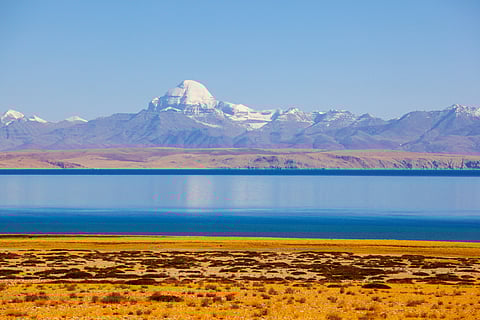
Lake Manasarovar with the Kangrinboqe Peak in the background Meiqianbao/Shutterstock
Your body needs time to adjust
As you move higher, the air gets thinner and oxygen drops. Your body does not adapt instantly, which is why acclimatisation becomes important. It helps reduce the risk of serious altitude-related conditions such as HAPE and HACE, which can develop if you ascend too quickly.
Do not rush the ascent
The safest approach is to move up in stages and stick to planned stops along the route. You are better off building in rest days rather than trying to cover distance in one go. Pushing ahead too quickly is one of the main triggers for Acute Mountain Sickness, something you will want to avoid on this journey.
Sort your medical readiness early
Before you set out, get a proper health check and make sure you are fit for high-altitude travel. Carry prescribed medication for altitude sickness and double-check your insurance coverage. It is better to have everything in place before you begin, rather than deal with issues once you are already on the route.
Advertisement
The Kailash Mansarovar Yatra: What To Expect
The Kailash Mansarovar Yatra is regarded as one of the most sacred pilgrimages, centred around Mount Kailash and Lake Mansarovar. For you, it is not just a trek but a spiritual circuit that includes the 52-km Parikrama around Mount Kailash, believed to cleanse past sins and hold deep religious significance across Hinduism, Buddhism, Jainism, and Bon.
Where the journey actually goes
The route takes you into Tibet, with access usually through Nepal or through India, depending on the itinerary. Once you are on the trail, the main focus is Mount Kailash and Lake Mansarovar, along with the 52-km circumambulation around the mountain. There are also key stops like Gauri Kund, but much of the journey is spent in remote, high-altitude terrain where facilities are limited and conditions can shift quickly.
This is not a short or easy pilgrimage. You are typically looking at around 15–20 days, with long stretches at very high altitude, often above 15,000 ft. The terrain is steep in parts, and the oxygen levels are low throughout. Good fitness and a steady pace matter more than speed here, and most people find that how you manage your energy day to day makes a big difference to the overall experience.
Advertisement
Check our guide to planning for the yatra here.
FAQs
Why is acclimatisation important for the Kailash Mansarovar Yatra?
It helps your body adjust to low oxygen levels at high altitude and reduces the risk of serious conditions like Acute Mountain Sickness, HAPE and HACE.
Where are the new acclimatisation centres located?
The new centres are in East Sikkim, at 18th Mile and near Hangu Lake, along the route used by pilgrims.
How long does the Kailash Mansarovar Yatra usually take?
The journey typically lasts around 15–20 days, depending on the route and weather conditions.
What is the biggest challenge during the yatra?
The combination of high altitude, low oxygen levels and steep terrain makes it physically demanding, even for fit travellers.
Published At: