Anyone familiar with Mumbai’s Gateway of India knows how busy it can get. Visitors spill across the promenade, lines build up at the jetties, and boats arrive and depart in a continuous flow. To address this, the Maharashtra government is planning a modern jetty to ease crowding and improve the movement of passengers and vessels along the waterfront.
Mumbai’s Gateway Of India To Get Modern Jetty Amid Rising Tourist Footfall
The Maharashtra government plans to develop a modern jetty at Mumbai’s Gateway of India to ease congestion and improve passenger movement

Advertisement
Rethinking A Crowded Waterfront
According to Ports Development Minister Nitesh Rane, the proposed jetty is designed to improve the flow of passengers and vessels. The Gateway of India, one of Mumbai’s busiest landmarks, sees high daily footfall, putting pressure on existing infrastructure and raising concerns about safety and efficiency.
The government plans to strengthen jetty management systems, introduce modern boats, develop marinas, and improve passenger amenities.
This approach reflects a shift toward upgrading not just physical infrastructure but also the quality of services at key maritime points. Enhancing facilities is expected to support domestic tourism and international maritime activity, making Mumbai more competitive as a global coastal destination.
Coordination With Centre On Key Issues
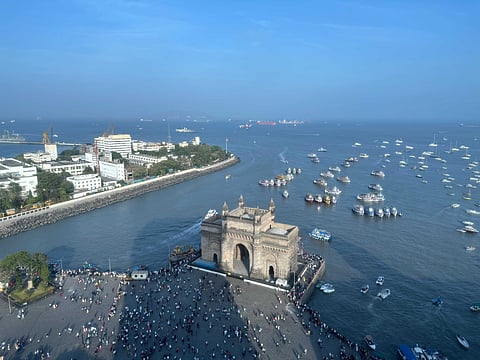
Aerial view of The Gateway of India and the Arabian Sea in Mumbai SwapFrance/Shutterstock
The state government has taken up several concerns with the Union Ministry of Ports, Shipping and Waterways regarding Jetty No. 5 at the Gateway of India. The state government has taken up several concerns with the Union Ministry of Ports, Shipping and Waterways regarding Jetty No. 5 at the Gateway of India. Rane raised these issues while replying to a calling attention notice moved by member Ashok Patil, with legislators Varun Sardesai and Prakash Surve also participating in the discussion.
Advertisement
These concerns include obtaining necessary permissions, revisiting the tariff structure, and ensuring adherence to safety regulations.
Such coordination is essential because maritime infrastructure projects often involve multiple regulatory authorities. Addressing these issues at the central level is expected to ensure smoother implementation and that the upgraded jetty meets national safety and operational standards.
Existing Jetty System And Proposed Changes
Currently, there are five jetties at the Gateway of India. Jetty Nos. 1 to 4 are used by general passengers and managed by the Mumbai Port Trust. These jetties handle most ferry and boat traffic, contributing significantly to congestion during peak hours.
Jetty No. 5 is proposed to be designated primarily for private and larger yachts. By diverting high-end and private vessel traffic to a separate jetty, the government aims to reduce pressure on the existing passenger jetties. This separation is expected to create a more organised flow of traffic and enhance operational efficiency across the waterfront.
Advertisement
Concerns Over Revenue-Sharing Model
There has been public dissatisfaction with the current revenue-sharing arrangement at Jetty No. 5. Under the existing model, a significant portion of revenue goes to a private entity, raising concerns about fairness and transparency.
In response, the Maharashtra government formally wrote to the Union Ministry on February 16, requesting a review of the tariff structure. Revisiting this model is seen as necessary to ensure a more equitable distribution of revenue and align financial arrangements with public interest.
Measures To Support Fishermen And Boat Operators
The government is also focusing on improving the livelihoods of fishermen and boat operators. One initiative is encouraging the transition from traditional wooden boats to modern vessels. To help, the government is assisting operators in accessing bank loans, making it easier to invest in upgraded boats. There is also a push to promote electric boats, which are expected to be more environmentally friendly and cost-effective in the long run.
Advertisement
Addressing Efficiency And Safety At A Key Landmark
The main goal of the proposed developments is to improve safety, reduce congestion, and enhance operational efficiency at one of Mumbai’s busiest waterfronts. By combining infrastructure upgrades with policy changes and stakeholder support, the government aims to create a more sustainable and organised maritime environment at the Gateway of India.
(With inputs from PTI.)
FAQs
1. Why is a new jetty being planned at the Gateway of India?
The new jetty is being planned to reduce congestion, improve passenger flow and enhance safety at one of Mumbai’s busiest tourist landmarks.
2. What changes are proposed under the Gateway of India jetty project?
The project includes building a modern jetty, improving passenger amenities, introducing better boats and strengthening jetty management systems.
3. How many jetties currently exist at the Gateway of India?
There are currently five jetties, with most passenger traffic handled by jetties 1 to 4.
4. What is the purpose of Jetty No. 5 in the new plan?
Jetty No. 5 is expected to be used primarily for private and larger yachts to reduce pressure on passenger jetties.
Advertisement
5. How will the project impact tourists?
Tourists can expect smoother boarding processes, reduced crowding and improved facilities at the Gateway of India.

Published At: