The Ladakh administration is planning to develop parts of Choglamsar and Wari La in Leh into a “Valley of Flowers” as part of efforts to draw more visitors to the region. The project is expected to be completed by late June 2026, according to officials.
Ladakh Plans High-Altitude ‘Valley Of Flowers’ Project To Boost Tourism
Ladakh is developing Choglamsar and Wari La in Leh as a “Valley of Flowers” to boost tourism and add colour to its cold desert landscape. The project focuses on planting hardy, high-altitude species and is expected to be completed by June 2026

Advertisement
Work under the initiative will focus on planting hardy flower species suited to high-altitude conditions across stretches of the cold desert terrain. The aim is to bring seasonal patches of colour to areas that are otherwise largely barren, adding a new visual element to Ladakh’s tourism landscape.
Plant Species Planned For High-Altitude Conditions

The landscape of Leh Shutterstock
The project will focus on introducing a carefully selected mix of resilient flowers and native flora capable of surviving Ladakh’s high-altitude desert conditions. While the final list of species for large-scale plantation is being finalised, the approach is centred on hardiness, low water requirement and suitability to extreme cold.
Resilient species: A broad range of plants identified by horticulture experts for their ability to withstand low temperatures, strong winds and limited moisture. These will form the core of the plantation effort.
Initial test varieties: Early-stage beautification work in the region has already experimented with a mix of hardy and ornamental species, including Petunia, Salvia, Marigold, Gitika, Champa, Blue Pine, Deodar, Cypress, Foxtail Palm, and Areca Palm, to assess adaptability in local conditions.
Advertisement
Native alpine flora: A key focus of the initiative is the integration and enhancement of indigenous high-altitude plants naturally suited to the cold desert ecosystem, helping ensure ecological balance alongside visual development.
The Selection Process
The selection of plant species is being carried out jointly by the Ladakh administration and horticulture specialists, including botanists who work with high-altitude ecosystems. The emphasis is on choosing varieties that can cope with the region’s extreme cold, thin air and poor soil conditions.
The project is part of a larger push to increase green cover, which also includes the "Him Sarovar" project (constructing 50 ponds to harvest glacier melt) to address water scarcity and enhance sustainability.
The Two Sites
Choglamsar lies along the Indus, a short drive from Leh, and is best known as a mixed residential and cultural area. It has a visible Tibetan presence, including the SOS Tibetan Children’s Village school. The settlement also connects to nearby heritage and social infrastructure such as the Chamba Rock carvings and the Mahabodhi Karuna Charitable Hospital. Compared to Leh, it is less commercial and more residential, with everyday activity centred around small shops and local services.
Advertisement
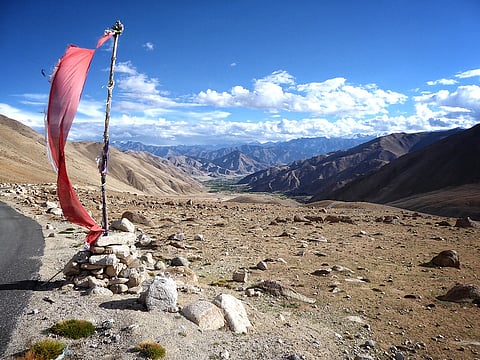
Wari La sits links the Indus Valley at Sakti with the Nubra Valley James Handlon/Flickr
Wari La sits links the Indus Valley at Sakti with the Nubra Valley. This high-altitude area is quieter than and sees far less traffic than Khardung La. There is no mobile connectivity along the route, and conditions are often harsh even in the main travel season. Entry to both Choglamsar and Wari La requires an Inner Line Permit, typically arranged through official channels or registered travel operators.
Fragile Ecology
In April this year, a trans-Himalayan cold desert urban forestry and food forest initiative was launched in Ladakh, in a move aimed at strengthening green cover, promoting environmental sustainability and improving food security in the region.

Bharal blue sheep in Ladakh Global Himalayan Expedition
Ladakh’s ecology is shaped by its high-altitude, cold desert conditions and remains highly sensitive to change. In recent years, shifting weather patterns, shrinking glaciers and rising tourist numbers have added pressure to an already limited resource base. Water availability is scarce, biodiversity is constrained, and waste management continues to be a growing challenge in several areas. As glacier reserves decline, there are already visible impacts on water supply for agriculture, highlighting the need for development that aligns closely with local environmental limits and long-established resource-efficient practices.
Advertisement
Environmental And Ecological Concerns
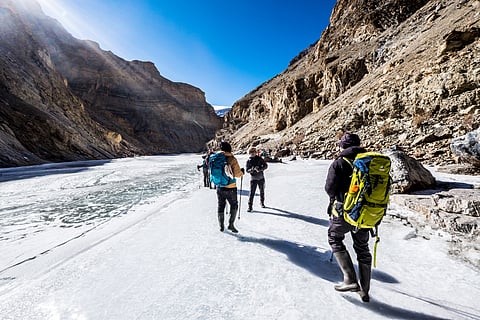
Trekkers walk across the frozen Zanskar River during Ladakh’s deep winter Shutterstock
The boom that tourism brings is only one side of the coin. The detrimental impacts are generating discussion and some corrective action. These include the degradation of Ladakh's fragile ecosystems and wildlife, a burgeoning solid waste and effluent problem, unregulated construction (much of it not following ecological and climate-sensitive approaches), increased vehicular load (especially visible in Leh town where traffic jams are becoming common), and detrimental socio-cultural changes such as the introduction of junk foods and homogenous western lifestyles.
Moreover, Ladakh receives minimal rainfall and depends largely on glacier melt for its water supply. With glaciers steadily receding, concerns have been raised that large-scale plantation efforts could further strain already limited water resources, particularly if new plantations require frequent irrigation during early growth stages.
These concerns are also relevant to the proposed “Valley of Flowers” project in Choglamsar and Wari La, where large-scale planting in a fragile ecosystem will require careful planning to avoid additional stress on water and soil resources.
Advertisement
FAQs
What is the Ladakh “Valley of Flowers” project?
It is a planned initiative to develop selected stretches in Choglamsar and Wari La with flowering plant species to enhance their visual appeal and support tourism in the region.
Which areas are being developed under the project?
The two identified locations are Choglamsar, a riverside settlement near Leh, and Wari La, a high-altitude mountain pass connecting the Indus and Nubra valleys.
What kind of plants will be used?
The project will use a mix of hardy ornamental species and native alpine flora suited to Ladakh’s cold desert conditions, selected for their ability to survive extreme weather and poor soil.
Who is overseeing the project?
The initiative is being implemented by the Ladakh administration in coordination with horticulture experts.
Is special permission required to visit these areas?
Yes, both Choglamsar and Wari La fall under the Inner Line Permit system, which is generally issued through authorised agents or official government channels.
Advertisement

Published At: