Ranthambore and tigers have always been synonymous. The majestic, striped beasts strike a sense of wonder when you see them roam in their wild home. And India’s tiger story has become one of the world’s most celebrated conservation successes. But with populations rebounding over the past two decades, the conversation is no longer just about bringing tigers back from the brink; it’s about ensuring they continue to thrive in landscapes that are changing faster than ever.
International Tiger Week 2026 Explores The Next Chapter Of India’s Tiger Story
Conservationists, policymakers and wildlife experts gathered in Ranthambore to explore how India's tiger success story can be sustained in an increasingly human-dominated landscape

Advertisement
That was the central message emerging from International Tiger Week 2026, organised by Live4Freedom at Ranthambore, where conservationists, policymakers, researchers and tourism stakeholders gathered from June 26 to 28 to discuss what the future of tiger conservation should look like.
The discussions repeatedly returned to one idea: conserving tigers cannot just be limited to protecting a single species. It requires safeguarding the ecosystems that support them. Conservation ecologist, author and photographer Dr Latika Nath argued that while tiger numbers remain an important measure of success, they cannot be the only one.
“We monitor the symbol, but are we monitoring the system?” she asked, urging conservationists to look beyond tiger counts and pay closer attention to the health of forests, prey populations and the ecological processes that sustain wildlife.
Nath also called for a shift from species-focused conservation towards ecosystem-based management, stressing that forests should be recognised as critical infrastructure rather than vacant land awaiting development. She noted that wildlife considerations often enter infrastructure projects only after planning is complete, instead of being integrated into decision-making from the outset.
Advertisement
Presenting what she described as a “Road to Resilience”, Nath outlined approaches that combine ecosystem restoration, climate resilience and community participation, while pointing to regional examples such as Bhutan and Nepal, where tourism revenues are reinvested into conservation and local livelihoods.
The second major theme of the conclave focused on the reality that an increasing number of India’s tigers now move beyond the boundaries of protected reserves.
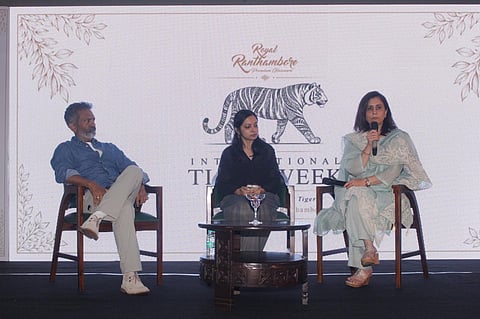
Dr Anish Andheria and Dr Latika Nath during a moderated discussion
Speaking on coexistence, Dr Anish Andheria, President and CEO of the Wildlife Conservation Trust, emphasised that conservation in today’s India must extend beyond national parks and tiger reserves. As roads, railway lines, and other infrastructure continue to expand, wildlife movement and habitat connectivity have become central conservation concerns.
Andheria also challenged the language commonly used around encounters between people and wildlife, suggesting that the phrase “human-wildlife conflict” oversimplifies complex situations. Instead, he advocated referring to them as “negative human-wildlife interactions”, arguing that such incidents require scientific understanding, better planning and long-term mitigation rather than reactive responses.
Advertisement
He also highlighted the importance of addressing disease risks at the wildlife-livestock-human interface and stressed that protecting tigers cannot remain the responsibility of forest departments alone. Effective conservation, he said, depends on coordinated action across government agencies, local administrations and communities.
Adding a visual dimension to the discussions, wildlife filmmaker Subbiah Nallamuthu revisited the extraordinary life of Ranthambore’s legendary tigress Machli through his award-winning documentary, reminding audiences how a single animal helped shape global interest in India’s wild tigers.
The conclave also explored the role of community participation, responsible tourism, corporate partnerships and habitat connectivity in ensuring that conservation keeps pace with development. The conclave also explored the wider conservation landscape through a series of discussions. Actor, screenwriter and producer Rahul Singh reflected on cinema's potential to inspire environmental awareness, while the Frontline Protection session saw Wildlife SOS Co-founder and CEO Kartik Satyanarayan speak about strengthening on-ground conservation efforts. In Responsible Safari, a panel featuring Antaraa Chatterjee (Outlook Traveller), Abhishek Kumar (Indit Associates), Neha Kumar (Climate Bonds) and Kunwar Angad Dev (Mandawa Group of Hotels) examined ethical wildlife tourism, responsible visitor behaviour and the role travellers can play in supporting conservation.
Advertisement
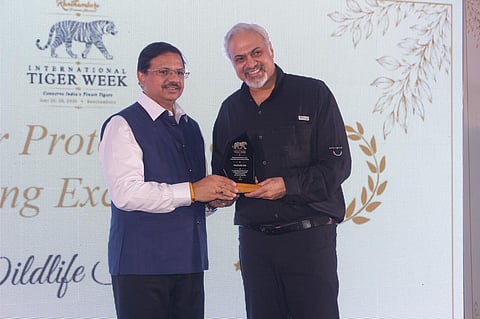
Wildlife SOS Co-founder and CEO Kartik Satyanarayan (right) being felicitated by Justice Dharmesh Sharma, Former Judge, Delhi High Court
The event concluded with the presentation of the International Tiger Week Awards, recognising individuals and organisations across 11 categories for their contributions to wildlife conservation. Children who spread awareness about tiger conservation through paintings were also felicitated.
Assam Chief Minister Himanta Biswa Sarma received the Tiger Conservation Leadership Award, while Union Minister Nitin Gadkari was recognised for the environmentally sensitive design of National Highway 44 through Pench Tiger Reserve, incorporating wildlife-friendly infrastructure to facilitate safe animal movement.
Live4Freedom partners Anand Bhardwaj and Suneal Mangal said that International Tiger Week is a unique platform that brings together leaders from conservation, government, tourism, business and civil society to strengthen collective efforts towards wildlife protection.
If there was one clear takeaway from International Tiger Week 2026, it was that India’s tiger story is entering a new phase. Recovering populations are worth celebrating, but the next chapter will depend on something far more complex: keeping forests connected, enabling coexistence with communities, and treating healthy ecosystems—not just tiger numbers—as the true measure of conservation success.
Advertisement
Published At: