A social media post about a traffic fine of nearly INR 1.5 lakh issued by Swiss authorities months after a holiday has drawn considerable attention online. The case involved an Indian visitor who said the penalty arrived close to a year after a trip to Switzerland in 2024 and was linked to the use of a rental car.
Indian Tourist’s Delayed Swiss Traffic Fine Highlights Strict Road Enforcement Abroad
A traffic fine of nearly INR 1.5 lakh issued by Swiss authorities almost a year after an Indian tourist’s visit has gone viral online, sparking discussion on delayed penalties and strict road enforcement across Europe

Advertisement
The post prompted a wave of responses from other travellers, many of whom said they had received speeding tickets and other traffic penalties long after returning from Europe. The discussion has highlighted how road traffic offences recorded abroad can be pursued well after a journey has ended, often through rental vehicle records and cross-border administrative processes.
The episode has served as a reminder that traffic violations recorded overseas do not necessarily disappear once a trip is over. In many European countries, enforcement systems can track offences through rental agencies and pursue penalties long after visitors have returned home.
Here is what travellers should know.
Traffic Rules In Switzerland
Driving in Switzerland comes with a set of rules that are enforced rigorously. From speeding offences to parking violations, penalties can be costly and are not always issued immediately after the incident.
Some of the most common violations that catch tourists off guard include:
Speeding offences: Switzerland operates an extensive network of speed cameras and automated monitoring systems. Penalties increase depending on how far a driver exceeds the limit, and can quickly run into hundreds of Swiss francs.
Parking violations: Leaving a vehicle without a valid parking ticket or overstaying the permitted parking period can lead to fines issued by local authorities.
Motorway vignette requirements: Drivers using Switzerland's motorway network must display a valid vignette, or highway sticker. Failure to do so can attract substantial penalties.
Advertisement

The city of Zurich in Switzerland Depositphotos
Rules That Often Catch Tourists Out Across Europe
Switzerland is not the only destination where visitors can face steep traffic penalties. Across Europe, local authorities make extensive use of cameras, digital tolling systems, and cross-border enforcement mechanisms, meaning fines can follow travellers home long after a holiday has ended.
Some of the regulations that frequently catch foreign drivers unaware include:
Restricted traffic zones: Many historic city centres, particularly in Italy, operate limited traffic zones that are reserved for residents, authorised vehicles, and local permit holders. Entering these areas without permission can trigger an automatic fine.
Average-speed monitoring: Several European countries use cameras that calculate a vehicle's average speed over a stretch of road rather than at a single point. Drivers exceeding the limit can face significant penalties.
Footwear requirements: In some countries, motorists can be fined if their footwear is considered unsafe for driving. Open-toed footwear and flip-flops are among the items that have attracted penalties in certain jurisdictions.
Mobile phone use: Holding a mobile phone while driving is prohibited in most European countries and can result in substantial fines, even if the vehicle is moving slowly or stopped in traffic.
Tolls and motorway stickers: Many roads require either electronic toll payments or the display of a valid motorway sticker. Failure to comply can lead to automatically generated penalties.
Immediate penalties: In some cases, motorists stopped by police may be asked to pay a fine immediately or provide a deposit before being allowed to continue their journey.
Cross-border enforcement: Traffic authorities routinely obtain driver information through vehicle registration and rental records, allowing penalty notices to be sent to travellers after they have returned home.
Advertisement

Many historic city centres in Europe operate limited traffic zones that are reserved for residents Shutterstock
What Can Happen If You Ignore It
Traffic fines in Europe do not stop at the border. Once a violation is recorded, details can travel through rental car companies and official enforcement systems, which is why notices often arrive long after a traveller has returned home.
If a fine is left unattended, the cost is rarely limited to the original amount written on the ticket. Extra charges can be added, and the case can become more complicated as time passes. Here are some rules to know.
Rental companies add their own charge: When police request driver details, the hire firm typically passes on the information and adds a separate administrative fee for handling the process.
Late payment pushes the bill up: If the notice is ignored past the deadline, extra charges can be added and the amount can climb beyond the original fine.
Rental companies don’t forget easily: Car hire firms often keep a note of unpaid violations, which can affect how future bookings are handled.
Advertisement
It can come back later: Unsettled fines tied to official records may surface again on later trips to Europe or during routine checks.
The letter is the only guide: Payment and appeal steps are written on the notice itself, along with strict deadlines. Missing them usually leaves fewer options.
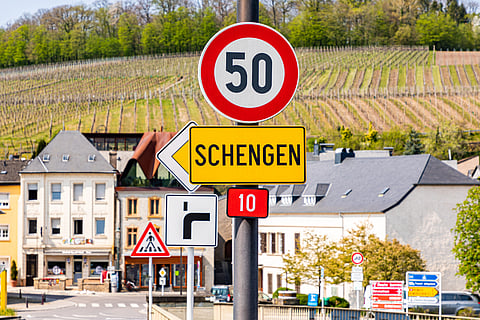
Road sign for Schengen town on the western bank of the river Moselle, Luxembourg Maloff/Shutterstock
What You Should Do
When a traffic fine arrives from Europe, it is important to deal with it rather than set it aside. The notice itself is usually the only document that explains what happened and what needs to be done next.
Go through the letter properly: The fine notice will mention the offence, along with where and when it was recorded. It will also include payment details and any option to respond.
Don’t miss the deadline: These notices come with fixed timelines. Paying within that window generally prevents the case from getting more expensive due to added charges.
Pay through the official link: Authorities usually provide a secure payment portal or QR code. Using those channels reduces the risk of delays or errors in processing.
Advertisement
Raise a dispute only if needed: If something looks incorrect or the notice arrives with unusually high added costs, it can be challenged with the issuing authority. The base penalty for the violation, however, is typically still payable.
When a traffic fine arrives from Europe, it is important to deal with it rather than set it aside Unsplash
FAQs
Can a European traffic fine be sent to India?
Yes. Fines linked to rental cars or recorded through enforcement systems can be processed and mailed to a driver’s home address, even after they have left Europe.
Why do fines arrive months later?
Many offences are captured through automated systems such as speed cameras and toll networks. The data is processed later and matched with rental records before being issued.
What happens if a fine is ignored?
Unpaid fines can attract additional charges and may be escalated through collection agencies or linked to future travel records in Europe.
Do rental companies charge extra?
Yes. Car hire firms often add an administrative fee for sharing driver details with authorities, which is billed separately from the original penalty.
Advertisement
Can travellers appeal a fine?
In most cases, yes. Appeals must usually be filed within a fixed deadline mentioned on the notice, using the official process provided by the issuing authority.

Published At: