Here is some welcoming news for Indian passport holders: Germany has announced that Indian nationals will no longer be required to obtain a Schengen Airport Transit Visa—also known as a Type A Schengen visa—when transiting through international airports in Germany.
Germany Announces Visa-Free Transit For Indian Passport Holders
Germany has announced that Indian passport holders can now transit through its airports without a Schengen Airport Transit Visa, making connections smoother for travellers heading to non-Schengen destinations

Advertisement
This change means that Indian travellers can now pass through Germany on their way to a third country without applying for a separate transit visa in advance, provided they meet the relevant conditions. This was announced during German Chancellor Friedrich Merz’s inaugural official trip to India on January 12-13, 2026.
Why It Matters
This move is particularly significant given the ongoing challenges India faces in terms of global mobility. At present, India’s passport continues to lag behind those of top-ranked nations. According to the Henley Passport Index (late 2025), the Indian passport is ranked 85th globally. This meant that it had slipped five places since the beginning of the year. Indians get visa-free or visa-on-arrival access to just 57 countries.
On social media, many users have highlighted the contrast between Indian travellers—often required to complete extensive paperwork even for brief airport layovers—and other nationalities who are able to transit freely with minimal formalities.
Advertisement
What It Means

The revised policy covers passengers passing through Germany’s key international airports, including Frankfurt Shutterstock
The revised policy covers passengers passing through Germany’s key international airports, including Frankfurt and Munich, while en route to destinations outside the Schengen zone. Visa-Free Transit (VFT)—also referred to as Transit Without Visa (TWOV)—allows travellers to transit through a country without a visa for a short, clearly defined period, as long as they do not enter the country beyond permitted limits. In simple terms, you can change planes or briefly enter a country while transiting to a third country, without applying for a visa in advance.
Visa-free transit should not be confused with visa-free entry. Transit permissions are strictly temporary and come with clear limitations, meaning travellers may not be allowed to leave the airport or move freely within the country. In some cases, transit must take place entirely airside, while other policies permit passengers to briefly exit the airport and remain within designated areas or cities.
Advertisement
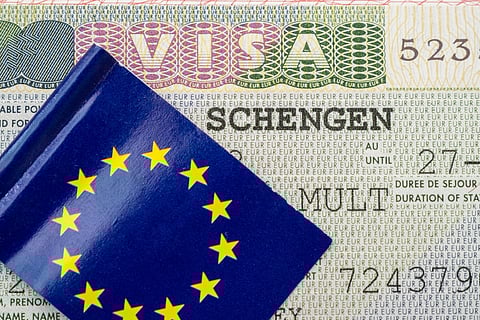
Travellers from certain nationalities have been required to obtain a Schengen Airport Transit Visa merely to connect between flights Savvapanf Photo/Shutterstock
In many European countries, travellers from certain nationalities have been required to obtain a Schengen Airport Transit Visa merely to connect between flights, even when remaining entirely within the secure transit area and without formally entering the country.
Until recently, this requirement applied regardless of whether you left the airport, collected baggage or passed through passport control. At Schengen airports, including those in Germany, failing to hold the necessary transit visa could result in people from these countries being denied boarding at their point of departure.
Transit regulations in Europe fall under the broader Schengen system, but each member state has the authority to determine which nationalities must obtain an airport transit visa. Germany had applied this requirement to a limited group of around 20 countries, including India, Afghanistan, Bangladesh, Pakistan, Somalia and Sri Lanka, while travellers from other nations were granted what is known as a “transit privilege”. That is set to change with the new development.
Advertisement
(With inputs from various sources.)
FAQs
Who can use visa-free transit in Germany?
Indian passport holders transiting through German airports to a non-Schengen country.
Which airports are included?
Major hubs like Frankfurt and Munich.
Do I need a transit visa now?
Indian travellers no longer need a Schengen Airport Transit Visa for eligible layovers.
Can I leave the airport?
Usually, you stay in the transit area; rules on leaving depend on the airport.
What documents do I need?
A valid Indian passport and a confirmed ticket to your next destination.

Published At: