On moonlit nights at the edge of India, something ancient is unfolding again. Massive sea turtles haul themselves onto the sands of Great Nicobar’s Galathea Bay, carving nests in silence. Their return, in unexpectedly high numbers, is stirring both hope and unease in a place already caught between conservation and development.
Galathea Bay’s Turtle Boom Stuns Experts: Record Nesting on Great Nicobar Challenges Environmental Fears
Fresh turtle nesting records at Galathea Bay are raising new questions about Great Nicobar’s fragile ecology. As conservation debates intensify, the return of leatherbacks reveals a story more complex than earlier warnings

Advertisement
Galathea Bay is not just another beach. It is one of the most important nesting grounds in the Indo-Pacific for the leatherback sea turtle, the largest turtle on Earth. These animals can grow over six feet long and weigh more than 500 kilograms. They have survived for millions of years, crossing entire oceans with remarkable precision, only to return to the very beach where they first emerged.
What stands out now is that they are still making that journey. Recent reports of record nesting suggest these turtles continue to choose this coastline, even as human activity grows around them. This negates much of the concern around the Great Nicobar project, which has rested on the idea that development would permanently disrupt these nesting patterns.
Leatherbacks are listed as critically endangered in many parts of the world. Their reliance on specific nesting beaches makes them especially vulnerable. A single disturbance, from artificial lighting to shoreline construction, can alter their nesting behaviour.
Advertisement
Yet Galathea’s beaches are still drawing them in.
More Than Just One Species
While leatherbacks draw most of the attention, they are only part of the story. Surveys along Great Nicobar’s coastline show that at least four species of sea turtles come here to nest, each returning to these shores in its own season.
Among them are green turtles and hawksbill turtles. They may not be as large or as visible as leatherbacks, but their role is just as important. By grazing on seagrass and interacting with coral reefs, they help keep these underwater habitats healthy and balanced. Leatherbacks, on the other hand, feed mostly on jellyfish, preventing their numbers from exploding and disrupting marine food chains.
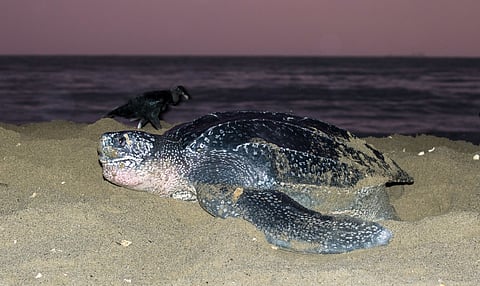
A female leatherback turtle Shutterstock
What makes Galathea Bay stand out is not just the beach itself, but everything around it. Mangroves line the shore, coral reefs sit just beyond the waves, and thick tropical forests stretch inland. All of it works together, each part supporting the other in ways that are not always visible. The island lies within the Great Nicobar Biosphere Reserve, a protected region known for species that cannot be found anywhere else.
Advertisement
Even nesting leaves its trace. Not every egg survives, and those that do not slowly return to the sand as nutrients. Over time, this feeds coastal plants and helps keep the shoreline stable.
A Debate Far From Settled
The surge in nesting has added a new layer to an already heated debate. Environmental concerns around the proposed development at Great Nicobar have centred on the risk to leatherback turtles and their habitat. The Galathea Bay Wildlife Sanctuary itself was once designated specifically to protect these nesting grounds.
Critics argue that large-scale infrastructure, including a transhipment port, could fragment habitats, increase light pollution, and disrupt nesting cycles. The region’s ecological sensitivity is not in doubt. It lies within a global biodiversity hotspot, where even small changes can ripple outward.
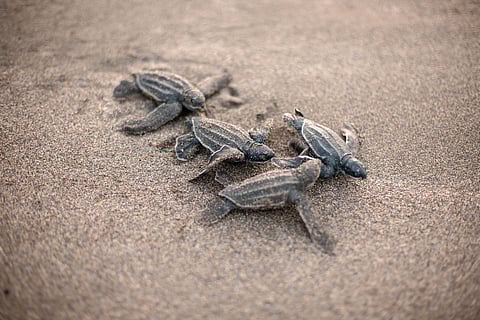
Leatherback turtles Shutterstock
The latest nesting records make the story less straightforward. If turtles are still returning in large numbers, it prompts a closer look at how resilient they really are and whether current impact assessments capture the full picture of their behaviour.
Advertisement
That does not mean the danger has passed. Leatherbacks live long lives and reproduce slowly, which means even small pressures can build up over time in ways that are not immediately visible. A population can appear stable for years before suddenly collapsing under sustained pressure. Scientists caution against reading short-term trends as long-term security.
Great Nicobar stands at a crossroads. The sight of hundreds of leatherbacks nesting under the stars should not close the debate. It should sharpen it.
FAQs
1. Why is Galathea Bay important for turtles?
Galathea Bay is one of the most significant nesting sites for leatherback turtles in the Indo-Pacific region.
2. What is unusual about recent turtle nesting at Great Nicobar?
Recent reports show record nesting numbers, surprising experts amid concerns about development in the region.
3. Which turtle species nest in Great Nicobar?
Leatherback, green, hawksbill, and other sea turtles use the island’s beaches for nesting.
Advertisement
4. Why are leatherback turtles endangered?
They face threats from habitat loss, light pollution, fishing, and coastal development.
5. How does development affect turtle nesting?
Infrastructure projects can disrupt nesting sites through habitat fragmentation, artificial lighting, and increased human activity.
Published At: