The Muzeul de Istorie Națională și Arheologie Constanța has revealed the discovery of 34 tombs dating from the Roman period, uncovered during preventive archaeological excavations at the Municipal Hospital site in Constanța — an area that forms part of the ancient necropolis of Tomis.
Excavation In Constanța Reveals Previously Unknown Sector Of Roman Necropolis
During preventive excavations at the Municipal Hospital site in Constanța, archaeologists uncovered 34 Roman-period tombs, including a rare Greek inscription and a ceremonial shield, revealing a previously unknown sector of ancient Tomis

Advertisement
A routine survey conducted ahead of infrastructure works has unexpectedly uncovered one of the most remarkable urban archaeological discoveries along Romania’s Black Sea coast in recent years.
An Unexpected Discovery
The excavation was carried out before the construction of a new hospital, as required by heritage law, and unexpectedly revealed tombs dating to the 3rd and 4th centuries, along with a rare Greek inscription and a ceremonial shield. Work was frequently paused because the old building on the site was at risk of collapse.
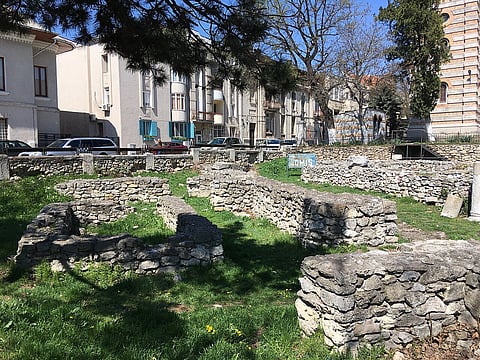
The urban residential area around the Romano-Byzantine city of Tomis (modern-day Constanța, Romania) CrisNYCa/Wiki Commons
The Muzeul de Istorie Națională și Arheologie Constanța has published a report on the dig, which brought to light a previously unknown part of the necropolis of ancient Tomis. The investigation was complicated by the fragile state of the existing structures, which dictated careful, phased work.
The Discoveries
The excavation, which began on September 3, 2025, uncovered 34 Roman-period tombs. Among them were several catacomb-style graves containing multiple burials, showing that the necropolis of ancient Tomis was used in an organised and sustained way, rather than as a series of isolated interments. These structures suggest family or community burial traditions that were carefully planned.
Advertisement
Many of the tombs contained items placed with the deceased, including jewellery, glass vessels, coins, and a large quantity of ceramics. Of particular interest were African amphorae, usually used to transport wine or olive oil. Their presence points to active trade between Tomis and North Africa during the Roman Empire and may also reflect the social status of those buried, as well as the symbolic value of imported goods in funerary customs.
What Stands Out
Two discoveries at Tomis are particularly rare. One is a Greek inscription from the 3rd century CE, showing that a religious group existed in the city. Such groups were part of everyday life, providing both social connections and places for worship. The second is the central metal boss of a parade shield, a ceremonial object rather than a weapon. Finding it in a tomb is unusual and suggests the person buried may have had a high civic or military status. Together, these finds make the excavation an important window into life in Roman Tomis.
Advertisement
The Site
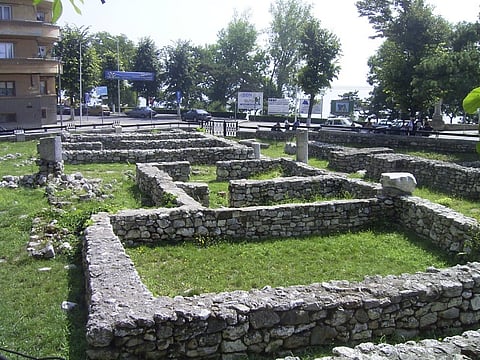
Ruins of Tomis Denis Barthel/Wiki Commons
The excavation took place within the protected area of the ancient Tomis necropolis. Tomis was a thriving Greco-Roman city and a major port on the western coast of the Black Sea. It played a key role in trade and administration in Roman Moesia Inferior and is also known as the place where the poet Ovid was exiled, giving the city both historical and cultural significance.
(With inputs from various sources.)
FAQs
Where were the tombs discovered?
They were found at the Municipal Hospital site in Constanța, within the ancient necropolis of Tomis.
How old are the tombs?
The graves date from the 3rd and 4th centuries CE, from the Roman period.
How many tombs were uncovered?
Archaeologists documented 34 tombs, some containing multiple burials in catacomb-style structures.
What kinds of objects were found in the graves?
Grave goods include jewellery, glass vessels, coins, and a large number of ceramic items, including African amphorae.
Advertisement
Why are the Greek inscription and shield umbo significant?
The inscription shows the existence of a religious group in Tomis, while the parade shield umbo, a ceremonial object, suggests the buried individual may have held a high civic or military status.
Why is this discovery important?
The finds reveal new details about the social, religious, and trade life of ancient Tomis and its connections across the Roman Empire.

Published At: