From a bluff high above the river, the Mae Khong is a wide ribbon of frothy coffee cutting through a khaki green carpet. I go down to the river for my first touch and I am already in Laos the Thai-Laos border in these parts is along the Thai shore. On the riverfront promenade, I walk to the boat dock past canopied Thai massage stations with masses of beached white flesh. Small dinghies fitted with outboard motors ply the Mae Khong here. None of the boats agree to float downstream, that would mean submitting to the river's caprices.
OT Travel Itinerary: A Week In North Thailand
A week-long tour starting from the rain-fed Mae Khong (or Mekong) and ending at Chiang Mai

Advertisement

Chiang Mai is famous for its historical sites
As the motor pushes my boat upstream, I get a sense of the river's weight. Mae Khong Mother Khong to the Thai, Mekong to the others, is the much storied life force of Southeast Asia. This being early September, the river is celebrating her monsoon girth. A tremendous rush of muddy water, with foaming whitecaps in places, flows about 14 feet above normal. As I head north towards the confluence of the Mae Khong with the Ruak river, Burma is up ahead across the Ruak, Thailand is to my left, Laos to the right, and China just 275km upstream. But all I see is the river. I am mesmerised by the enormous eddies churning all around my tiny boat as the river flexes her muscles. The outboard motor is all that stands between me and the river. A part of me wants to cut the motor and let her carry me like a twig, all the way past Vietnam to the South China Sea.
Advertisement
Enroute Chiang Rai
I boarded the boat near the northern tip of Thailand, at the ancient capital of Chiang Saen. I am on a week-long trip through North Thailand starting at Chiang Rai, winding my way through the hilly tribal areas near the Burmese border, and ending in Chiang Mai. The north has been central to the history of imperial Siam. Over the course of the 13th century, the capital of the Lanna kingdom moved south from Chiang Saen to Chiang Rai, and eventually to Chiang Mai. But ruins are hard to come by restoration is the norm. The moat around the old city of Chiang Saen now resembles an innocuous storm drain. But inside the Wat Pa Sak complex, gnarly laterite columns provide a glimpse of the vanished grandeur of the prayer hall in front of the main chedi. This is the only wat I see on this trip that has intact, original stucco figures of Buddha and Mahakaal. A heavy mantle of moss covers the chedi, and the outlines of what must have been the monastery walls.
Advertisement
Chiang Rai, once an imperial capital, is now a laid-back small town. I am lodged at the Golden Triangle Inn, where my room is sheltered by a shady verandah overlooking a tropical garden replete with orchids. I happily pad barefoot on my teak-panelled floor, worn to a high sheen. The weather has been kind. I am lulled to sleep each night by the drone of rain on the corrugated roof, and wake to birdcalls and a freshly washed morning. Jane, the man in charge, walks about in a denim kurta-sarong ensemble, with a jangle of gold chains, and a bracelet bearing his name. "Used to be," that's what his name means, he says with a half-sigh. He lives on the premises and weeds the garden himself. Is he the owner "Maybe," is his somewhat evasive response. I later find out that the owner is a lady in her eighties who also lives on the premises. Perhaps Jane has some plans. Be that as it may, he agrees to drive me to points of interest around Chiang Rai in his prehistoric Volvo.
Advertisement

Wot Rung Khon in Chiang Rai Flickr
En route to the hill station at Doi Mae Salong, our first stop is at the Pa Tueng hot spring. The spring bubbles out of the ground less than a hundred feet from a river, its tall plume of steam set off handsomely against the green paddies nearby and the blue hills in the distance. The snack shack here is run by an old woman who has been fending off lucrative offers from investors who want to build a spa. Boiling eggs in a hot spring is a favourite Thai pastime. A bamboo-slat bag with a dozen quail eggs is strung up from a stick so you can dip it into the boiling water. Jane makes a special dip with soy sauce, ginger and black pepper. He then teaches me how to dunk the peeled egg after exposing the yolk slightly. Paired with toothsome steamed bamboo shoots, this is an exquisite ensemble of texture and flavour.
Advertisement

Peak Mountain Chiang Rai Public Domain Pictures
At Mae Chan we turn off from the main highway and the hills are suddenly under us. A steep uphill stretch along a ridge leaves Jane's Volvo wheezing, so we stop at a bamboo shelter by the road. The scene in front of me could be a Cézanne canvas purple-green pineapple fields falling away from my feet, ochre-green corn rising on the near slopes, rice paddies an iridescent green on the far slopes, and dense bamboo a smoky blue on the hills beyond. As a cicada chorus rises and falls and a cool breeze ruffles the thatch of our shelter, the serenity of this place seeps into me.
These comely hills used to be prime opium country, central to the infamous Thai-Burma-Laos Golden Triangle that supplied much of the world's narcotics until recently. On each hill, opium would be sown on the sunrise side and marijuana on the sunset. This is the neighbourhood that housed Khun Sa, the dreaded Burmese warlord and drug kingpin whose word was law in the Thai-Burma border region until the mid-nineties. The guns have fallen silent, Khun Sa is dead, and opium paraphernalia have been swept into museums. Come January, one can still spot a few opium poppies, but they are carefully planted along steep grades to avoid the prying eyes of Thai military helicopters. A wildly successful crop substitution programme has carpeted these fertile hills with tea, coffee, pineapple, corn and avocado. Having tasted each of these post-opium crops, I can report that this soil has no memory.
Advertisement
Home To Many Tribes

Hills of Chiang Mai Flickr
These hills are home to Thailand's northern tribes Akha, Karen, Lahu, Yao, and many others, each with its own language and culture. Near Doi Mae Salong, we stop at a Yao village at the home of Jane's friend, Chi Quay, 54. Chi's family left China's Yunnan province and headed south five generations ago with a few precious possessions, notably the family seal and the ancestral registry. Chi brings out the seal to face the sun it is a row of four highly stylised horses animals plentiful in the Yunnan but completely absent in his adopted land. The ancestral registry is a dog-eared sheaf of hand-made paper wrapped lovingly in silk, bearing the names of 19 generations in Chinese characters. Reciting these names is central to Chi's spiritual practice. Chi has the slow, deliberate manner of a retired librarian, who is clearly accustomed to suffering fools. In response to my request that he read from the registry, he gets up with a bemused look and arranges himself on a low stool on the porch. Then on second thought, he looks up at Jane and asks if I want him to dress up in Yao finery for the reading. That look instantly transports me into a parallel universe where everybody wears spandex, where strangers troop into my home bearing thinly veiled admission fees in the form of fried chickens and ask me to read from the Geetanjali. And I ask the group's guide if I should wear a Dhonekhali sari.
Advertisement
The drive to Mae Sai, at the border with Burma, takes me past miles of verdant jasmine rice glowing in the late sun. This is Thailand's chief cash crop, contributing over 12 per cent to the nation's GDP. We glide on smooth spotless roads, with spiffy signs, past police checkpoints with smartly dressed men who try to keep the illicit opium from leaching in from Burma. North Thailand's civic infrastructure looks first world. There is not a speck of trash anywhere, urban or rural. Across the border from Mae Sai is the Burmese town of Tachilek, the two connected by a bridge over the river Ruak. Standing at the Thai end of the bridge, I can see familiar clumps of plastic bags and putrid waste clinging to the Burmese shore. For the first and only time during the entire week, I see children begging. They have delicate Burmese features. As I climb down the hilly path from a viewpoint of the border area, I hear a group of excited voices. The day's lottery announcements have just been made. A lone monk in robes checks out the listings, disappointment writ large on his face.
Advertisement
.jpg?w=480&auto=format%2Ccompress&fit=max)
Hill tribes of Thailand Wikimedia Commons
A two-day trek into the tribal areas begins with a ride on the Mae Kok river on a long-tailed boat. It takes me from Chiang Rai to a Lahu village about 30km upstream. The Mae Kok's shores are truly picturesque paddies in places, teak plantations in others on occasion, a hill rises directly from the water's edge, or a hot spring bubbles not 20 feet ashore. My guide is Kuan, a member of the Shan tribe originally from south Burma. At 31, he is single, his girlfriend has left him for an older man with money. "That's what Thai women want," he says. He's probably not just being bitter. During the week, I can't help notice all the pretty young Thai arm-candy on grizzled white men.
Our trail winds up and down hillsides covered with exuberant monsoon vegetation, past gurgling brooks, under shady arches of bamboo, and along aisles of stepped rice paddies. This part of the rural north still sees some participation in the opium traffic from Burma. In the villages we walk past, dealer homes stand out like flashy scarecrows in an otherwise uniform field of bamboo-rattan-thatch structures. Their gleaming 4WD pickups routinely get stuck in the tracks of glutinous mud that connect their village to the outside.
Advertisement
Kuan carries a sharp machete lodged in a handmade rattan sheath attached to his belt. He uses it to cut through overgrown foliage, and to harvest choice bits of bamboo. I soon discover he is finessing his finds into a delightful BB gun. He whittles away intently with his machete while walking, clearly not needing his eyes for the trail, except when foraging. Two slim pieces of bamboo fit snugly, one with a shaft that the other slides into. Bits of wet paper are apparently ideal pellets, which one launches with a swift lunge resulting in an impressive pop, complete with smoke. "For the dogs," he says quite seriously, and hands it to me. This is a man after my own heart. He equips me for dogs even before I can spot them.

The Mae Ya Waterfall of Chiang Mai Patiwat Sariya/Shutterstock.com
In a thicket of bamboo, we come upon a kid who is tentatively trying to harvest worms. Kuan nudges him aside and hacks into the bamboo taking out a three-foot section. As he strips away the outer casing, the compartments within the bamboo shaft come alive. They are crawling with worms, each an inch of fleshy white. One compartment is filled with a sticky goop. "This is the toilet," says Kuan. These worms have excellent toilet habits out of necessity they would otherwise drown in their own excrement. Each colonised bamboo shaft is a column of bedrooms with a shared toilet, with a hole in each separating knuckle to allow toilet-bound traffic. "These are the cleanest worms in the world," Kuan says as he pops a few live ones into his mouth like so many peanuts. He then instructs the kid to fashion a container - a foot-long piece of green bamboo with a knuckle at the base - and proceeds to gather the harvest. Thus stored, the worms will continue to eat and grow until they are used.
Advertisement
Life In The Countryside
The skies open up as we come into the Lahu village of Ja-noo, our stop for the night. I sit on the bamboo porch of a raised hut and watch fat ropes of rain lash the village and the surrounding hills. This is a small hamlet of a couple dozen homes, but each has a 120W solar panel. They were handed out for free during the rule of Thaksin, the since deposed PM who has fled the country. Inside, Kuan whips out an elaborate meal over a wood fire. Rice, stir-fried greens, a tofu and pork soup, chicken with cabbage, freshly caught fish rubbed with salt and lemongrass, wrapped in leaves and thrown into the embers to roast. And bamboo worms. He picks up a few dozen from the container, tosses them about in the wok for half a minute, and sprinkles some salt. I pop one in. The skin is flavourful and breaks easily, yielding a rush of juices tasting like bamboo shoots laced with melted cheese. I eat another. Then I can't stop.
During a post-dinner stroll, we stop by a home of a friend of Kuan's. Unlike my host's, this home has some furniture, notably a mirrored dresser. Checking out her reflection in it is an emaciated young woman, 24, with a face painted white and lips painted red. She is a cousin who now lives in Bangkok. What does she do? "She works for money," Kuan says after a pause. "She has a husband who is not really legal, you know". I had heard that rural northern women comprise a significant fraction of Bangkok's storied flesh trade. Does she want to come back to the village Her sunken eyes flash momentarily, "Never." I can't help wonder if she is wondering what I'm doing here.
Dawn breaks with a grunt chorus from the pigsty in the crawlspace under the hut. As I emerge onto the front porch, the woman of the house is doing last night's dishes with rainwater harvested in buckets left on the deck. I can hear the village waking up the dull thud of firewood being chopped, the "thrush-thrush" of rice tossed on a bamboo tray, separating grain from chaff. Three little girls freshen up their hopscotch court that the rain erased last night. On our way out of the village, I see luxuriant rice paddies on a 45-degree slope. Does this strain of rice not require standing water Even Kuan doesn't know.
Back in Chiang Rai, while strolling through the leafy complex of Wat Phra Kaew, the temple of the Emerald Buddha, I am drawn to the soothing visual of large terracotta vessels brimming with water. Some have lotus leaves, barely resting on the surface, with tiny ornamental fish flitting about. Turtles bask on wooden platforms placed in a serene pond. A monk is sweeping what looks to me like a spotless courtyard. "Ah, India", he exults, "Taj Mahal. Varanasi." "Bodh Gaya," I butt in thoughtlessly. His face falls I have clearly interrupted his travel reverie with curricular thoughts.
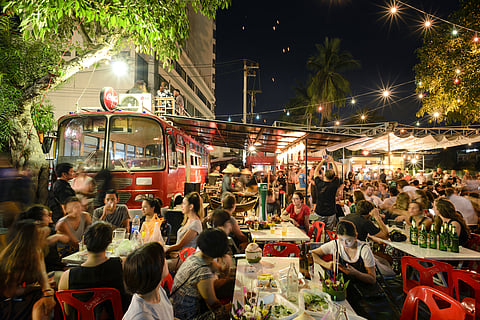
The thriving nightlife of Chiang Mai 501room / Shutterstock
The last day, I am in Chiang Mai staying at the Chedi. From the glass balcony of my third floor suite, I can see a reflecting pool in the central courtyard that has floating candles in glass enclosures. In the evening, with the candles lit and reflected, the place has the air of a silent Diwali. And then rain. I watch the man who had just finished lighting the candles. As rain pelts the candles, snuffing some out and toppling others, he winces in frustration. Then he goes still and waits. The rain will stop. He will pick up each candle, and light them all again.
The Information
Getting There
Bangkok is well connected by air to all major Indian metros.
By Air: Chiang Mai and Chiang Rai are both short domestic hops from Bangkok, served by Thai Airways or Bangkok Air. I flew into Chiang Rai and out of Chiang Mai, all on Thai. The total cost of the tickets (Kolkata-Bangkok-Chiang Rai, Chiang Mai-Bangkok-Kolkata) was approx. Rs 25,000, inclusive of taxes. A comparable itinerary ex-Delhi would cost approximately Rs 35,000.
By Rail: Chiang Rai is not connected by rail, but you can take the train from Bangkok to Chiang Mai. Most journeys are overnight and take 12-15hr. There are some day trains if you wish to take in the scenery. On the train there are a number of choices first class has private cabins for two, second-class sleeping berths have either AC or fan. Sprinter trains have AC chair-cars and are faster. For timings and fares, see this website
By Bus: Both Chiang Mai and Rai are served by overnight buses from Bangkok, a 10hr ride to Mai, 11 to Rai. "VIP" buses are super-plush, with wide push-back seats. Timings and fares can be found at here. I took a VIP bus from Chiang Rai to Chiang Mai. A smooth 3hr ride, with an on-board loo, was a complete bargain at 295 baht.
Visas
Thailand issues visas on arrival at its airports at Bangkok, Chiang Mai and Chiang Rai. If you'd like to get your visa in advance, use the online e-visa application here or apply directly at the Royal Thai Embassy, 56-N Nyaya Marg, Chanakyapuri, New Delhi (011-26118103, thaidel@thaiemb.org.in) or 18B Mandeville Gardens, Kolkata (033-2440625, rtcgkkt@eth.net).
Chiang Rai
Getting Around
A cab ride from the airport should be about 300 baht. The bus station is right in the heart of town, with a bevy of tuk-tuks to carry you places. This is a small town, much of it very walkable. Should your feet need rest, most tuk-tuk rides are under 40 baht. Your hotel can also book a cab.
Where To Stay
Luxury: The Dusit Chainarai Riverside(from 1530 baht 66-0-5360-7999, Website) and The Legend (from 2124 baht 5391-0400, Website) are both near the Mae Kok river. There is also the edgy boutique hotel The Mantrini (from 2,590 baht 5360-1555, Website). But it's the newly refurbished and swanky Anantara Golden Triangle (from 38,480 baht 5378-4084, Website) that has pride of place at the highest-end of Chiang Rai's few luxury hotels.
Mid-range: There are several nice options available in this price category. Try the Wangcome Hotel (from 1,333 baht 5371-1800, Website).
Budget: Centrally located with the night bazaar and restaurants just a short walk away, the Golden Triangle Palace (800 baht AC single/ 1000 baht AC double, breakfast included 5371-1339) is a gem. My incredibly cosy room had teak-panel floors and bamboo mats on the walls and the gabled ceiling. The garden was chock-full of fruit trees - mangoes, coconuts, bananas - all in fruit. To arrange forays ex-Chiang Rai, Golden Triangle Tours is conveniently located on the premises. The hotel arranges tours as well. The Baan Warabordee (from 400 baht 53754488) is also well regarded.
Where To Eat & Drink
I wanted to sample Lanna cuisine (Thai with Burmese shades) and every local finger pointed at Phu Lae (612/6 Phaholyothin Rd). My tamarind-based pork curry was stunning, and the chicken with young jackfruit richly satisfying. If you want to dine alfresco in a festive but noisy setting, the place to be is the night bazaar food court. Every night between 7pm and 11pm, dozens of stalls serve up soups, stir-fries, spicy seafood salads, grilled fish, sushi, tempura and exquisite clay pot ensembles that are brought to your table and assembled with great ceremony. The quality is high, prices shockingly low.
What To See & Do
Visit the city's various wats - Wat Phra Singh, Wat Phra Kaew, Wat Ngam Muang. Wat Doi Tong, the city's oldest, sits atop a small hill with charming views of the Mae Kok river.
The Mengrai Monument, tribute to the 13th-century founder of the city, is best viewed at night. Locals from all walks of life come to pay daily homage.
A walk through the main market in the centre of town will provide at least a visual introduction to the incredibly rich back story of a Thai meal. From live eels to towering stupas of fresh curry paste, this place is a feast for the senses.
The night bazaar, with dozens of stalls offering textiles and handicrafts, is a good place for gift shopping. Bargaining required.
Day Trips
You could use Golden Triangle Tours who arranged the day trips for me. For a steeper price, you'll get a decent car and a lot less flexibility. The price is for the car, driver and a certified guide.
Head north towards the Myanmar border Chiang Saen, Mae Khong river (600 baht for a boat ride from Chiang Saen to the Golden Triangle), Opium Museum (entry 50 baht), Mae Sai. En route, the 5-tribes rural development centre (entry 500 baht) offers you your only opportunity to see long-necked Karen women, albeit in a less than natural setting. Price 3,000 baht excluding the above fees.
Head northwest to Doi Mae Salong (1,408m). Stop at the Pa Tueng hot spring, and a Yao village en route. Visit the Kuomintang village of Santi Kiri. Have a Yunnanese lunch. Stroll through tea plantations. Price 2,500 baht
Treks
Most treks on offer are a combination of some 4-wheeling on rural roads, some elephant riding, some boat riding and some walking. You are likely to see real rural life of several tribes, up close. My guide Kuanchai Woharn (kuan999@hotmail.com, 899984653) works for 9 HillTribes Tour (587 Rummit M.2. Meayao Mung, Chiang Rai 57000). Chiang Rai has numerous trek operator shops along the main drag near the night bazaar, with elaborate photo galleries. If you feel more comfortable booking in advance (prices are lower in person), see here. I paid 5,400 baht for 2 persons for a 2D/1N trek, inclusive of all meals, a 4WD SUV (Kuan drove), a 30min elephant ride in a Karen village, a 45min long-tailed boat ride on the Mae Kok river and a homestay at a Lahu village. My visit was off-season, prices are higher starting November.
Chiang Mai
Getting Around
The options are similar to those in Chiang Rai, but this is a much larger city, so the distances are likely greater on average.
Where To Stay
Chiang Mai is by far North Thailand's most popular destination - and the range of hotels reflects this.
Luxury: Originally opened as The Chedi in 2000's, the luxury hotel is now in the Anantara portfolio as Anantara Chiang Mai Resort & Spa (from INR 18,000 Website) has a charming location right on the Mae Ping river. As you come into the lobby from the bustle of Chiang Mai, white lotuses afloat in vessels brimming with water will instantly have a calming effect. My Club Suite was spacious (100 sq m) with traditional teak and rattan features paired expertly with terrazzo and glass. A generous balcony with a daybed overlooked a restored colonial bungalow (that houses the restaurant) with the river behind it. The staff speak excellent English, and have the same soothing quality as the lotus-vessels. The colourful night market is less than a five-minute walk away. The Four Seasons (from INR 49,000 5329-8181, Website) is another outstanding resorts.
Mid-range: Tamarind Village (from 5,500 baht 5341-8896-9, Website) is a lovely, leafy hotel actually set inside the walls of historic Chiang Mai city. Also try Villa Water Orchid (from 1,150 baht 3566-5200).
What To See & Do
The ruins of the old city walls and the surrounding moat are pleasant to walk along. There is a charming market for cooked meals at the Chiang Mai gate, where tiny women carry around vast amounts of food on two-wheelers. Inside the old city walls, Wat Phan Tao has a spectacular prayer hall with moulded teak-panels fitted together.
Wiang Kum Kam - A 20min journey on the Mae Ping river, on a teak-fitted cruise boat to the Fisherman's Quay, where a horse-drawn carriage takes you on a tour of the ruins of this 13th-century city (2hr, 700 baht call 053-252873).
Day Trips
Doi Inthanon, Thailand's highest mountain (2,565m), is inside a national park, 2.5hr southwest of Chiang Mai. There are several chedis on this mountain. The view from the top can be quite spectacular in clear weather. Park entry 400 baht
The Chiang Dao caves are a complex housed in limestone scarps (2,175m) 75km north of Chiang Mai. The cave system is fluorescently lit in places, but in others you need a guide with a kerosene lantern to show you the treasures.
Published At: