A banyan tree on an ITC campus in Munger, Bihar, has been identified as the oldest banyan in the world with a scientifically confirmed age. Researchers from the Birbal Sahni Institute of Palaeosciences in Lucknow used radiocarbon dating to estimate the tree's age at around 700 years. The Department of Science and Technology announced the finding this week.
Bihar's Munger Banyan Is Now the World's Oldest Scientifically Dated Tree of Its Kind
Radiocarbon dating puts the age of a banyan on Munger's ITC campus at roughly 700 years, overturning old assumptions and giving scientists a new way to date tropical trees

Advertisement
Banyans, like most tropical broadleaf trees, do not form the annual growth rings used to date trees in temperate climates. Because of this, the ages of large banyans have typically been estimated using folklore, local accounts or historical records, methods that are often inaccurate. No scientific protocol existed for dating them.
Dr Trina Bose, invited by the Bihar Forest Department to investigate the tree, worked with Dr Mayank Shekhar and Dr Akhilesh K. Yadava to develop a new method. The team extracted alpha-cellulose, a stable component of plant cell walls, from wood samples taken near the pith of a secondary trunk and an old primary branch. The pith represents the earliest wood formed in the tree's growth, making it the key to establishing an accurate age.
The Tree Predates The Building Beside It
The result contradicts a long-held local account. The banyan stands in front of the Burra Bungalow, a building whose architecture places it in the late Mughal-early British period, roughly 300 to 350 years old. It had been assumed the tree was planted alongside the bungalow as a setting for meetings between rulers and residents, village assemblies, and religious ceremonies.
Advertisement
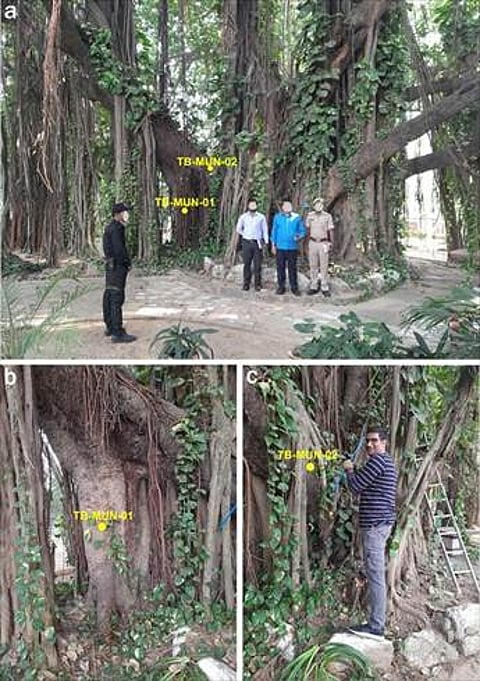
Heritage Banyan tree at ITC campus, Munger, Bihar, India. (a) Central composite trunk; the yellow mark denotes the sampled secondary trunk and branch. (b) Secondary trunk sampled as TB- MUN-01. (c) Oldest apparent branch sampled as TB-MUN-02. Press Information Bureau
The radiocarbon dating shows otherwise. At nearly 700 years old, the tree predates the bungalow by several centuries. Researchers say it is likely a remnant of a natural forest that once covered the region, meaning it was already mature when the bungalow was built next to it.
A Method For Other Heritage Trees
Researchers say the method itself is the main outcome. It gives forest departments and conservation agencies a way to accurately date heritage trees rather than relying on estimates. Many prominent banyans across India are widely believed to be centuries old, but their ages have never been confirmed. This method offers a way to test those claims.
The banyan is India's national tree and carries cultural significance tied to shelter, endurance and community life. It appears in festivals such as Vat Savitri Vrat and functions as a gathering point in villages across the country. The Munger tree now holds a second distinction as a reference case for a new scientific method.
Advertisement
Researchers say the same approach can be applied to other tropical trees across South Asia and beyond, opening the possibility of re-dating other heritage trees whose ages have so far only been assumed.
(With inputs from various sources)
FAQs
Q1. Where is the world's oldest scientifically dated banyan tree?
It is located on the ITC campus in Munger, Bihar, where researchers have confirmed its age at around 700 years.
Q2. How old is the Munger banyan tree?
Radiocarbon dating estimates the tree to be approximately 700 years old.
Q3. How did scientists determine the banyan tree's age?
Researchers analysed alpha-cellulose extracted from wood samples using radiocarbon dating, creating a new method for dating tropical trees that lack annual growth rings.
Q4. Why is this discovery significant?
It establishes the first scientifically verified age for a banyan tree and introduces a reliable technique for dating other heritage trees across tropical regions.
Q5. Why is the banyan tree important in India?
The banyan is India's national tree and holds cultural, religious and ecological significance, serving as a symbol of longevity, community and resilience.
Advertisement
Published At:
Tags