In an archive in Uttar Pradesh, pages brushed with gold and ink have sat undisturbed for centuries. Now, they are set to make a journey of their own. The Rampur Raza Library will share rare Persian Ramayana manuscripts with Ayodhya’s upcoming museum, adding a fresh layer to how the country engages with its past.
Ayodhya’s Museum To Get Rare Persian Ramayana
From Mughal ateliers to modern museums, rare Persian Ramayana manuscripts from Rampur Raza Library are set to travel to Ayodhya, carrying stories of translation, art, and a shared civilisational memory

Advertisement
This collaboration between the Rampur Raza Library and the International Ramkatha Museum carries real weight. The library will also send facsimile copies of Persian Ramayana manuscripts, some from the 16th and 17th centuries, so they can be studied and displayed in Ayodhya without risking damage to the originals.
Among the key additions is a 1627 Persian translation by Mullah Masih Panipati, along with an illustrated 1715 version. The 1627 manuscript, prepared during the reign of Jahangir, is one of the earliest known Persian renderings of the Ramayana. Another highlight is the richly illustrated 1715 Persian Ramayana created by Sumer Chand under Farrukh Siyar. The collection also includes Kissa-e-Ram Sita, a later manuscript from 1825 written by Ahmed Khan Gaflat.
Officials describe the move as part of a larger effort to turn Ayodhya into a global centre for Ramayana studies, where manuscripts from across regions and languages will sit side by side.
Advertisement
The manuscripts carry their histories lightly, but you can see it in the details. Some glow with gold work, fine miniature paintings, and calligraphy shaped by Mughal ateliers. Others show how scribes reimagined a Sanskrit epic in the language and style of Persian storytelling.
The Rampur Raza Library, founded in the late 18th century by the Nawabs of Rampur, holds more than 17,000 manuscripts in Arabic, Persian, Turkish, and Urdu. It also houses around 83,000 printed books, including 13 Ramayan manuscripts and several related works. It remains one of India’s most important Indo-Islamic archives, preserving texts that survived the dispersal of Mughal collections after 1857.
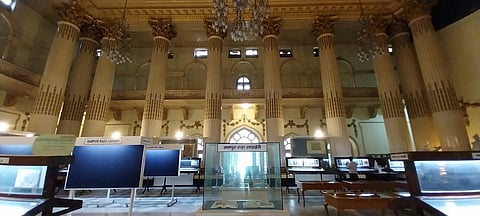
Inside the Rampur Raza Library Wikimedia Commons
About The Persian Ramayana
The Persian Ramayana refers to translations of the Sanskrit Ramayana into Persian, largely undertaken during the Mughal period when Persian served as the language of administration. These translations did more than convert words. They reinterpreted the epic for a different courtly audience.
Advertisement
One of the most notable versions housed in Rampur was translated by Sumer Chand in 1715 during the reign of Mughal emperor Farrukh Siyar. The work often included elaborate illustrations, sometimes running into hundreds of paintings, blending Indian narrative traditions with Persian miniature styles.
Long before this, the court of Akbar had begun encouraging scholars to translate Sanskrit texts into Persian, as part of a wider attempt to bring different traditions into conversation. The Ramayana, like the Mahabharata, hence found its way into Persian literary circles. Readers saw it not just as a sacred text but as a story about kingship, ethics, and the responsibilities that come with power.
In these manuscripts, Rama becomes a just ruler in a Persianate idiom, while the storytelling borrows from both Sanskrit kavya traditions and Persian dastan narratives.
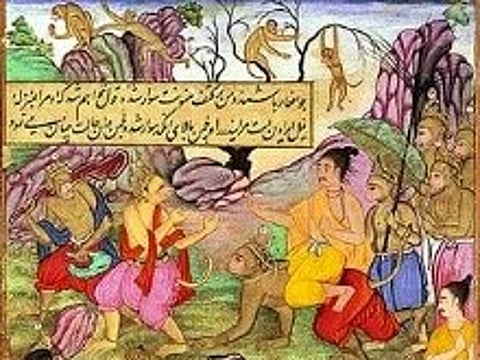
An excerpt from Persian Ramayana Wikimedia Commons
Significance Of The Manuscripts
Besides their literary value, these manuscripts also work as archaeological artefacts. The paper, ink, pigments, and binding techniques reveal details about trade routes, material culture, and artistic practices of their time.
Advertisement
Many of these Persian Ramayan manuscripts were made on handmade paper, coloured with natural dyes and finished with gold leaf. Their illustrations bring together two visual worlds, with Indian landscapes shaped through Persian styles of composition. If you look closely, each folio carries traces of the workshop that produced it, from marginal notes to distinct artistic signatures.
Scholars often read these manuscripts like compact historical sites. They reveal how courts functioned, what patrons valued, and how ideas moved across languages and faiths. The museum in Ayodhya, which is already gathering handwritten Ramayana manuscripts from across India and beyond, hopes to place these varied traditions side by side.
(With inputs from various sources.)
FAQs
1. What is the Persian Ramayana?
The Persian Ramayana refers to translations of the Sanskrit epic into Persian, mainly during the Mughal era, adapting the story for courtly audiences and blending literary traditions.
2. Where are the manuscripts being moved?
Advertisement
They will be displayed at International Ramkatha Museum in Ayodhya.
3. What is the Rampur Raza Library known for?
Rampur Raza Library houses thousands of rare manuscripts in Persian, Arabic, Urdu, and other languages.
4. Why are Persian Ramayana manuscripts important?
They show how the Ramayana travelled across cultures, blending Sanskrit storytelling with Persian literary and artistic traditions.
5. When were these Persian Ramayanas created?
Most were created between the 16th and 18th centuries during the Mughal period, especially under emperors like Akbar and Farrukh Siyar.
Published At: