South Korea’s Cultural Heritage Administration said Thursday that conservation work at the Ramesseum in Luxor has turned up an unexpected detail — a hieroglyphic cartouche carrying the name of Pharaoh Ramesses II. The marking was identified during efforts to stabilise the temple’s pylon gate, part of a joint project with the Korea National University of Heritage.
Archaeologists Uncover 3,300-Year-Old Royal Cartouche At Luxor’s Ramesseum
A 3,300-year-old cartouche bearing the name of Ramesses II has been uncovered at the entrance pylon of the Ramesseum in Luxor, during restoration work led by a South Korean team

Advertisement
A Rare Inscription
The most striking element of the find is the cartouche itself—an oval band used in ancient Egypt to enclose and protect a royal name. In this case, it carries that of Ramesses II, and was identified during a closer look at the base of the Ramesseum’s first pylon. Researchers say the inscription, dating back roughly 3,300 years, had not previously been recorded in this part of the temple complex, making its appearance here particularly noteworthy. The marking came to light during fieldwork carried out in November last year, as attention turned to structural details often overlooked in earlier surveys.
Clues To Construction
The discovery is expected to help refine how scholars understand the building phases of the Ramesseum, the vast mortuary temple raised for Ramesses II on the west bank of the Nile. The excavation team from the Korea National University of Cultural Heritage, working under the Korea Heritage Service, has been surveying the northern stretch of the collapsed first pylon since June 2025. According to officials, the cartouche was carved into the foundation stones themselves—a detail that may prove useful in dating different stages of the structure. The work also reflects the increasingly international character of archaeological research in Egypt, where overseas teams are taking on a growing role in long-term conservation and study projects.
Advertisement
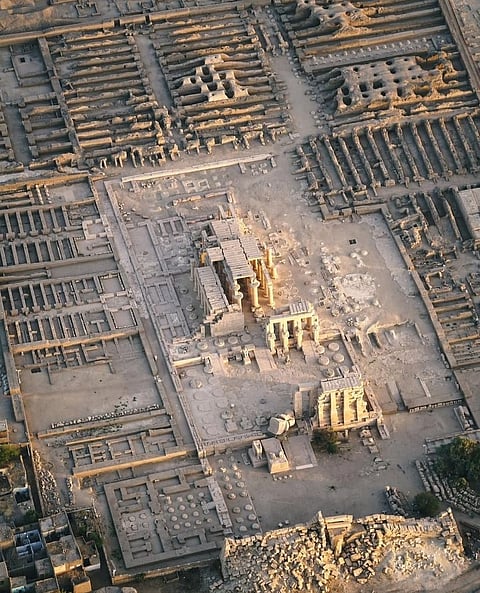
The Ramesseum on the West Bank of Luxor heraldofages/Instagram
A Find In An Unexpected Place
A cartouche of Ramesses II had earlier been recorded by a French team inside the temple’s inner sanctuary, but this latest example was found at the entrance pylon—something researchers say has not been seen before at the site. The Korea Heritage Service said the form of the inscription could help pin down when this part of the structure was built.
Alongside it, the team identified part of an architectural element carrying a previously unknown place name. Scholars believe it may offer fresh clues about Egypt’s reach during Ramesses II’s reign, though the details are still being studied.
Egypt Discoveries
Major archaeological discoveries reported across Egypt in 2026 span thousands of years of history, from prehistoric settlement to New Kingdom temple architecture.
Qubbet el-Hawa (Aswan): Rock-cut tombs at Qubbet el-Hawa have produced more than 160 pottery vessels, bronze mirrors and sealed jars, shedding light on burial customs of the Old Kingdom and First Intermediate Period.
Advertisement
Luxor Papyri (Qurna): Near Luxor, archaeologists uncovered sealed papyrus scrolls from the Third Intermediate Period close to the tomb of Seneb. The finds came alongside brightly painted coffins, adding further detail to the wider Theban necropolis record.
Karnak Temple Gate: At the Karnak Temple Complex, a monumental gate associated with Ramesses III has been documented, with evidence that blocks from the time of Amenhotep III were later reused in its construction.
Sinai Rock Shelter: In Sinai, a prehistoric shelter has revealed traces of human activity going back roughly 10,000 years, including early signs of settlement and the keeping of livestock.
FAQs
What exactly was discovered at the Ramesseum?
Archaeologists identified a 3,300-year-old cartouche bearing the name of Ramesses II at the Ramesseum, carved into the base of the temple’s first pylon.
Why is the discovery important?
The cartouche’s form and placement could help researchers better date different construction phases of the temple, offering clearer insight into how and when it was built.
Advertisement
Where was the cartouche found?
It was uncovered at the entrance pylon of the temple—an area where such inscriptions had not been recorded before, making the find unusual.
Who made the discovery?
The find was made by a team from the Korea National University of Cultural Heritage, working under the Korea Heritage Service.
Were there any other findings?
Yes, researchers also reported an inscribed architectural fragment carrying a previously unknown place name, which may provide clues about Egypt’s territorial reach during the period.
Has anything like this been found there before?
A French team had earlier discovered a cartouche of Ramesses II inside the temple’s inner sanctuary, but this is the first time one has been found at the entrance.
Published At: