On a pleasantly cool evening of February in New Delhi, a long vertical table with the paraphernalia of whisky tasting awaited its recipients on the twenty-eighth floor of ITC Maurya. Glasswares, spittoons and whisky sat latent on the table, conversations were low and hushed, and soon they came to a curious silence as Jim Murray, a renowned authority on whisky all over the world, took to preside over the evening that was to mark the first public tasting of Rampur 1943 Virasat. Alongside Murray was Abhishek Khaitan, Managing Director of Radico Khaitan.
A Decade In The Glass: An Evening With Jim Murray And Rampur 1943 Virasat In Delhi
At ITC Maurya, whisky author Jim Murray and Radico Khaitan’s Abhishek Khaitan marked ten years of Rampur Indian Single Malt with the first public tasting of Rampur 1943 Virasat

Advertisement
The event, a course in whisky tasting by the whisky wizard himself, was less about spectacle and more a first-of-its-kind assertion: Indian single malts had arrived, and they were ready to be judged and have an equal say at the table as any other single malt in the world.
A Distillery With Memory
Rampur 1943 Virasat takes its name from the year the Rampur distillery came into being. If alongside silence there hung anything else in that room that evening, it was the distillery’s legacy. Murray spoke fondly of his long bonhomie with the Rampur establishment, going three decades back to when he first visited the place. At that time, he recalled, the oldest spirit maturing at the site was just 18 months old. Though ideas to bottle it as a single malt was yet to be found on the cards, Murray recalled encouraging the authorities to give it a thought.
Advertisement
Fast forward three decades, the Whisky Bible keeper found himself in Delhi formally opening Rampur’s latest stillhouse and tasting a new expression that, in his words, expands the portfolio even wider. There was a certain full-circle-ness to the evening: a world-renowned critic who had once goaded the distillery towards single malts making a return to mark the moment of that very idea seeing the light of day.
In his part, Khaitan described the evening as a moment of affirmation. Over the past decade, Rampur Indian Single Malt has moved from curiosity to being a credible global player, propelled, he noted, by discipline and an uncompromising pursuit of excellence.
Six-Row Barley And New Stills
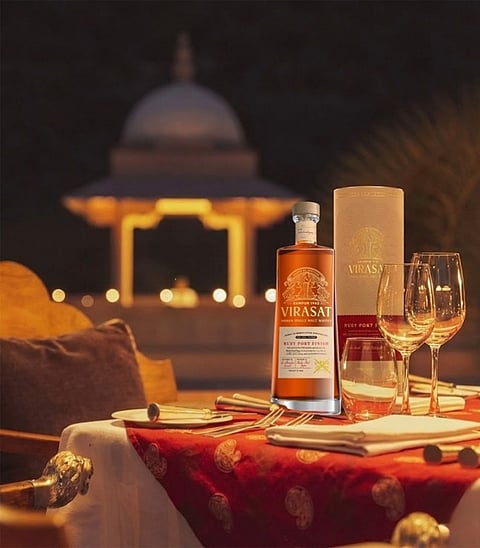
A shot of the Rampur 1943 Virasat virasatindiansinglemalt/instagram
As the tasting took off, Murray guided all through the anatomy of the whisky with the precision and dexterity of a maestro. Rampur 1943 Virasat comes out of six-row Indian barley grown in the foothills of the Himalayas. The distillery has also introduced newly designed pot stills, made with an eye to preserve Rampur’s core character while refining the profile.
Advertisement
The whisky wizard lingered on maturation, highlighting how the spirit’s journey started in American bourbon barrels before its final touches in ruby port pipes. It is a sequence that hints at confidence rather than experimentation for experimentation’s sake.
What piqued my attention was Murray’s delineation of North India’s climate and its impact on maturation. The region’s extreme shifts—involving intense summers and equally extreme monsoon and winters—not only accelerate the ageing but also turn it into a tightrope act. These fluctuations, he argued, give the whisky a certain depth, balance and complexity. Once in the glass, the effect translates into a profile that is rounded and assertive, carrying as much its geography as design.
Numbers And Nods
In the 2026 edition of his Whisky Bible, remarked Murray, the nine Rampur single malts he reviewed scored an average of 91.9 out of 100. “That’s really some achievement,” he added, saying that after tasting Virasat, he could hardly see the average dropping anytime soon.
Advertisement
Such figures sent a series of gasps and guffaws through the room. For the assembled connoisseurs and industry stakeholders, such figures matter. They signal not just approval but consistency.
Yet, the tasting was barely an event of pie charts and graphs. Glasses were raised, noses were employed, spittoons were used and notes compared mindfully. The attitude with which people engaged with the whisky was less of ceremony and more of curiosity.
Ten Years On
The event marked a decade of Rampur Indian Single Malt’s international rise. Its trajectory has unfolded against the broader growth of Indian single malts in global markets, where interest has steadily deepened.
Khaitan spoke about the introduction of new pot stills as a transformative chapter, designed to elevate and intensity flavour while safeguarding what he called the soul of Rampur.
As the evening drew to a close, conversation drifted towards export markets and how Indian whiskies are increasingly being poured in bars far beyond the subcontinent. Walking out into the Delhi night, I kept returning to Murray’s recollection of that early visit, when the distillery’s future as a single malt producer was uncertain. The arc from 18-month-old spirit to a portfolio averaging over 91 points tells its own story.
Advertisement

Published At: